Trapezoid windows deserve a shade plan that follows their geometry without creating the wrong expectations about operation. Before ordering custom shades for trapezoid and angled windows, separate three decisions: which glass you want covered, which section needs to move, and how the fabric should manage light throughout the day.
World Wide Shades makes custom specialty shapes, including trapezoids, triangles, pentagons, hexagons, arches, and skylights. For trapezoids, operation is limited to the rectangular section; pure triangles are fixed panels. Start with those limits rather than assuming every angled edge can disappear when you open the shade.
If your window combines several panes or an unfamiliar slope, explore specialty-shape shades before selecting a standard rectangular product. Resolving the shape first makes the remaining choices more useful.
Identify the Shape and the Coverage You Actually Want
A room may have a single trapezoid opening, a triangle above a rectangle, or several separate panes following a sloped ceiling. These can look similar from across the room but require different ordering conversations. Describe the actual framed openings, not just the overall silhouette of the glass wall.
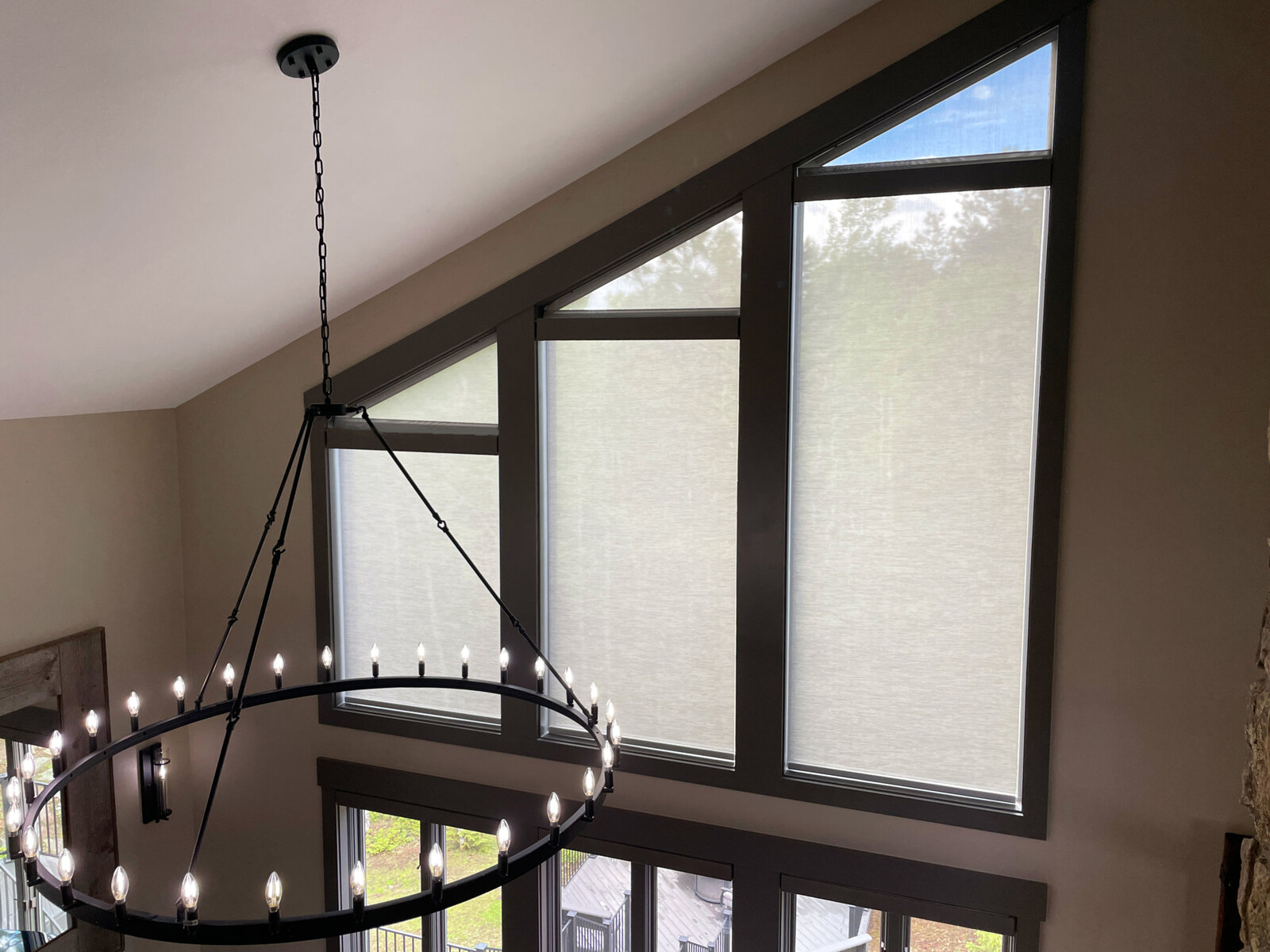
For example, imagine a living room with a rectangular window below a separate triangular pane. Covering only the rectangle leaves the upper pane exposed even when the lower shade is closed. That may suit a daylight-focused room, but it does not meet a goal of covering all the glass.
Decide whether preserving the upper daylight is intentional or simply an assumption you have not tested. In a bedroom, the upper pane may deserve as much attention as the lower window; in a stairwell, the priorities may be different.
For a trapezoid, be explicit about the rectangular operating section and the angled coverage. Do not describe the entire shape as retractable. World Wide Shades treats these as specialty-shape orders, so confirm the coverage plan before moving on to fabric and control selections.
Discuss your angled-window layout with World Wide Shades, or call (844) 674-2716 before ordering. Bring the conversation back to one practical question: which parts of this opening will remain covered when the operable section is open?
Understand What Can Move
Operation matters most when you picture the shade in daily use. A trapezoid's rectangular section operates, while the angled section should not be treated as an independently retractable or motorized surface. A pure triangle is a fixed panel, so choosing it means choosing permanent fabric coverage at that opening.
That distinction can change your fabric decision. A dense fabric on fixed upper coverage may support your light-blocking goal, but you cannot plan on lifting that triangle later to recover an unobstructed view. Choose the fixed section for the way you want the room to feel over the entire day.
World Wide Shades buyers should confirm the control choices available for their specific rectangular operating section before deciding on automation. A general motor comparison does not establish that a particular specialty configuration supports every control.
If controls are part of your project, use our Somfy versus Automate motorized-shade guide to organize your questions, then confirm the actual order configuration. Review the trapezoid shade product page with the coverage and operating limits in mind.
Choose an Inside or Outside Mount Before Finalizing Dimensions
Mount location changes the dimensions you submit, so settle it before entering an order. For inside mounting, World Wide Shades requires a minimum frame depth of 1.5 inches; 2.5 inches is recommended for motorized shades. Shallower frames call for outside mounting.
Consider depth where the hardware must sit rather than judging only the apparent depth of decorative trim. Also think through the finished relationship between the shade, the frame, and neighboring windows. A drawing that shows the intended mounting plane can make that conversation clearer.
For an inside mount, measure width at the top, middle, and bottom and use the narrowest measurement. Measure height at the left, center, and right and use the tallest measurement. Enter the exact opening dimensions: the factory makes the deductions, so do not subtract an allowance yourself.
Those width and height rules do not replace the shape-specific information needed to describe an angled opening. Follow the instructions for the selected shape and confirm anything unclear rather than trying to make the geometry fit a rectangular entry.
For an outside mount, add 2–3 inches on each side and 3 inches above the frame. Make sure the proposed coverage works with the space around the opening before submitting dimensions. Use the World Wide Shades measuring guide alongside the specialty-shape instructions, not as a reason to estimate an angle.
Match Fabric to Privacy, Daylight, and Sleep
Fabric should answer a room requirement, not only match a paint color. World Wide Shades offers 500+ colors across 40+ fabric families, with blackout and light-filtering choices from Phifer, Mermet, Ferrari, Copaco, Senbesta, and Texstyle. The catalog includes published openness factors and actual fabric photos.
Use those details to narrow the selection deliberately. Decide whether the main goal is softened daylight, privacy, or greater light blocking, and then assess how that choice affects any fixed angled coverage. Do not assume a fabric labeled blackout makes the entire installed opening completely lightproof; the coverage and fit still need review.
For a living room, start by ranking daylight, outward views, and privacy rather than treating them as interchangeable goals. If an upper angled panel remains covered, consider how much daylight you want through that panel while the lower shade is open.
Compare the published openness factor and fabric photo for each candidate. If evening privacy is important, discuss that requirement explicitly instead of inferring it from the daytime appearance of a product image.
For a bedroom, account for every pane that could undermine the desired darkness. Selecting blackout fabric for the lower rectangle does not address an uncovered upper triangle, and fixed upper fabric remains in place during daytime use.
Tell World Wide Shades whether sleep or daytime brightness takes priority, then confirm the proposed coverage accordingly. This is a design tradeoff to make before ordering, not something to discover after installation.
For an office, describe when and where unwanted brightness affects your work. A window behind a monitor presents a different planning question from an angled pane above a reading chair, so base your selection on the actual room arrangement.
Browse the fabric collection with those priorities in hand. Our guide to the best fabrics for roller shades can help you structure the comparison without letting color become the only decision.
Compare Sellers on the Whole Specialty Order
When deciding where to buy, compare the configuration you need rather than a generic roller-shade description. Ask each seller to identify the covered area, fixed area, operating section, mount requirements, fabric specification, and order terms. A quote is only useful if it describes the same intended result.
World Wide Shades makes every shade 100% custom by hand in the USA, with free US shipping. Standard delivery is 2–4 weeks from order; specialty shapes and limited-stock fabrics take 3–4 weeks. Plan this trapezoid project around the specialty-shape timeline rather than assuming the shortest standard window.
If you are comparing online sellers, read our Blinds.com versus World Wide Shades custom roller-shade comparison alongside your shape requirements. For projects that include controls, the SelectBlinds versus World Wide Shades motorized-shade comparison offers another buying framework.
Also review the Smith & Noble versus World Wide Shades custom roller-shade comparison if that seller is on your shortlist. These comparisons should support, not replace, confirmation that the exact angled configuration meets your needs.
Read the Fit Terms Before You Commit
Custom geometry makes an accurate order especially important. World Wide Shades custom orders are nonreturnable, so review the shape, mount, dimensions, fabric, and control selection before placing the order. Keep a copy of the final specification for your own records.
Manufacturing defects are remade free within 30 days, with motors covered for one year. If a shade is mismeasured, World Wide Shades offers a one-time free recut, with the customer paying shipping. Treat that protection as support if something goes wrong, not a substitute for resolving uncertainty beforehand.
An incorrect dimension and an incorrect expectation about operation are different problems. A recut policy should not be read as a promise that fixed angled coverage can become retractable. Confirm your specialty-shape order details before purchase if either the fit or function remains unclear.
Ready to Order?
Move from geometry to checkout in a deliberate sequence. These five steps keep the shape, fabric, and operating expectations aligned before you commit.
- Measure: Identify the actual opening and mount, then follow the measuring and shape-specific instructions. Enter exact inside-opening dimensions without making factory deductions yourself.
- Choose fabric: Compare color, published openness factor, and actual photos in the fabric catalog. Account for any angled coverage that stays fixed.
- Confirm control: Verify the available control for the rectangular operating section. Do not assume the angled section will move with it.
- See live pricing: Configure your shade in the builder using the confirmed specifications. Review the complete selection rather than relying on a generic starting figure.
- Order: Recheck the configuration and terms before checkout. For help completing the purchase, contact World Wide Shades or call (844) 674-2716.
For trapezoids, allow 3–4 weeks from order for specialty-shape delivery. If your project includes other unusual openings, review the specialty-shape collection before treating each one as the same type of shade.
Frequently Asked Questions
For World Wide Shades trapezoids, operation is on the rectangular section. Do not order with the expectation that the angled section will retract or that the entire shaped opening will become unobstructed.
Pure triangles are fixed panels. If your window arrangement has a separate rectangle beneath a triangle, discuss those sections individually rather than assuming they operate as one unit.
Measure width at the top, middle, and bottom and use the narrowest; measure height at the left, center, and right and use the tallest. Enter the exact opening measurements without subtracting deductions, and follow the additional instructions needed for your selected specialty shape.
Inside mounting requires at least 1.5 inches of depth, with 2.5 inches recommended for motorized shades. Use an outside mount for shallower frames, adding 2–3 inches on each side and 3 inches above the frame.
Specialty shapes take 3–4 weeks from order, as do limited-stock fabrics. World Wide Shades makes every shade custom by hand, so build that timing into the room plan rather than expecting an off-the-shelf turnaround.