Start With the Air Conditioner, Not the Shade Width
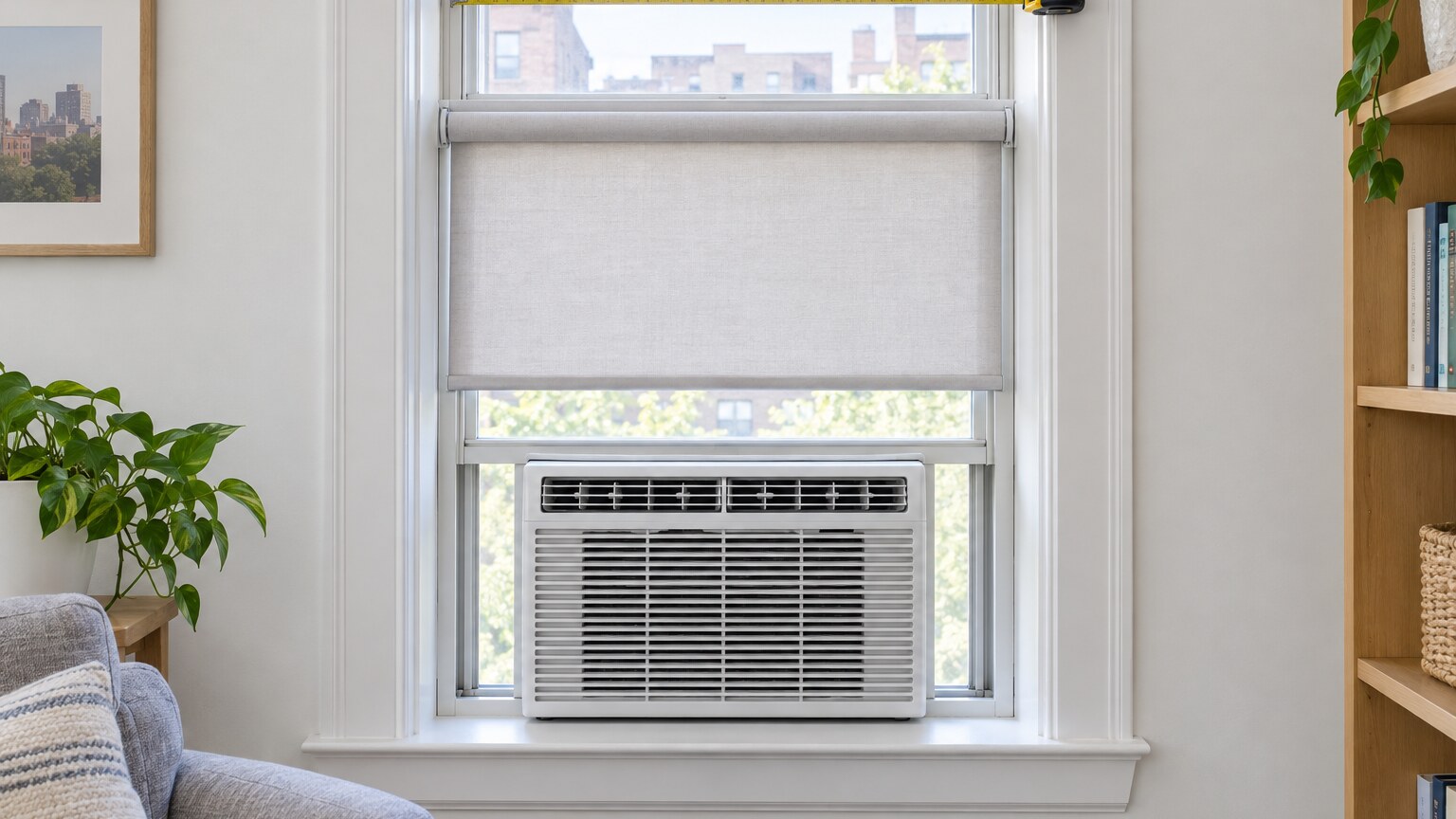
To measure shades around window air conditioner installations, begin by deciding where the fabric can safely stop. A shade that fits the window opening can still collide with a projecting cabinet, cover controls, or hang across an air outlet. The goal is useful coverage above the appliance without interfering with its operation.
World Wide Shades recommends treating this as a three-dimensional fit problem: width, drop, and depth all matter. You need a clear path for the fabric and bottom rail, room for the roller assembly, and continued access to the appliance. Keep the AC installed and secured while you assess the window; do not loosen brackets, remove panels, or disassemble the unit to gain measuring space.
Before choosing a fabric, contact World Wide Shades with your window photos and questions, or call (844) 674-2716. A front view and a side view make the obstruction easier to discuss than a single width measurement.
Establish the Appliance’s Required Clear Space
Find the model number and read the manufacturer’s installation and operating instructions. Identify the air intake, discharge louvers, controls, filter access, and any service requirements relevant to the indoor face. Do not assume that a neighboring unit or an online photo represents your model.
There is no universal shade-to-AC clearance that works for every appliance and mounting arrangement. If the manual does not address nearby window treatments, ask the appliance manufacturer about your proposed layout. A gap that prevents physical contact does not automatically provide acceptable airflow.
GE Appliances specifically warns that curtains, blinds, or furniture blocking the front of an air conditioner restrict airflow and affect cooling performance (GE Appliances support). Use that principle as a reason to keep the treatment away from the appliance’s working face, not as permission to invent a clearance dimension.
Map Three Different Types of Obstruction
Measure the AC cabinet’s indoor projection from a consistent reference, such as the face of the window trim. Record its highest point and widest indoor edges. Include any raised control housing rather than measuring only the main rectangular cabinet.
Think about the entire shade assembly passing this object. A bottom rail may project differently from the fabric, while a cassette or valance requires its own mounting space. World Wide Shades can review your proposed arrangement, but your appliance’s clearance requirements remain the controlling constraint.
Distinguish the AC’s accordion filler panels and their channels from the appliance casing. Their frames, fasteners, and seals may occupy the same recess that an inside-mounted shade would otherwise use. Record the top edges and inward projection of these parts without pushing, pulling, or compressing them.
If you are also considering light-blocking shade side channels, label those separately in your sketch. They are additional shade hardware, not replacements for AC filler panels. Do not assume they can run through an occupied area or attach to the appliance installation.
Measure locks, handles, tilt latches, and crank operators independently. Note both their resting projection and the space needed for permitted operation. A handle that clears the stationary fabric may still strike the bottom rail as the shade moves.
Do not open or reposition a sash that secures the AC just to test clearance. Use the window and appliance instructions to establish what movement is allowed. For another hardware-sensitive installation, see our guide to roller shades for French doors.
Record the Window Opening and Mounting Surface
Use a metal tape measure and a simple sketch showing the front and side of the opening. Label which dimensions are measured inside the recess and which start at the face of the trim. Avoid mixing those reference planes when comparing a cabinet projection with a shade bracket.
For a possible inside mount, measure the clear opening width at the proposed top position and at other points within the intended shade area. Record each reading, including any narrowing caused by trim or hardware. Measure usable mounting depth on both sides, excluding space already occupied by locks, channels, or fasteners.
Record the height from the proposed mounting location to the intended lower stopping area. Also note the distances to the top of the cabinet, top of each side panel, and highest projecting control. These are obstacle measurements, not automatic order dimensions.
Use the selected product’s measuring instructions when converting these observations into an order. Do not subtract a guessed allowance or assume every manufacturer defines ordered width the same way. Our guide to installing roller shades provides broader installation context.
Choose Inside Mount or Outside Mount
An inside mount is worth considering when the upper recess provides sufficient unobstructed depth for the selected brackets and roller. The shade must descend in a plane that clears window hardware and stops safely above the AC installation. Confirm the complete assembly’s requirements, not just the thickness of the fabric.
The appliance and side-panel channels may make the lower recess unusable even when the top is open. In that situation, a shorter upper-window treatment may be more practical than attempting full-height coverage. World Wide Shades can help you separate your desired coverage from the physical limits of the opening.
An outside mount places the brackets on a suitable surface beyond the recess, such as the surrounding wall or trim. It can offer a different fabric plane when handles or shallow jambs complicate an inside mount. However, moving the shade forward does not make it safe to lower fabric across the AC face.
Measure the proposed bracket area, available width, and drop from that location. Confirm the mounting surface and approved fastening method before ordering; never use the AC cabinet or its filler panels as shade supports. If appearance matters above the opening, explore roller shade valance options while checking their additional dimensions.
Start a World Wide Shades configuration in the shade builder once you know the likely mounting approach. Keep your recorded measurements available so product-specific dimensions can be checked before purchase.
Set a Safe Lower Stopping Position
Choose the lowest position the shade may reach while satisfying the appliance manufacturer’s requirements and avoiding hardware contact. Measure to that proposed stopping point from the product’s specified top reference. Do not measure to the sill simply because that would be the normal drop for an unobstructed window.
Imagine the bottom rail at every point in its travel, including any position where its edges could catch on a handle or side channel. Keep the treatment out of intake and discharge paths. If the plan depends on fabric resting on the AC, draping over it, or being tucked behind it, revise the plan.
Do not assume a motor limit or a promise to stop pulling makes an otherwise incompatible installation acceptable. Ask how the selected shade’s ordered height and operating limits work. Where accidental overtravel would create a problem, resolve that with the shade supplier before ordering.
For example, suppose the apparent upper opening is 28 inches high, but a projecting control housing occupies part of that area. The usable drop is not automatically 28 inches minus a standard gap. Establish the appliance’s required clear zone first, then measure the remaining coverage from the actual mounting reference.
Preserve Filter Access and Seasonal Flexibility
Find out how routine filter cleaning occurs on your exact unit. GE notes that filter removal and location vary by model and directs owners to their specific manual for instructions (GE Appliances support). Plan shade placement around that documented access route rather than guessing which panel opens.
Consider whether the raised shade, brackets, and bottom rail would obstruct the permitted service path. The fabric should not need to be wedged behind the appliance whenever maintenance is due. Do not treat shade hardware as a handhold or support during AC servicing.
If the unit is removed seasonally, distinguish the summer arrangement from the winter arrangement. A short shade will remain short after removal; a longer treatment requires a separately verified safe operating plan while the AC is installed. Renters should also review mounting permission and our guide to roller shades for rental apartments.
Send your mounting sketch to World Wide Shades, or call (844) 674-2716 before committing to a configuration that depends on seasonal changes. Include the appliance model and clearly identify any dimensions you still need to verify.
Choose Fabric After the Fit Is Resolved
Start with the room’s privacy and light goals, then compare fabric options within the safe coverage area. Blackout fabric above the appliance does not create complete blackout if uncovered glass remains beside it or light enters around the AC installation. Treat fabric opacity and total-window coverage as separate decisions.
Our guide to light-filtering shades can help frame the daylight discussion. For a sleeping space, compare the expectations described in blackout curtains versus blackout shades without assuming either treatment may cover an operating appliance.
If you are considering a separate treatment for the exposed glass, read roller shades versus window film for heat control. Keep that comparison separate from AC fit, and verify any film’s compatibility with your particular glazing before choosing it.
Order World Wide Shades swatches to evaluate color and privacy in the actual room. Hold samples away from appliance vents and keep them under your control rather than leaving loose fabric near the unit.
Frequently Asked Questions
Do not plan to lower a shade across the operating face. GE warns that blinds and curtains blocking the front restrict airflow and affect cooling (GE Appliances support). Choose a layout that preserves the model’s required clear space and unobstructed appliance access.
There is no single clearance number this guide can safely provide. Follow your appliance’s instructions and confirm unresolved treatment clearances with its manufacturer, then check the shade assembly’s travel and dimensions separately.
Measure both, and identify them separately on your sketch. The cabinet, panel channels, seals, and controls can have different heights and projections, so one overall width will not describe every potential interference.
It may provide a more useful fabric plane, but compare the actual bracket projection and bottom-rail path with the handle’s permitted movement. A different mounting plane still must preserve AC airflow and service access.
Do not cut a finished roller shade to make a DIY AC opening. Ask the supplier about supported configurations instead, such as verified upper-window coverage; an improvised cutout is not a substitute for a compatible design.
Confirm the Configuration Before Ordering
The most useful final review combines your window dimensions, chosen mounting reference, appliance instructions, and photos of every projection. Ask about overall assembly width versus fabric width, required bracket depth, ordered drop, and the bottom rail’s dimensions. Resolve uncertain fit details before placing the order.
World Wide Shades can help turn those observations into a shade selection without pretending the AC is an ordinary sill. Return to the shade builder to explore your configuration, then confirm that the proposed product and operating arrangement suit the measured space.