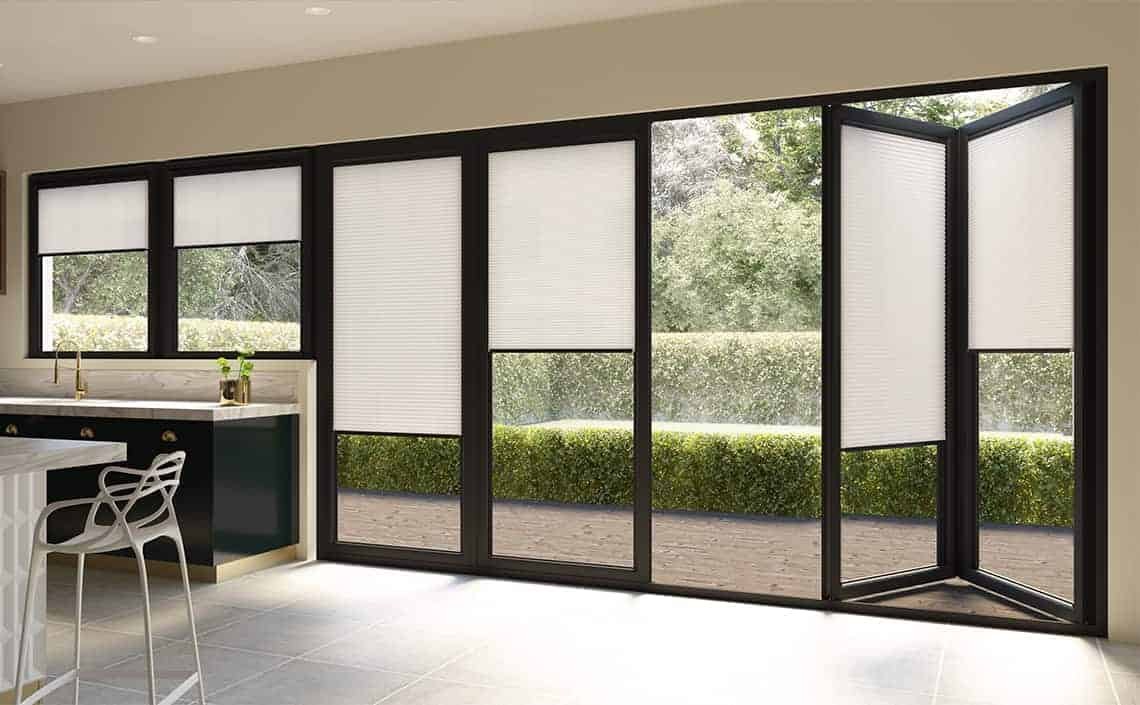
Bifold doors create a wide, flexible opening, but their folding panels leave little room for a conventional window treatment. The wrong shade can collide with a handle, rub against a neighboring panel, or prevent the door from folding completely. The right roller shade follows the door’s movement, stacks where it will not be damaged, and gives you control over glare and privacy when the opening is closed.
World Wide Shades designs custom roller shades around the actual door system rather than treating a bifold wall like one oversized window. Start with the World Wide Shades builder to explore fabric and control options, then contact World Wide Shades with the number of panels, opening width, and preferred mounting position.
Why bifold doors need a different shade plan
A typical bifold opening has two or more leaves connected by hinges. Each leaf may fold inward, outward, left, or right. Handles and hinges project into the clearance zone, and the top track can occupy the same space needed for a shade cassette. A shade that looks perfect while the doors are closed may become an obstruction the moment a panel starts to fold.
Three dimensions matter most:
- Fold direction: Identify which panels lead and where the folded stack rests.
- Hardware projection: Record the handle depth, hinge position, and any restrictor arms.
- Clear opening: Leave enough space for fingers, handles, and the panel path, not just the glass.
For a four-panel opening that is 144 inches wide, four individual shades might be easier to operate than one 144-inch shade. Dividing the width reduces roll diameter, weight, and the risk that one adjustment blocks the whole room. World Wide Shades can compare a shade per leaf, paired shades, or a bank over the full opening. Request a configuration review from World Wide Shades before ordering a single oversized unit.
The best mounting positions
An inside mount sits within the recess of a fixed frame or individual door leaf. It keeps the fabric close to the glass and can preserve the sightline between panels. This approach works when the recess is deep enough for the bracket and the handle does not touch the fabric. Allow roughly 1/2 to 1 inch of practical clearance around moving hardware, but confirm the manufacturer’s bracket dimensions for the exact shade.
Inside mounting is usually more successful on fixed sidelights or narrow leaves than on a shallow folding system. A door that folds inward may require the shade to be fully raised before opening. Include that operating habit in the design instead of assuming the shade can remain partially down.
An outside mount places the cassette above or in front of the frame. It can cover the gaps between panels and provide better privacy, especially when the closed door has uneven mullions. The tradeoff is projection: a cassette, fascia, or valance can occupy the path of a folding leaf. The top of the shade may need to sit several inches above the frame, and trim or a header must be strong enough to carry the load.
Use World Wide Shades swatches to compare fabrics before choosing a cassette color. A slim white cassette can disappear into light trim, while a dark frame may look better with a charcoal or black hardware finish.
Multiple shades make sense when the opening is wider than about 96 inches, when the door has two operating zones, or when family members use one side more often. A center split can provide access without raising an entire wall of fabric. Leave a small, intentional light gap between units rather than trying to force the tubes together; exact gap size depends on the mounting brackets and fabric width.
The roller-shades-for-french-doors guide explains the same hardware-clearance logic for hinged doors. Bifold systems add folding geometry, so World Wide Shades should verify the panel path with the doors moving through their full range.
Fabric choices for bifold doors
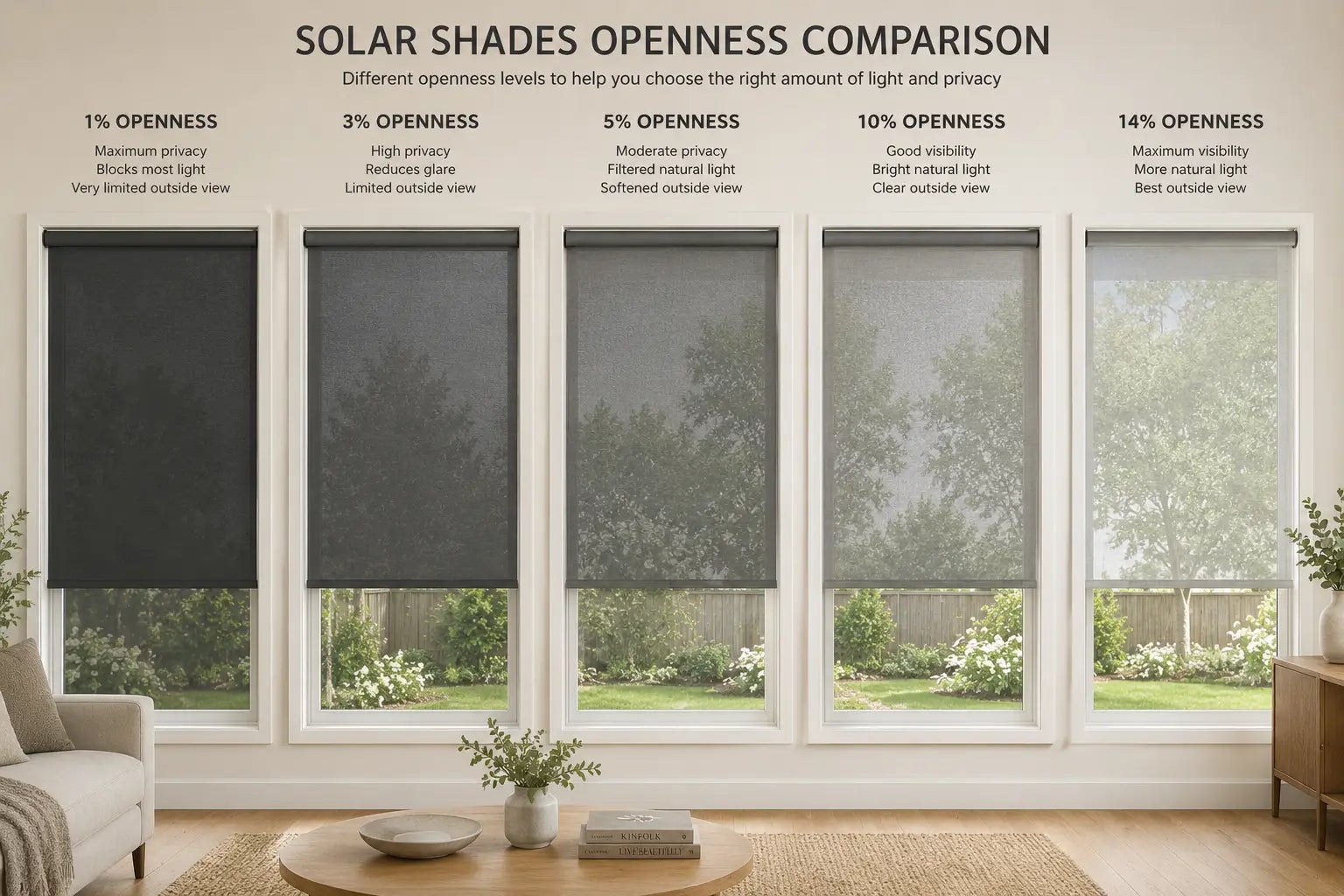
A solar screen fabric can reduce direct glare while preserving an outside view. Openness factors commonly range from 1% to 10%; a 3% fabric offers more privacy and glare control than a 10% fabric, while the 10% option keeps a brighter, clearer view. Darker solar fabrics often preserve the view better in daylight because they reduce interior reflections.
Solar fabric is useful in a kitchen or great room where the doors face west and the opening is closed during late-afternoon sun. Compare the details in the light-filtering shades guide and UV protection window shades guide before selecting a color.
Light-filtering roller fabric diffuses sunlight and gives a softer appearance than a technical screen. It can be a good fit when the bifold opening faces a private garden and the main goal is less brightness, not a crisp exterior view. Ask for samples at the opening because a fabric that looks warm in a showroom may appear gray or cool next to black door frames.
Blackout fabric is helpful for a bedroom, media room, or guest suite with folding doors. It will not eliminate every edge glow unless the system includes adequate overlap or side channels. Door hardware and the folding stack can make a fully sealed perimeter impractical, so set expectations before ordering. World Wide Shades can compare a blackout roller with a layered solution if you need both daytime view and nighttime darkness.
Cordless and motorized operation
Cordless manual shades remove dangling loops from a busy doorway. They are simple for a small opening, but reaching several shades over a tall door can become inconvenient. A bottom rail must also be kept clear while the doors fold, and uneven manual adjustments can make a wide group look misaligned.
Motorization is often the most comfortable choice for a high or frequently used bifold wall. One remote can raise a group before the doors open, while a scene can lower the shades after the doors close. A typical residential motorized shade may add roughly $250–$800 per unit over a comparable manual configuration, depending on size, power, controls, and installation. Use the motorized shades with Alexa and Google Home guide to think through voice commands, and review smart-home motorized shades setup before choosing a hub.
Call World Wide Shades at (844) 674-2716 if the top of the opening is more than 10 feet high or if charging access would require a ladder. A design that looks affordable on paper can be frustrating if the shade cannot be reached safely.
How to plan the measurements
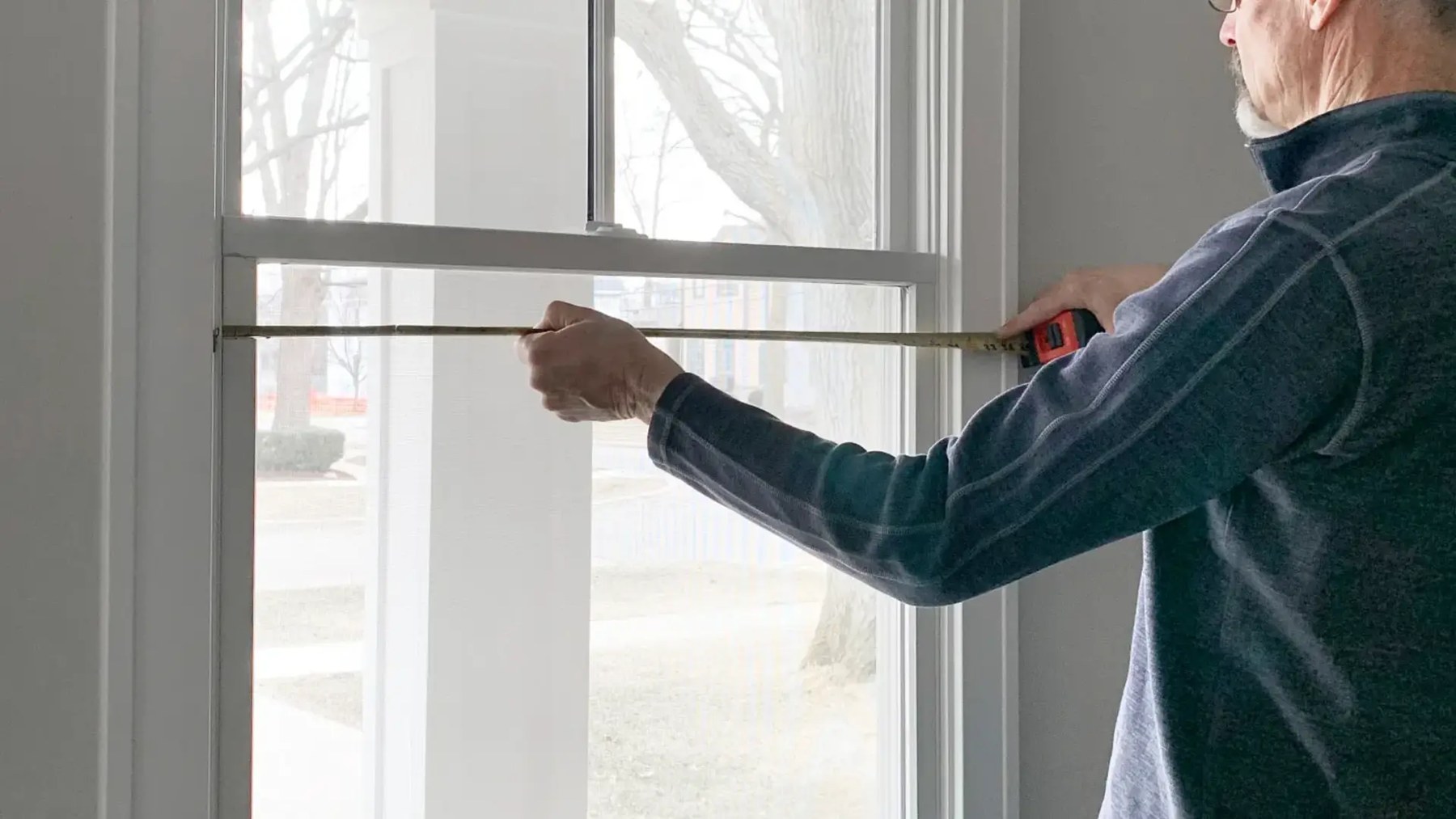
Measure the finished frame after trim, flooring, and door hardware are installed when possible. Record the width at the top, middle, and bottom; the smallest opening controls an inside mount. Record height on both sides and at the center. Note whether the frame is square, whether the track is recessed, and where folded leaves park.
For each panel, note the glass width, stile width, handle projection, and distance from the top frame to the first hinge. Photograph the closed and fully folded positions. A 1/8-inch difference may not matter on a fixed window, but a small error at a hinge can determine whether the door clears the shade. The how to install roller shades guide covers bracket alignment; bifold doors also require a movement test before final tightening.
World Wide Shades can review those dimensions and flag conflicts before fabrication. Send your opening details to World Wide Shades, or use the builder to begin a room-by-room plan.
Budget and installation expectations
A small manual shade over one bifold section may cost roughly $250–$650, while a multi-panel custom system can run $1,200–$4,000 or more depending on fabric, width, cassette, motorization, and installation. These are planning ranges, not a quote. A wide opening with five panels, tall access, side channels, and rechargeable motors will cost more than two simple inside-mount units.
Installation should include a dry run: close the doors, lower and raise each shade, fold every leaf, and confirm the stack does not snag. Ask the installer to mark the shade positions and explain the sequence for opening the doors. World Wide Shades can coordinate the shade layout with the door operation so the finished treatment is not just attractive but usable every day.
Common mistakes to avoid
- Ordering one oversized shade without checking tube limits and door movement.
- Measuring glass only and ignoring handles, hinges, tracks, and trim.
- Choosing blackout fabric without discussing edge light at the folding joints.
- Mounting a cassette exactly over a door track that needs service access.
- Adding a smart scene that lowers shades while the doors are open.
- Waiting until furniture and trim are finished to discover that the door stack needs extra room.
For a second opinion, ask World Wide Shades for a bifold-door plan and include photos from both sides of the opening. The team can also compare the approach with roller shades for French doors and roller-shade valance options.
FAQ: roller shades for bifold doors
Yes. Roller shades can be installed inside each recess, above the opening, or as multiple units across the wall. The correct choice depends on folding direction, handle projection, frame depth, and where the panels stack. World Wide Shades should test the full door path before finalizing the brackets.
One shade per panel gives independent control and can preserve clearance, while one large shade offers a more continuous look. For openings wider than about 96 inches or with two operating zones, multiple shades are usually easier to lift, service, and operate.
Motorization is often worth considering when the opening is tall, wide, or used several times per day. It can raise the shades before the doors fold and lower them after the doors close. Budget roughly $250–$800 per unit for the motorized upgrade, with exact pricing determined by size and control system.
A 3% or 5% solar screen is a common starting point for reducing glare while retaining a view. A 1% screen gives more daytime privacy and glare control; a 10% screen gives a brighter, more open view. Sample the fabric at the door because orientation and interior lighting change the result.
Share the opening width and height, panel count, folding direction, frame photos, handle projection, and your goals for privacy, glare, or darkness. Contact World Wide Shades or call (844) 674-2716 for a configuration discussion, then use the World Wide Shades builder to compare options.