Bay windows are one of the most rewarding architectural features in a home, but they're also one of the trickiest to dress well. A typical bay is really three separate windows meeting at two angled corners, which means three separate roller shades that all need to look like one coordinated system rather than three shades that happen to share a wall. World Wide Shades fields more measuring questions about bay windows than almost any other window type, and the good news is that with the right panel sequencing, mounting depth, and fabric choice, a three-panel bay can look as clean and intentional as a single picture window. This guide covers how to measure each panel correctly, how to keep light gaps consistent at the angled seams, motorization options for grouped control, and typical costs for a full three-panel bay.
Why Bay Windows Need a Different Measuring Approach
A standard window gets measured once, top to bottom and side to side. A bay window needs each of the three panels measured independently, because even "matching" bay windows are rarely perfectly symmetrical — builders commonly angle the two side panels at 30 or 45 degrees relative to the center panel, and slight construction variance means the two side panels may differ from each other by a quarter inch or more. Treat each panel as its own project with its own measurements, then unify the look through consistent fabric, color, and mount depth rather than assuming one measurement applies to all three.
Start by measuring the width of each panel at three heights — top, middle, and bottom — since many bay window frames taper slightly. Record the smallest width measurement for an inside mount to guarantee clearance. Order fabric swatches from World Wide Shades before you finalize color, since bay windows often catch light differently on each panel throughout the day and a fabric that looks neutral on the center panel can look noticeably warmer or cooler on the angled sides.
Inside Mount vs. Outside Mount for Bay Windows
Inside-mount shades sit within the window frame and give bay windows a cleaner, more architectural look, which is especially important where the side panels are visible from outside the house. The tradeoff is that inside mount requires more precise measuring and at least 2.5 to 3 inches of mounting depth per panel, which not every older bay window frame has.
Outside-mount shades hang from brackets above and outside the window opening, which is more forgiving of minor frame irregularities and allows better light and privacy control since the fabric can extend 2 to 3 inches beyond the frame on each side. For bay windows specifically, outside mount also makes it easier to hide the angled seams between panels, since the headrails can be trimmed to nearly meet at the corner rather than leaving a visible gap. Most bay window installations from World Wide Shades use outside mount for exactly this reason, though inside mount remains the right call when the window trim itself is a feature you want visible.
Coordinating Fabric and Color Across Three Panels
The single biggest visual mistake homeowners make on bay windows is choosing a slightly different fabric weight or color for the center panel versus the two side panels — even a subtle mismatch becomes obvious once all three shades are down at the same time. Order the same fabric roll and color code for all three panels rather than reordering separately weeks apart, since dye lots can shift slightly between production runs.
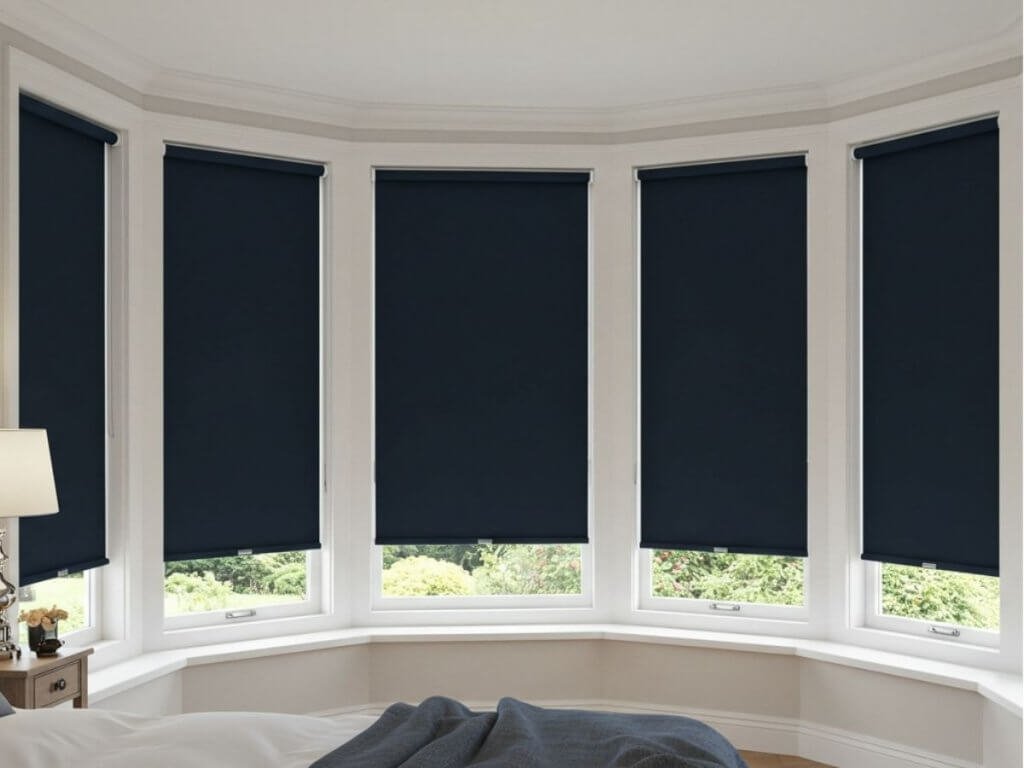
For light filtering, a light-filtering fabric in the 5 to 10 percent openness range works well for bay windows that need daytime privacy without going fully dark, while a blackout or near-blackout fabric in a bedroom bay controls both light and the temperature swing common in glass-heavy bay alcoves. If you're deciding between filtering levels, our detailed comparison in light filtering shades guide breaks down openness percentages by room type. Design your three-panel bay window shades in the World Wide Shades builder to preview fabric and color consistency across all three panel widths before ordering.
Solving the Angled Corner Light Gap Problem
The two seams where the center panel meets each angled side panel are where light gaps show up most, since the panels can't physically overlap at an angle the way two shades can overlap on a flat wall. The most effective fix is minimizing headrail width at the corner by choosing the narrowest bracket profile your motor or clutch system offers, positioning brackets as close to the actual corner as structurally possible, and running fabric with 1 to 2 inches of extra width overlap on the two panels closest to the corner rather than the center panel.
For homes where the light gap is a significant issue — south- or west-facing bays especially — layering a coordinating valance across all three panels visually unifies the top of the bay and further reduces light leak at the header. Our guide to roller shade valance options covers matching valance styles to a three-panel layout. Corner-specific mounting challenges share a lot of overlap with true corner windows; see our companion piece on best roller shades for corner windows for additional detail on minimizing seam gaps at an angle.
Motorizing a Three-Panel Bay for Grouped Control
Because a bay window functions as one visual unit, most homeowners want all three panels to move together rather than operating three separate remotes. Grouping three motorized shades into a single scene — through a smart home app, a multi-channel remote, or Apple Home and Siri Shortcuts — lets you raise or lower the entire bay with one command while still allowing individual adjustment when needed, such as tilting just the center panel for a specific view. If you're setting this up in an Apple Home environment, our walkthrough on roller shades with Apple HomeKit and Siri Shortcuts covers naming conventions that keep grouped bay shades unambiguous to Siri.
Budget for motorization on a three-panel bay typically runs $450 to $900 total for the motor upgrades across all three shades, plus $80 to $200 for a bridge or hub if your chosen platform requires one. Talk to World Wide Shades about grouping options or call (844) 674-2716 if you want a recommendation on which motor platform handles three-way grouping most cleanly.
Measuring Checklist for a Three-Panel Bay
Before you order, confirm each of the following for every one of the three panels individually: exact width at top, middle, and bottom; total height at both the left and right edges, since bay window sills sometimes aren't level; mounting depth available inside the frame if you're considering inside mount; and the angle of each side panel relative to the center, which affects whether a valance can run continuously or needs mitered corners. Photograph each panel with a tape measure visible in frame and send these to World Wide Shades along with your measurements — a second set of eyes catches sizing issues before fabric gets cut. Order swatches and get a measuring walkthrough from World Wide Shades if this is your first time measuring an angled bay.
What a Three-Panel Bay Window Project Typically Costs
Costs vary by fabric tier and mount type, but a standard three-panel bay with mid-range light-filtering fabric on manual chain-and-clutch shades typically runs $280 to $550 total for all three panels combined, including hardware. Upgrading to a blackout fabric adds roughly 10 to 20 percent to the fabric cost per panel. Adding motorization brings the full project to $750 to $1,450 depending on motor platform and whether a bridge or hub is required. For a broader look at how bay window pricing compares to standard single windows, see our cost breakdown in how much do custom roller shades cost.
Working with World Wide Shades on Your Bay Window
World Wide Shades has measured and fabricated three-panel bay windows in homes with everything from standard 30-degree builder-grade bays to custom architectural bays with unusual angles, and the consistent lesson is that treating all three panels as one coordinated order — same fabric lot, same color code, matched hardware — is what makes the finished look feel intentional rather than assembled from three separate shades. Start your bay window project in the World Wide Shades builder, or if your bay has an unusual angle or sill condition, call World Wide Shades at (844) 674-2716 for a measuring consultation before you order fabric.
Frequently Asked Questions
No — bay window panels are often slightly different widths even when they look symmetrical, so each should be measured and ordered individually while keeping fabric, color, and mount type identical across all three for a coordinated look.
Outside mount is more common for bay windows because it's more forgiving of frame irregularities and makes it easier to minimize the light gap at the angled corners; inside mount works well when the window trim itself is a feature you want to keep visible.
Use the narrowest available bracket profile, position brackets as close to the actual corner as possible, add 1 to 2 inches of extra fabric overlap on the panels nearest the corner, and consider a coordinating valance across all three panels.
Yes, though most homeowners motorize all three panels together since a bay window reads as one visual unit and mismatched operation styles can look unfinished; grouping all three into one scene solves this without giving up manual override.
A manual mid-range setup typically runs $280 to $550 for all three panels combined, while adding motorization brings the total to roughly $750 to $1,450 depending on motor platform.
Yes — World Wide Shades regularly works with non-standard bay angles and uneven sills, and can walk through measuring by phone or video before you commit to fabric and hardware.