Corner windows — two window panes that meet directly at an interior or exterior corner with no wall between them — create one of the most visually striking features a home can have, and also one of the most persistent shade-installation headaches. Because the two panels meet at a 90-degree angle with essentially zero wall space at the corner, standard bracket hardware often can't sit close enough to eliminate a visible gap where light leaks through. World Wide Shades has installed corner window shades in everything from mid-century ranch homes to modern builds with floor-to-ceiling glass corners, and the light-gap problem has a handful of reliable solutions once you understand why it happens. This guide covers bracket selection, mounting depth requirements, the corner light-gap fix that works most often, and motorized alignment for keeping both panels moving in sync.
Why Corner Windows Create a Light Gap
A standard two-window installation has at least a few inches of wall between the two windows, giving brackets room to sit flush and shades room to hang without their headrails colliding. A true corner window removes that wall space entirely, so the two shade headrails have to meet almost edge to edge at the corner. Any bracket that projects more than an inch or so from the wall creates a physical gap between the two shades at exactly the point where privacy and light control matter most.
The severity of the gap depends on three factors: the depth of the bracket and headrail system, whether the window trim allows the bracket to mount closer to the actual corner, and whether the two panels are mounted at exactly the same height. Getting all three right is the difference between a corner window that looks seamless and one with a visible slice of daylight down the middle. Order swatches and get a corner-window measuring consult from World Wide Shades before ordering hardware, since the right bracket depth varies by manufacturer and motor type.
Choosing Low-Profile Brackets for Minimal Gap
The single most effective fix for a corner light gap is choosing the narrowest-projection bracket available for your chosen shade system. Standard clutch-system brackets often project 2 to 3 inches from the wall, while low-profile brackets designed for tight installations can bring that down to under an inch. On a corner window, every inch of bracket depth saved translates roughly one-to-one into a smaller visible gap at the meeting point.
Motorized shade systems frequently offer slimmer headrail profiles than manual clutch systems because the motor housing is integrated into the tube itself rather than requiring external bracket hardware, which is one reason many corner-window installations from World Wide Shades end up motorized even when the homeowner wasn't originally planning on it. Design your corner window shades in the World Wide Shades builder to compare bracket depth across available motor and mount options for your specific window dimensions.
Inside Mount vs. Outside Mount at a Corner
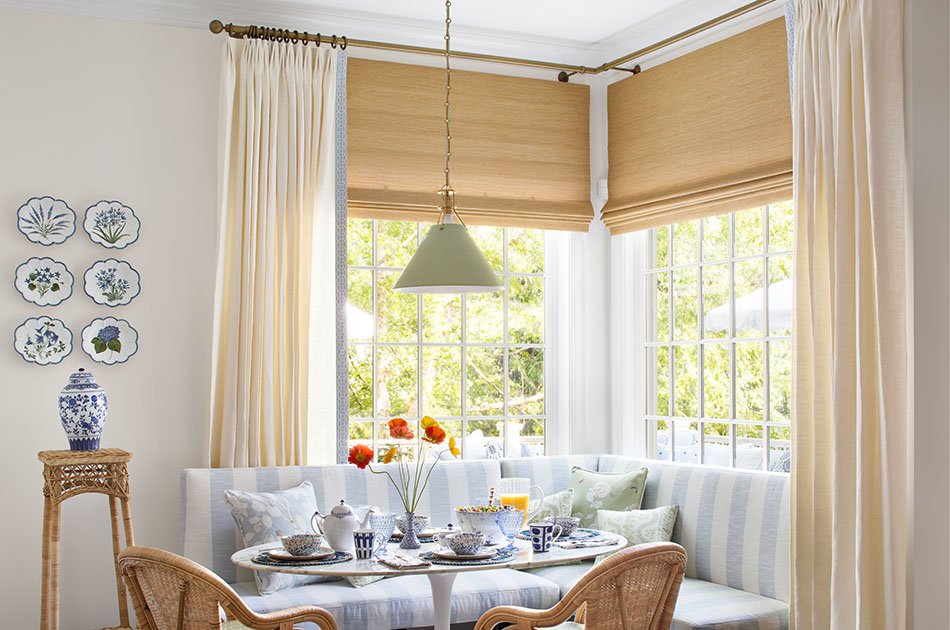
Inside mount is rarely possible at a true corner window because there typically isn't enough flat frame depth on both sides of the meeting point to seat two separate inside-mount brackets without them colliding. Outside mount is the standard approach for corner windows, with brackets mounted to the wall or trim above and to the sides of each window panel independently.
When outside-mounting two shades that meet at a corner, position each bracket as close to the actual corner as the wall structure allows, and use a header board or continuous mounting strip across both panels if your installer offers one — this keeps both headrails at precisely the same height, which matters more at a corner than anywhere else in the house because any height mismatch is immediately visible where the two shades meet. Our general measuring guide on how to install roller shades covers baseline outside-mount technique that applies here with the added corner-alignment step.
Closing the Gap: The Overlap and Trim Technique
Beyond bracket selection, two additional techniques close most of the remaining gap. First, order 1 to 2 inches of extra fabric width on each of the two shades so the fabric itself extends slightly past the headrail toward the corner, creating a soft overlap rather than a hard edge. Second, if the window trim allows it, a thin vertical trim piece or corner post installed after the shades can visually break up any residual sliver of light without blocking either shade's operation.
For bedrooms or media rooms where full blackout at the corner matters most, pairing this overlap technique with a genuine blackout fabric — rather than a light-filtering fabric in a dark color — makes a measurably bigger difference than color alone. Compare fabric performance in our guide to blackout curtains versus blackout shades. Talk to World Wide Shades about blackout fabric options for corner rooms or call (844) 674-2716 to discuss overlap sizing for your specific corner dimensions.
Motorizing Corner Windows for Synchronized Movement
Because corner window shades are so visually linked, most homeowners want both panels to raise and lower together rather than operating two separate manual chains at slightly different speeds, which quickly looks uneven. Grouping two motorized corner shades into a single remote channel or smart-home scene keeps both panels moving at matched speed and stopping at matched height every time.
If you're building this into an Apple Home or similar smart-home setup, our detailed walkthrough on roller shades with Apple HomeKit and Siri Shortcuts covers the naming and grouping conventions that keep a two-panel corner group responding to one voice command. Corner windows share several coordination challenges with three-panel bay windows as well — see our companion guide on best roller shades for a bay window if your home has both window types and you want a consistent smart-home naming scheme across rooms.
Measuring a Corner Window Correctly
Measure each of the two panels independently at three heights, since corner window frames can have subtle taper just like any other window. Record the mounting depth available at both the outer edge of each panel and, critically, at the corner itself, since trim depth often decreases as it approaches the meeting point. Photograph the corner from both inside and outside the room with a tape measure visible, and note whether the corner is a true 90-degree interior angle or a slightly obtuse angle, which affects how close the two headrails can physically sit. Order swatches from World Wide Shades and send your corner measurements along for a second review before fabric gets cut — corner windows are one of the few installations where a small measuring error becomes highly visible.
What Corner Window Shades Typically Cost
A standard two-panel corner window with mid-range light-filtering fabric on manual clutch shades typically runs $220 to $420 total for both panels including low-profile brackets. Upgrading to motorized shades with synchronized grouping brings the project to $600 to $1,100 depending on motor platform and whether a hub or bridge is required. Blackout fabric adds roughly 10 to 20 percent to the base fabric cost per panel. For a wider view of how corner and specialty window pricing compares to standard installations, see our full breakdown in how much do custom roller shades cost.
Getting a Seamless Corner Window with World Wide Shades
Corner windows reward careful bracket selection and precise measuring more than almost any other window type in the house, and World Wide Shades has refined a bracket-and-overlap approach specifically for these installations after years of measuring true corner windows in homes across the country. Start your corner window project in the World Wide Shades builder to compare low-profile bracket and motor options side by side, or call World Wide Shades at (844) 674-2716 if your corner has an unusual angle or limited trim depth and you want a measuring consultation before you order.
Frequently Asked Questions
The gap comes from bracket and headrail depth at the point where the two shades meet; standard brackets often project too far from the wall, and low-profile or motorized headrails typically close most of that gap.
Rarely — most true corner windows lack enough flat frame depth on both sides of the meeting point for two inside-mount brackets to sit without colliding, so outside mount is the standard approach.
Often yes, because motorized headrails integrate the motor into the tube rather than requiring bulky external bracket hardware, which typically allows a narrower profile than manual clutch systems.
Most installations benefit from 1 to 2 inches of extra fabric width on each panel to create a soft overlap toward the corner rather than a hard edge, though exact sizing depends on your specific bracket depth.
A manual two-panel setup with mid-range fabric typically runs $220 to $420 total, while a motorized synchronized setup runs $600 to $1,100 depending on motor platform.
Yes — World Wide Shades regularly works with slightly obtuse or non-standard corner angles and can recommend bracket and overlap adjustments specific to your window's geometry.