Window treatments in K-12 school buildings carry requirements that most commercial projects never face: federal child safety standards, state fire codes that mandate tested flame-resistant fabrics, daylighting performance criteria tied to documented effects on student achievement, and the sheer physical abuse of hundreds of children interacting with the same hardware five days a week for 180 school days a year. Getting the specification wrong means replacing shades every three years, failing a fire inspection, or—in the worst case—a cord-related injury that creates liability.
This guide covers what education-grade roller shades need to do, what standards govern them, how to budget a district-wide procurement, and how World Wide Shades can support K-12 facilities teams through the full specification and installation process.
Child Safety Compliance: Cordless Is Not Optional
The Window Covering Manufacturers Association (WCMA) updated its A100.1 standard in 2018 to require that all stock (off-the-shelf) window coverings sold in the United States either be cordless or have inaccessible cords. The Consumer Product Safety Commission estimates that a child dies from cord strangulation approximately every 30 days in the United States, with most incidents involving children under age 6. While K-12 classrooms primarily serve older children, early childhood education centers, kindergarten rooms, and spaces adjacent to daycare facilities have direct exposure to the at-risk age group.
Beyond the WCMA standard, many state building codes and school district procurement policies now explicitly require cordless or motorized window coverings in all K-12 spaces, regardless of age group. California, New York, Texas, and Illinois all have active regulatory frameworks that go further than the federal baseline. Specifying any corded shade in a school building today creates both a compliance gap and a liability exposure that no facilities director should accept.
Cordless manual roller shades use a spring-assisted clutch or push-pull cassette mechanism that eliminates all exposed cords. Motorized roller shades eliminate cords entirely by replacing manual operation with a 24V DC motor. Both approaches satisfy the WCMA A100.1 standard. For high windows, motorized operation is the only practical option that also satisfies ADA reach-range requirements (discussed later in this guide).
World Wide Shades supplies only cordless and motorized roller shades for educational installations. Contact our education team at /contact or call (844) 674-2716 to confirm compliance specifications for your state and district requirements.
Child-safe window treatments: a full guide to cordless options covers the regulatory landscape in detail.
Daylighting and Student Achievement: The Research Case
The business case for high-quality window treatments in classrooms is not just operational—it is academic. The Heschong-Mahone Group conducted a landmark study for Pacific Gas & Electric (published in 1999 and subsequently replicated) that analyzed the relationship between daylighting quality and student performance across 21,000 students in California, Washington, and Colorado. Students in classrooms with the best daylighting conditions progressed 20–26% faster on math tests and 20% faster on reading tests than students in the least-daylit classrooms.
The mechanism is well-established: natural light exposure during the school day supports circadian rhythm alignment, which regulates alertness, mood, and cognitive function. Disrupted circadian rhythms—common in windowless or excessively shaded classrooms—correlate with reduced attention span and lower information retention. A 2021 meta-analysis in the journal Building and Environment confirmed that daylighting interventions in schools consistently improved student outcomes across multiple studies and geographic regions.
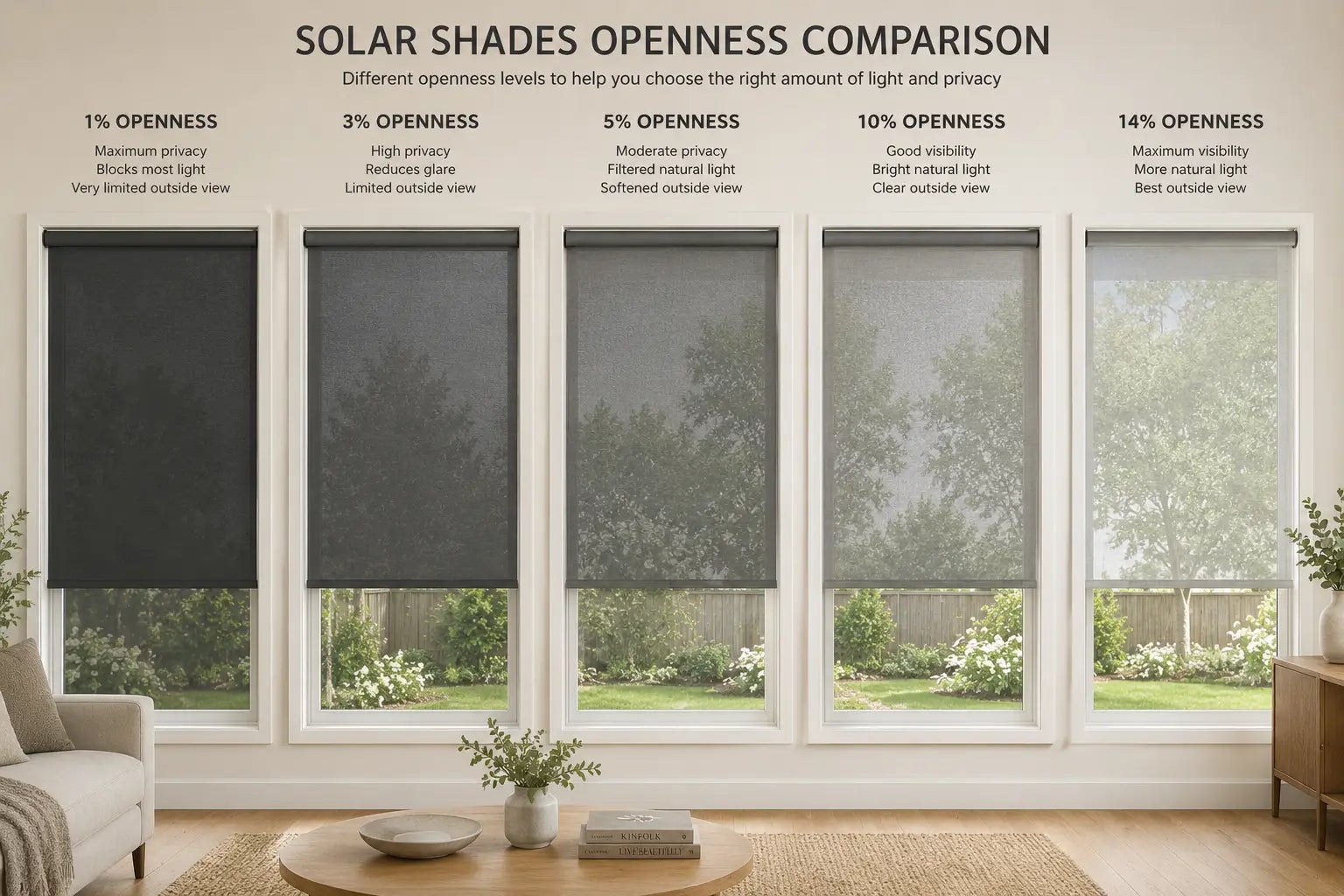
The implication for window treatment specification is not "install blackout shades everywhere." It is "install tunable shading that delivers controlled natural light throughout the school day and full blackout when needed for projection." A 5% or 10% openness solar shade on classroom perimeter windows maintains the daylighting benefits while eliminating the glare-on-whiteboard problem that forces teachers to pull cheap vinyl blinds all day and lose the daylight benefit entirely.
Energy-efficient window shades and daylighting principles explain how to specify for both light quality and thermal performance simultaneously.
Glare on Whiteboards, Smartboards, and Projection Screens
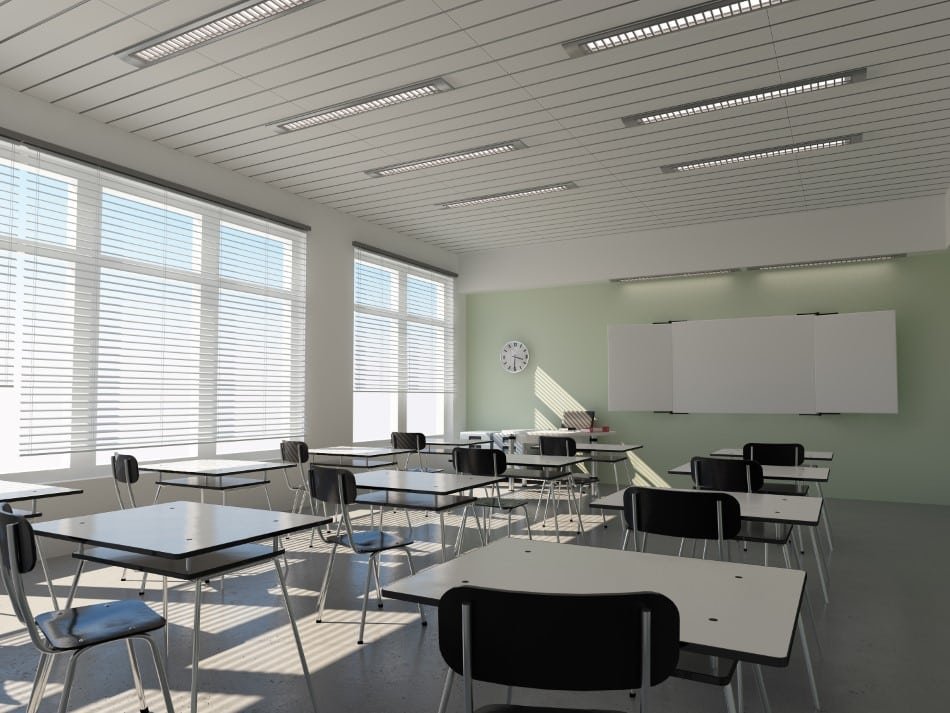
Modern classrooms use interactive whiteboards (SMART Board, Promethean) and short-throw projectors that require controlled ambient light to produce a legible image. The ambient light rejection ratio of a typical classroom projector is approximately 15:1—meaning the projected image has 15 times more brightness than the surface it hits. If direct sun hits the projection wall at even 20% intensity, the contrast ratio drops below 2:1 and the image becomes unreadable.
The practical standard for classroom projection zones is a minimum of 85% light reduction on windows that face the projection wall. For rooms with windows on the wall behind the projector screen—a common layout in older school buildings—blackout shades are required to prevent backlit interference. For side windows in a standard front-facing classroom layout, a 5% solar shade on the window wall opposite the board is usually sufficient to manage indirect glare.
A two-zone specification approach works well: 5% solar shade on primary daylight windows to maintain circadian benefits and views, blackout shade on any window facing or adjacent to the projection surface. This two-layer configuration can be achieved with a dual-shade system (a solar shade and a blackout shade on the same window, each independently operable) in classrooms where windows are on multiple walls.
World Wide Shades offers dual-shade fascia systems that accommodate both a solar and a blackout roller on the same headrail, operated by independent controls. Start configuring with our online builder to see how dual-shade systems fit your window dimensions.
Fire-Rated Fabrics: NFPA 701 Compliance
NFPA 701 (Standard Methods of Fire Tests for Flame Propagation of Textiles and Films) is the primary U.S. fire test standard applicable to window coverings in schools. The standard defines two test methods: Test Method 1 for fabrics and Test Method 2 for film-based materials. Most state fire marshals and school building codes require NFPA 701 compliance for any window covering installed in an occupied educational building.
The test measures flame propagation, afterflame time, and char length after a controlled flame exposure. Fabrics that pass the test are rated as flame-resistant; those that fail cannot legally be installed in code-regulated occupancies without a treated field application (which has limited durability and must be reapplied periodically).
Fiberglass solar shade fabrics inherently pass NFPA 701 because fiberglass does not sustain combustion. Most commercial-grade PVC-coated polyester fabrics also achieve NFPA 701 compliance through the coating formulation. Residential-grade fabrics—particularly untreated polyester or cotton-blend products—frequently fail and should never be specified for a K-12 application.
Every roller shade fabric that World Wide Shades supplies for educational projects comes with a documented NFPA 701 test report. Request documentation through our contact page at /contact or call (844) 674-2716 to speak with a compliance specialist before your specification is finalized.
Commercial roller shades for office and institutional applications covers the full regulatory framework that applies to both commercial and educational buildings.
Education-Grade Durability: What K-12 Abuse Actually Means
A classroom shade sees approximately 350–500 operating cycles per school year (2–3 per day, 180 days). Over a 10-year service life, that is 3,500–5,000 cycles—well within the rated capacity of a commercial-grade shade (250,000+ cycles). The issue is not cycling frequency; it is lateral force, impact, and deliberate misuse.
Students routinely push shades sideways, pull them at angles, hang on pull cords (which is why cordless matters), throw objects at shade surfaces, and write on or otherwise mark fabric surfaces. The hardware failure points under these conditions are the end brackets, the roller clutch, and the fabric-to-tube attachment. Education-grade hardware addresses all three:
- End brackets: Minimum 12-gauge steel with anti-tamper fasteners (hex or Torx head screws rather than Phillips)
- Roller clutch: Metal-bodied chain-drive or spring-drive mechanism, not plastic-bodied residential hardware
- Fabric-to-tube attachment: Continuous welded seam or mechanical staple-and-batten attachment rather than adhesive tape
Shade fabric itself should have a minimum weight of 300 g/m² for blackout applications and 200 g/m² for solar applications to resist tearing and puncture. Ask for fabric weight specifications in writing before accepting a bid.
World Wide Shades specifies education-grade hardware as standard for all K-12 projects, and provides 10-year warranties on hardware components for educational installations. Compare fabric options and weights at /swatches to verify the specifications before ordering.
Motorization for High Windows and ADA Considerations
Many school buildings—particularly those built between 1950 and 1990—have clerestory windows, gymnasium skylights, or high-mounted windows that exceed the ADA-compliant reach range of 15–48 inches above the floor. Any operable building element in a space accessible to staff and students must be reachable within that range or must be operable by an alternative mechanism that is within range.
Motorized roller shades with wall-mounted control switches satisfy the ADA reach requirement by moving the point of interaction from the window to a switch at standard mounting height (typically 42–48 inches above finished floor). This is not merely a convenience feature for high windows—it is an access requirement under the Americans with Disabilities Act for any public school building.
Beyond ADA compliance, motorization dramatically reduces the custodial burden for gymnasium and cafeteria shades, which may span 10 to 14 feet in height and require a stepladder to operate manually. Automated scheduling through a building management system can eliminate manual operation entirely for most daily scenarios: shades down at start of first period, up during passing periods, down for afternoon sun, up at dismissal.
Motorized roller shades: are they worth the cost? provides a return-on-investment framework that applies directly to educational facility decisions.
World Wide Shades provides motorized systems designed for high-window applications with motor torque ratings up to 50 Nm, covering tubes up to 120 inches wide and fabric weights up to 600 g/m². Configure a high-window motorized system using our online builder.
Cleaning and Custodial Protocols
School custodial staff clean classroom surfaces on a daily or weekly schedule using commercial cleaning products that include quaternary ammonium disinfectants, bleach solutions, and solvent-based cleaners. Any roller shade fabric that cannot withstand these chemicals will degrade, discolor, or lose its flame-resistance treatment within one to two school years.
Fiberglass solar shade fabrics tolerate most custodial cleaning protocols, including diluted bleach solutions (up to 1:10 bleach-to-water), without surface degradation. PVC-coated polyester fabrics are generally bleach-tolerant as well. Fabric-only products without a coating—screen-printed polyester or uncoated woven textiles—should be avoided for K-12 applications.
Cleaning protocol for standard roller shade fabric:
- Dust with a dry microfiber cloth weekly
- Wipe with a damp cloth and mild soap monthly
- For disinfection, apply diluted quaternary ammonium solution with a damp cloth; do not saturate
- Allow to air-dry fully before raising the shade to prevent mold growth in the fabric roll
Avoid steam cleaning, pressure washing, or soaking. Do not use acetone or solvent-based cleaners on PVC-coated fabrics.
Reach out through /contact to request the full cleaning and maintenance guide for any World Wide Shades product before accepting delivery.
Bulk Procurement Pricing and District-Wide Programs
Individual classroom shade replacements are the most expensive way to buy roller shades on a per-unit basis. A single blackout roller shade for a standard 36" × 72" classroom window runs $150–$280 installed at retail pricing. The same shade ordered as part of a 50-unit procurement drops to $120–$210 per unit, and a 200-unit district program typically reaches $95–$160 per unit—a 30–40% reduction from single-unit pricing.
Typical cost ranges for educational roller shades, installed, at volume:
- Solar shade (36" × 72"), 50+ units: $120–$200 per shade
- Blackout shade (36" × 72"), 50+ units: $130–$220 per shade
- Motorized solar shade (36" × 72"), 50+ units: $280–$400 per shade
- Motorized blackout shade (36" × 72"), 50+ units: $300–$450 per shade
- Dual solar/blackout system (same window), 50+ units: $380–$550 per window
For a standard 30-classroom elementary school (30 classrooms × 4 windows each = 120 windows) with solar shades on three windows and a blackout on one per room, a budget estimate runs $55,000–$90,000 for manual systems or $110,000–$160,000 for fully motorized systems. These figures include hardware, fabric, installation labor, and a 10-year hardware warranty.
See detailed custom roller shade pricing and solar shade cost breakdowns for the full pricing methodology.
World Wide Shades works directly with school districts, facilities management companies, and construction managers on bulk procurement. Contact our commercial team at /contact or call (844) 674-2716 to initiate a district pricing conversation.
UV Protection for Classrooms and Hallways
Prolonged UV exposure damages classroom materials—maps, posters, artwork, upholstery, and flooring—and increases cumulative UV dose for students and staff who spend 6–7 hours daily in sun-exposed rooms. A 5% openness solar shade blocks approximately 95% of UV radiation at the glass line, which is sufficient to protect interior furnishings from photo-degradation and to reduce occupant UV exposure to negligible levels.
UV protection is also relevant for computer labs and media centers where monitor screens and printed materials are stored. Solar shade fabrics with UV rejection ratings above 95% (ASTM G173 standard) are appropriate for any room with sustained sun exposure. Fiberglass fabrics inherently block UV; polyester fabrics vary by coating and should be verified against published UV rejection test data before specification.
UV protection window shades: what the ratings mean covers how to read UV rejection test reports and compare products across manufacturers.
Light Filtering Options for Art Rooms and Special Education Spaces
Not every classroom needs the same shading solution. Art rooms and photography studios need precise light quality control—diffused north light is ideal for color evaluation, while direct sun creates harsh shadows that distort color perception. A 3% openness solar shade on south and west windows, combined with an open or minimal shade on north windows, gives art teachers the controllable light environment that professional studios use.
Special education classrooms, particularly those serving students with autism spectrum disorder (ASD) or sensory processing differences, often require lower light intensity than standard classrooms. Research suggests that students with ASD show reduced behavioral dysregulation in environments with diffused, low-intensity artificial and natural light. A 1% openness solar shade, which allows approximately 1% of light through and blocks 99% of direct radiation, creates a significantly dimmer and more uniform light environment without going to full blackout.
Light filtering shades: a full guide to openness, translucency, and room effect covers the full spectrum from sheer to blackout and how to match fabric opacity to room function.
Compare fabric openness percentages in detail to see how 1%, 3%, 5%, and 10% openness perform in different light conditions.
Frequently Asked Questions
The WCMA A100.1 standard (updated 2018) requires all stock window coverings sold in the U.S. to be cordless or have inaccessible cords. Many state building codes and school district procurement policies go further, requiring cordless or motorized products in all educational occupancies regardless of age group served. World Wide Shades supplies only cordless and motorized options for K-12 installations. Call (844) 674-2716 or visit /contact to confirm requirements for your state.
Request the original test report from an accredited third-party laboratory (Underwriters Laboratories, Intertek, or equivalent), including the specific test method used (Method 1 or Method 2), the fabric name and lot number tested, and the test date. Certificates that do not reference a specific test report or lot number are not sufficient for code compliance documentation. World Wide Shades provides full test documentation for all educational fabrics. Contact us at /contact to request documentation before ordering.
For a 30-classroom school with 4 windows per room, manual solar and blackout shades run approximately $55,000–$90,000 installed at 120-unit volume pricing. Fully motorized systems for the same school run $110,000–$160,000. Per-shade pricing ranges from $95–$220 for manual and $280–$450 for motorized at 50+ unit volume. Contact World Wide Shades at (844) 674-2716 for a district-specific quote.
Commercial-grade roller shades properly specified for K-12 use should achieve a 10-to-15-year service life on hardware components and 8-to-12 years on fabric before visible degradation (yellowing, surface wear, or delamination) becomes an aesthetic issue. World Wide Shades offers a 10-year hardware warranty on all educational installations. Fabric replacement is possible without replacing hardware, which reduces the long-term total cost of ownership compared to full-shade replacement.
Fiberglass and PVC-coated polyester fabrics—the two material families World Wide Shades uses for educational projects—tolerate diluted bleach solutions (up to 1:10), quaternary ammonium disinfectants, and standard commercial cleaning products. Avoid solvents and do not saturate the fabric. Allow to air-dry before rolling up to prevent mildew. Full cleaning protocol documentation is available through our contact page.
In-stock fabrics ship within 5–10 business days of order confirmation. Large district orders (100+ units) with non-stock fabric colors or specialty hardware may require 15–25 business days. For renovation projects tied to a school calendar (summer installation window is typical), World Wide Shades recommends placing orders by April 1 to ensure delivery and installation before the fall semester. Start your district quote at /contact or call (844) 674-2716 to discuss your project timeline.