A motorized shade that stops responding often needs a battery replacement before it needs a new motor. Low voltage can make a shade move slowly, stop halfway, beep, or ignore a remote even when the remote's indicator light still works. The correct replacement depends on the motor: some shades use an internal rechargeable lithium pack, others use an external wand with AA cells, and hardwired models have no user-replaceable battery at all.
World Wide Shades can help identify the control system before you open the headrail. If you are planning a replacement or new motorized project, use the World Wide Shades builder, request swatches, or contact World Wide Shades with a photo of the shade label and motor connection.
First, identify the battery and motor type
Look at the headrail, bottom bar, or nearby wall for a model label. A rechargeable shade may have a small charging port, a removable battery wand, or a cable leading to an external pack. A wand commonly holds 6, 8, or 10 AA-size cells, but the voltage and connector still need to match the motor. Do not assume that any tube labeled “battery wand” is interchangeable.
Hardwired shades connect to a low-voltage power supply and should be serviced by a qualified technician or electrician. A solar recharging panel may supplement a battery but does not necessarily replace it. Smart shades can also appear dead when the battery is fine but a hub, remote, or network has lost communication.
The smart-home motorized shades setup guide covers the difference between power problems and control problems. World Wide Shades can confirm the compatible battery and charger when you send a product photo.
Symptoms of a weak battery
A healthy motor should start promptly, move at a steady speed, and stop cleanly at its programmed limits. Common low-power symptoms include a motor that runs for only a few inches, a shade that reverses under load, a chirp or flashing indicator, and a charging light that turns off unusually quickly. A wide blackout shade can show low-voltage symptoms sooner because the motor must lift more fabric.
Before buying parts, try the shade from both the remote and the local control button. If neither works, plug in the charger for the time specified by the manufacturer, often 4–8 hours for a depleted rechargeable pack. If the shade works only while charging, the battery may be at end of life. If it still does not move after a verified charge, look for a jam, obstruction, failed charger, or lost pairing.
Do not repeatedly press the button for several minutes. A stalled motor can overheat, and repeated commands can make troubleshooting harder by changing the shade's state.
Safety before opening a shade
Lower the shade to a stable position and remove jewelry that could catch on the fabric or brackets. Disconnect the charger or low-voltage supply before opening an external battery compartment. Keep loose batteries away from children and pets, and recycle used cells through a local battery program instead of putting rechargeable lithium packs in household trash.
Never puncture, crush, or bend a lithium battery. Stop using a pack that is swollen, hot, leaking, or emitting an unusual odor. A replacement battery should have the specified chemistry, voltage, connector, and polarity. A higher-capacity pack is not automatically safer or compatible.
If the shade is above a stairwell or requires a ladder, contact World Wide Shades rather than balancing to reach the battery. Call (844) 674-2716 for help identifying the right service path.
Replacing an external battery wand
Before unplugging anything, take a close photo of the connector, wire routing, and battery orientation. Mark the shade name or window location if several shades share a room. This prevents a left-window battery from being plugged into the wrong channel during reassembly.
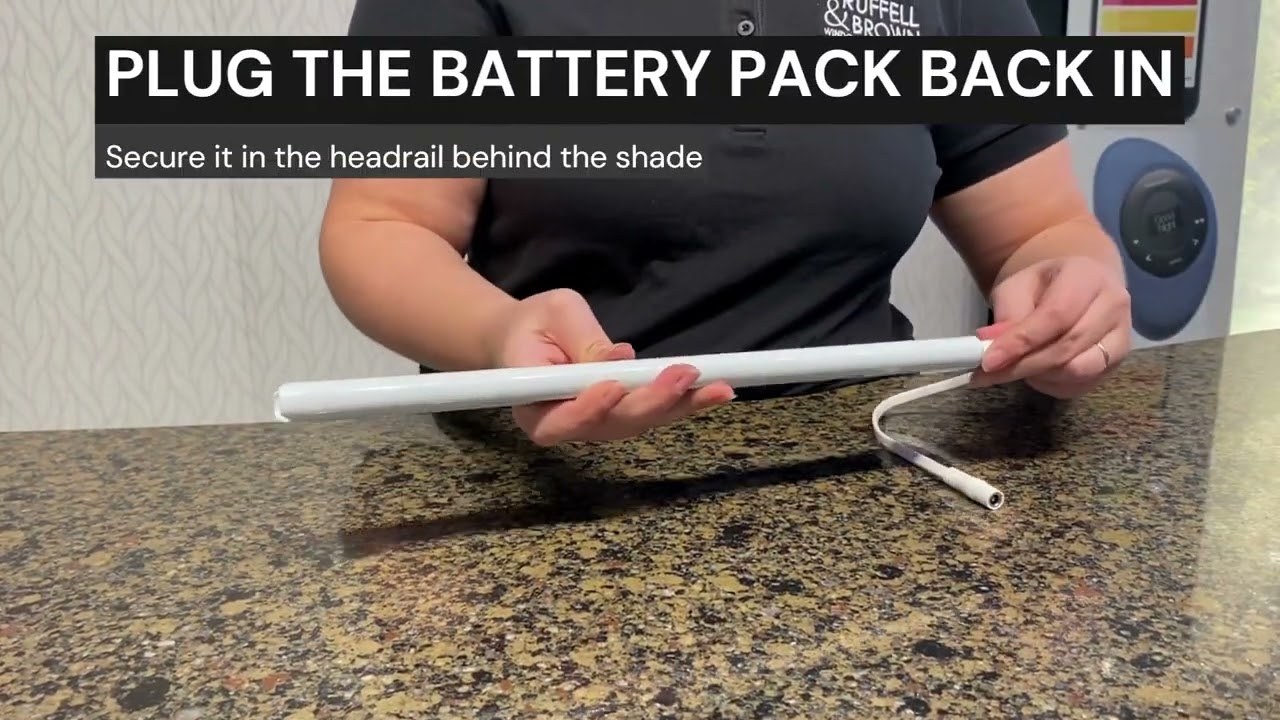
External wands may clip into holders, slide out of a bracket, or hang behind the headrail. Support the pack so it does not pull on the motor lead. Release the connector by its housing, not the wire. If the connection is tight, stop and check for a locking tab instead of twisting the cable.
Insert the batteries or new pack in the indicated direction, then connect the plug without forcing it. The connector should seat fully and remain aligned with the motor socket. Secure the wand where it will not rub against the fabric or be visible from the room. A typical 8-AA wand may provide about 12 volts, but verify your system's label rather than copying that number.
Use the local button or remote to jog the shade for one or two seconds. Listen for a steady motor sound and watch the fabric edge. If the motor hums without movement, stop; the issue may be a mechanical obstruction rather than power.
Ask World Wide Shades to confirm a replacement battery if the connector, voltage, or motor label does not match. A compatible part is usually cheaper than repairing damage caused by reversed polarity.
Rechargeable battery replacement
Internal rechargeable packs may be located inside the headrail and may require the shade to be removed. Some systems offer a serviceable plug-in pack; others require a trained technician to open the cassette. Check the installation manual for the exact access procedure and do not pull the fabric roll out of its brackets unless the instructions explicitly allow it.
A replacement lithium pack can cost approximately $80–$250, while an external battery wand may cost $35–$120. Labor or a high-access appointment can add $100–$300. Newer systems may have a USB-C or proprietary charger, but the port shape is not proof of charging compatibility. Use only the supplied or manufacturer-approved charger.
World Wide Shades can help plan a motor replacement when the battery is no longer supported. Start a new motorized shade configuration or call (844) 674-2716 with the shade width and motor model.
When to reset limits after replacing a battery
A simple battery change should not erase upper and lower limits on many systems. If the shade still stops at the correct positions, do not reset it unnecessarily. Limits may need reprogramming after a motor replacement, a full factory reset, a tube change, or a shade that has lost calibration.
A reset normally involves holding a program button for a defined number of seconds, jogging the shade, setting the upper limit, setting the lower limit, and saving the values. Exact sequences vary widely. A five-second hold on one motor can pair a remote; on another, it can erase all channels. Keep the manual open and identify the motor family first.
After setting a limit, run three complete cycles. Check that the bottom bar stops before the sill, that the fabric remains centered, and that the motor does not keep running after the stop. If the shade rolls up crookedly, correct the mechanical alignment before reprogramming limits.
Battery life and prevention
Battery life depends on shade size, fabric weight, temperature, daily cycles, and whether the motor communicates with a hub. A small solar shade used twice per day may go 12–24 months between charges; a large blackout shade cycled six times per day may need attention in 6–12 months. These are planning ranges, not guarantees.
Set a calendar reminder when the battery reaches 20–30% if the app reports a level. Keep the charging port accessible, avoid pinching the cable behind trim, and do not leave the pack in direct heat. If several shades installed at the same time show low power together, check the charger or hub rather than replacing every battery.
For a full upgrade, compare battery, hardwired, and smart control options in the World Wide Shades builder. Request fabric swatches if a new shade is being fabricated at the same time.
If a battery replacement turns into a broader upgrade, compare energy-efficient window shades, how to install roller shades, child-safe window treatments, and motorized shades with Alexa and Google Home before ordering a new system.
Frequently asked questions
Read the motor or battery label and match chemistry, voltage, connector, polarity, and physical dimensions. Photograph the existing pack and ask the shade provider before ordering. AA count alone is not enough to confirm compatibility.
Usually not if you replace the pack without performing a factory reset, but behavior varies by motor. Test the upper and lower stops first. Reprogram only when the manual says the limits were lost or the motor was replaced.
Many systems last roughly 6–24 months per charge, depending on size, fabric weight, temperature, and daily cycles. Large blackout shades and frequent automation generally use more power.
Only if the motor manufacturer specifies them and the voltage remains within the system's range. Rechargeable AA cells often have a lower nominal voltage than alkaline cells, so confirm the requirement before substituting.
Check for a jam, a disconnected motor lead, a lost remote pairing, a disabled channel, or a failed charger. A humming motor with no movement points toward a mechanical or drive problem rather than a battery.
Contact World Wide Shades, build a service or replacement project, or call (844) 674-2716. Do not use an unstable ladder or open a headrail above a stairwell without proper support.