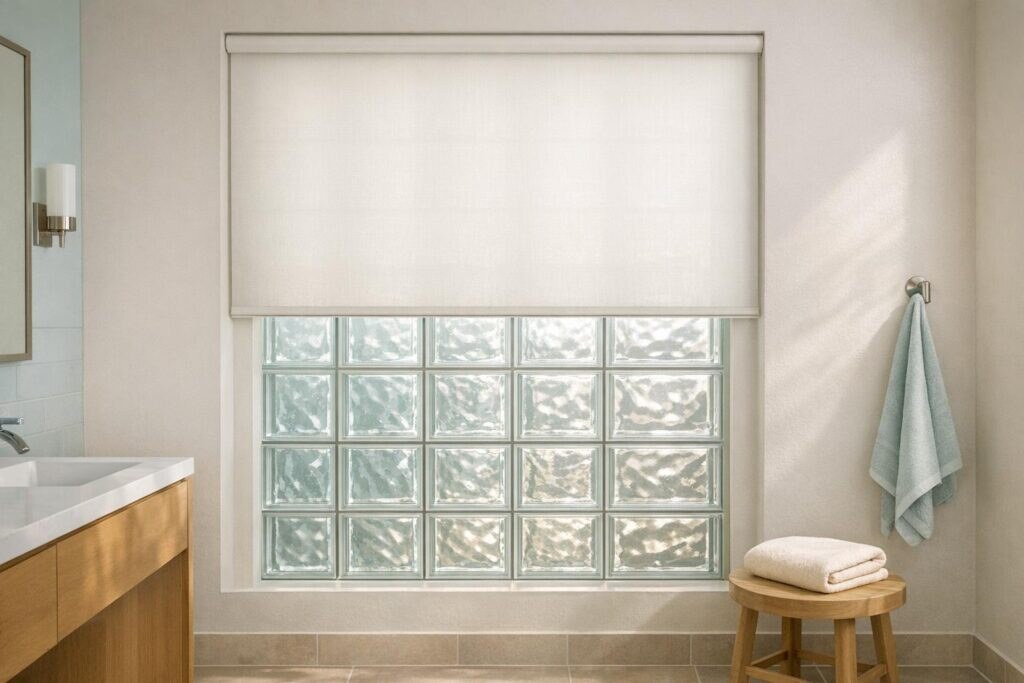
Yes, you can often add roller shades in front of glass block windows, provided the surrounding opening offers a suitable attachment point. The sensible starting point is the wall, jamb, or header around the panel, not a drill aimed at the blocks.
For a World Wide Shades project, separate two decisions: where the brackets can safely attach and how much light or privacy you want. Solve the mounting question first, then select fabric and controls that suit the room.
Why glass block requires a different approach
Glass block often occupies a mortared masonry opening rather than a conventional window sash with an accessible frame. Pittsburgh Glass Block describes frameless panels installed into masonry with perimeter mortar, as well as different methods for wood-framed openings; the visible glass alone does not reveal the underlying construction. (Pittsburgh Glass Block installation instructions)
Calling the opening “masonry” does not mean the blocks are structural supports. SGM explicitly says glass block panels must not support structural loads and calls for movement provisions at the jambs and header. (SGM glass block installation guidance)
Treat the glass panel, its perimeter seals, and its surrounding support as different components. A painted strip might be decorative trim rather than framing, while an apparently solid border could conceal a movement joint.
Before buying, ask a qualified installer to identify the bracket substrate and inspect for loose material, cracking, staining, or damaged trim. World Wide Shades fabric advice cannot replace an on-site assessment of an unfamiliar wall.
Discuss your opening with World Wide Shades or call (844) 674-2716 before choosing hardware. Send an overall photo and close-ups of the top and side returns so the conversation starts with the actual installation.
Where roller-shade brackets can go
An outside mount, also called a face or surface mount, is worth evaluating first when the recess lacks usable depth. The proposed brackets sit above or beside the opening, and the fabric lowers in front of the glass.
This arrangement may be practical if the surrounding substrate is sound and the attachment method is appropriate for the shade. Have the installer confirm the material, fasteners, bracket spacing, and clearance required by the selected product rather than assuming a generic anchor will work.
Do not assume decorative casing can carry the assembly. If the planned position misses suitable backing, consider relocating the brackets or having properly supported blocking installed before ordering.
An inside mount is an option only when the recess has both adequate space and a verified attachment surface independent of the blocks. Measure the usable return at the intended bracket locations, not simply the distance from the wall face to the glass.
Compare that depth with the specific bracket and cassette requirements. Plan enough room for the fabric and bottom rail to move without touching projecting glass, uneven masonry, vent hardware, or the sill.
Our roller-shade installation guide helps explain ordinary bracket planning. For openings with an actual metal surround, also read installing roller shades on steel window frames, without assuming its attachment approach applies to masonry.
Sometimes a supported mounting board above the opening or an approved ceiling position offers a better layout. Ask the installer whether that location provides a suitable attachment path and whether the chosen brackets permit that orientation.
Include any board, spacer, or extended bracket in the final depth calculation. A new mounting surface should solve the support problem, not hide uncertainty behind fresh paint.
Once the location is confirmed, explore a World Wide Shades configuration. Keep the proposed dimensions provisional until the installer approves the mounting arrangement and product requirements.
Why drilling the blocks is not the shortcut
Do not drill the glass blocks or their mortar joints for shade brackets without specific review by a qualified glass-block professional and applicable manufacturer guidance. This is a precaution for the existing assembly, not a suggested do-it-yourself technique.
Mortar joints are not simply convenient screw locations: SGM describes panel reinforcing, anchors, and movement provisions as parts of the glass-block installation. (SGM glass block installation guidance)
A nearby masonry wall may offer a different mounting opportunity, but its condition and construction still need assessment. Distinguish surrounding brick or concrete from the joints that hold the glass panel together.
Avoid treating adhesive brackets, suction mounts, or tension systems as universal fixes. Consider one only if its manufacturer explicitly supports the exact surface, shade weight, dimensions, and environment; otherwise, choose a properly reviewed mounting method or a different treatment.
Measure the proposed shade, not just the block grid
Begin with the selected mount position and the product’s ordering instructions. Record dimensions to the precision requested by the manufacturer, and label whether each number describes the opening, finished assembly, or desired fabric coverage.
For a possible inside mount, measure the clear width at the top, middle, and bottom, then the height at the left, center, and right. Record variations rather than averaging them away, and follow the product instructions about which measurements to submit and whether factory deductions apply.
For an outside mount, define the area you want the lowered fabric to cover. Measure from the intended roller position to the desired bottom stopping point, then assess side coverage and the space available for brackets or a cassette.
For example, an opening measuring 36 inches across might prompt consideration of 40 inches of fabric coverage for a two-inch overlap on each side. That is a planning example, not an order width: confirm the assembly-to-fabric difference, bracket footprint, and available wall space before specifying anything.
Record the depth of any projecting trim and the location of a vent latch. Ask for a layout showing how the lowered material clears those obstructions, including when a vent opens.
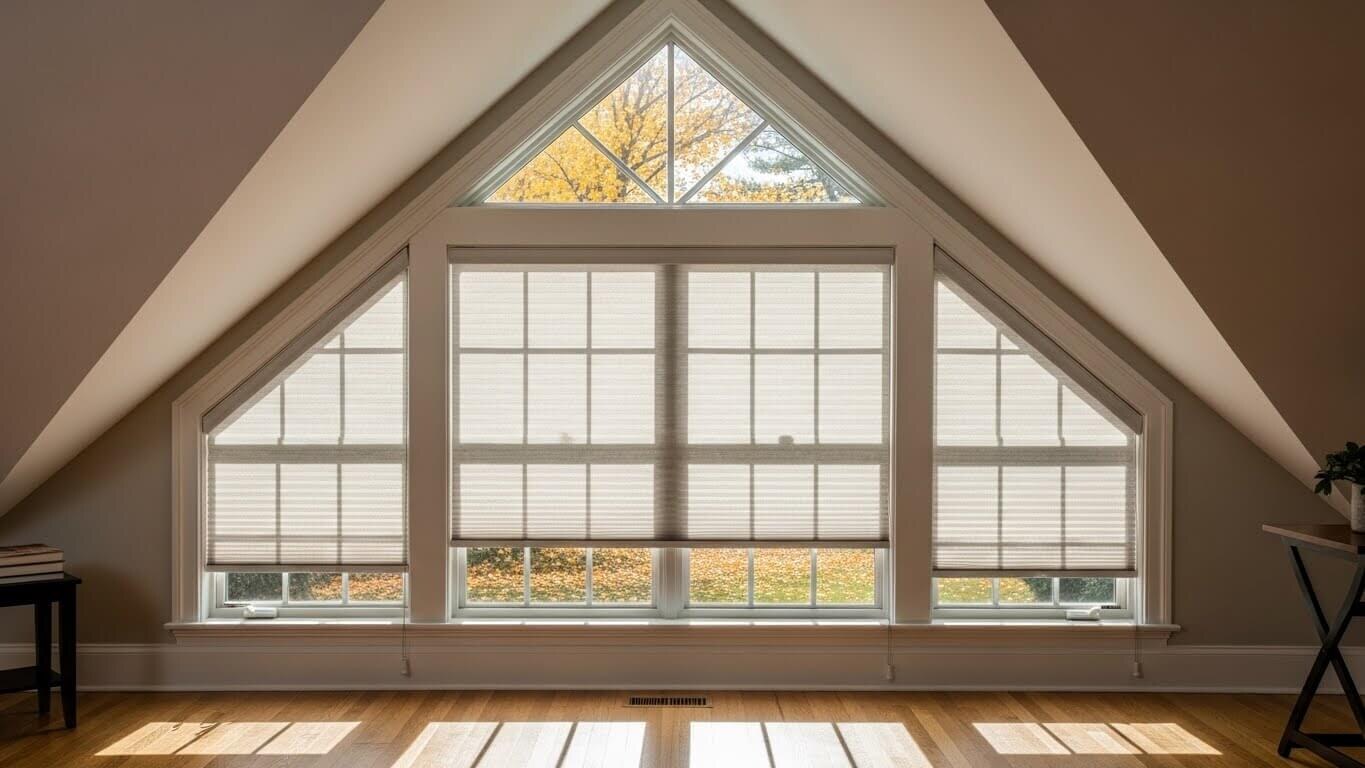
If several windows share a wall, establish a common reference line rather than copying one opening’s height. Our guide to aligning roller shades across adjacent windows addresses that visual planning, while measuring triangular gable windows for shades offers a related reminder to distinguish glazing shape from treatment coverage.
Choose privacy and daylight separately
Decide what the shade must accomplish when lowered. A bathroom privacy treatment, basement glare solution, and bedroom darkening layer should not automatically use the same material.
- Light-filtering fabric: Consider it when you want softer daylight rather than maximum darkening. Ask about the specific material’s nighttime privacy performance instead of relying on a color name.
- Room-darkening or blackout fabric: Consider it when stronger light reduction is the priority. Evaluate the completed installation, including side and bottom gaps, rather than treating the fabric specification as a room-wide blackout guarantee.
- Solar-screen fabric: Evaluate it for glare management, but do not select it as your only privacy strategy without understanding visibility under your actual indoor and outdoor lighting.
Use our light-filtering shades guide and roller-shade fabric comparison to organize those choices. For a sleeping room, compare blackout curtains and blackout shades before deciding whether one roller is sufficient.
Request World Wide Shades swatches and compare them against the existing glass during the day and with interior lights on after dark. Treat a small sample as a selection aid, not a guarantee of the finished installation’s privacy or light control.
If preserving the block texture is important, a retractable shade lets you plan for uncovered daytime viewing and added coverage when needed. Alternatively, consider a separately mounted curtain, a privacy screen where practical, or leaving the panel uncovered if its existing privacy meets your needs.
Do not assume ordinary window film will suit textured glass block. Confirm surface compatibility and installation approval with both the film supplier and the glass-block manufacturer before considering an applied product.
Account for moisture and cleaning access
Resolve active dampness before installing a treatment that makes the area harder to inspect. EPA identifies moisture control as the key to mold control and advises fixing the water problem rather than addressing visible growth alone. (EPA mold and moisture guidance)
EPA recommends keeping indoor relative humidity below 60 percent, ideally between 30 and 50 percent, and drying condensation promptly while reducing its moisture source. (EPA moisture prevention guidance)
Plan access so you can raise the shade, inspect the perimeter, and clean behind the fabric. Do not position the lowered shade against a wet sill or use it to conceal recurring staining.
Choose materials and hardware whose care instructions suit the room’s exposure. Ask specifically about splash resistance, acceptable cleaners, and any restrictions for bathrooms; do not translate “easy care” into “waterproof.”
For regular maintenance, follow the shade manufacturer’s directions and avoid soaking the fabric or mechanism. Let cleaned surfaces dry before lowering the treatment, and leave yourself enough room to wipe the sill without removing brackets.
Our guide to roller shades in kitchens and bathrooms provides a useful companion for room planning. Ask World Wide Shades about fabric care or call (844) 674-2716 with details about shower proximity, recurring condensation, and cleaning access.
Select controls with safety and reach in mind
Choose a control arrangement you can operate without climbing over a tub, sink, or furniture. Consider how you will reach a cordless bottom rail or service a motorized unit before settling on the installation height.
The U.S. Consumer Product Safety Commission recommends cordless window coverings as the safest option when young children are present. (CPSC window-covering safety guidance)
Do not assume a high window makes an accessible cord safe; CPSC advises moving beds, cribs, furniture, and toys away from windows and covering cords. (CPSC safety precautions)
Review child-safe window treatments while comparing operating styles. For a different interior-glass application, our article on roller shades for office glass partitions helps separate privacy planning from the attachment decisions unique to glass block.
Frequently asked questions
Do not plan direct attachment as the default. Have a qualified professional review the actual assembly and applicable manufacturer guidance, and look first for suitable support in the surrounding opening.
An outside mount may be more practical when the recess is shallow or offers no usable bracket surface. An inside mount remains possible when its support, depth, and operating clearances are confirmed.
Only consider an adhesive system explicitly approved for your exact application. If the supplier cannot confirm compatibility with the surface, load, and moisture exposure, do not treat adhesive mounting as a dependable substitute for a reviewed attachment.
Do not assume it will, because the coverage layout must also address light around the shade. Ask for an installation-specific discussion of overlap, fabric width, and edge gaps before ordering.
Send photos of the whole opening, close-ups of the surround, preliminary dimensions, and a description of your privacy goal. Include any vent, moisture issue, or reach limitation so the proposed design accounts for daily use.
Start with support, then choose the shade
The right roller shade begins with a verified mounting surface and a clear coverage plan. Keep the glass-block assembly undisturbed unless a qualified professional specifically approves otherwise, and resolve moisture concerns before adding fabric.
Start your World Wide Shades design once the mounting approach is established. Choose the fabric and controls around the room’s needs rather than forcing the opening to accept an unsuitable installation.