Open-plan coworking spaces and startup offices live and die by their atmosphere. Natural light draws members in, but uncontrolled glare kills productivity, washes out monitors, and turns video calls into squinting sessions. The right roller shade program balances daylight with visibility, supports acoustic privacy, reflects brand identity, and holds up to the daily churn of dozens of users who are not especially gentle with shared fixtures. This guide covers what to spec, what to avoid, and how World Wide Shades can help you build out your window treatment program from a single hot-desk studio to a 40,000-square-foot multi-floor build-out.
Why Coworking Spaces Have Harder Window Treatment Challenges Than Standard Offices
A traditional corporate tenant controls who uses the space and signs a 10-year lease that justifies custom millwork. A coworking operator faces the opposite reality: monthly memberships, multiple simultaneous tenants with conflicting preferences, and lease terms that may run as short as 12 months. That creates three compounding problems.
First, usage is unpredictable. A morning yoga class needs full blackout. The afternoon startup running a pitch rehearsal needs 80% light reduction on one wall and open views on another. The evening networking happy hour wants ambient glow. Residential blinds fail under this workload inside 18 months. Commercial-grade roller shade fabrics rated for 250,000 operating cycles—standard for the systems World Wide Shades supplies—hold up under that kind of rotational demand.
Second, aesthetics drive revenue. Coworking brands like WeWork, Industrious, and Convene spend significant resources on Instagram-worthy interiors because members photograph and share the space as a signal of their own status. A mismatched, yellowed, or saggy shade destroys that perception. Fabric color and texture are branding decisions as much as operational ones.
Third, turnover is fast. When a new anchor tenant takes over a floor, operators often need to reconfigure window treatments within a 2-to-3-week fit-out window. Modular roller shade systems that mount on standard fascia brackets can be swapped or reordered quickly—unlike custom drapery that requires weeks of lead time.
Learn how commercial roller shades differ from residential options before specifying your next project.
Glare Control and Monitor Visibility: The Core Technical Problem
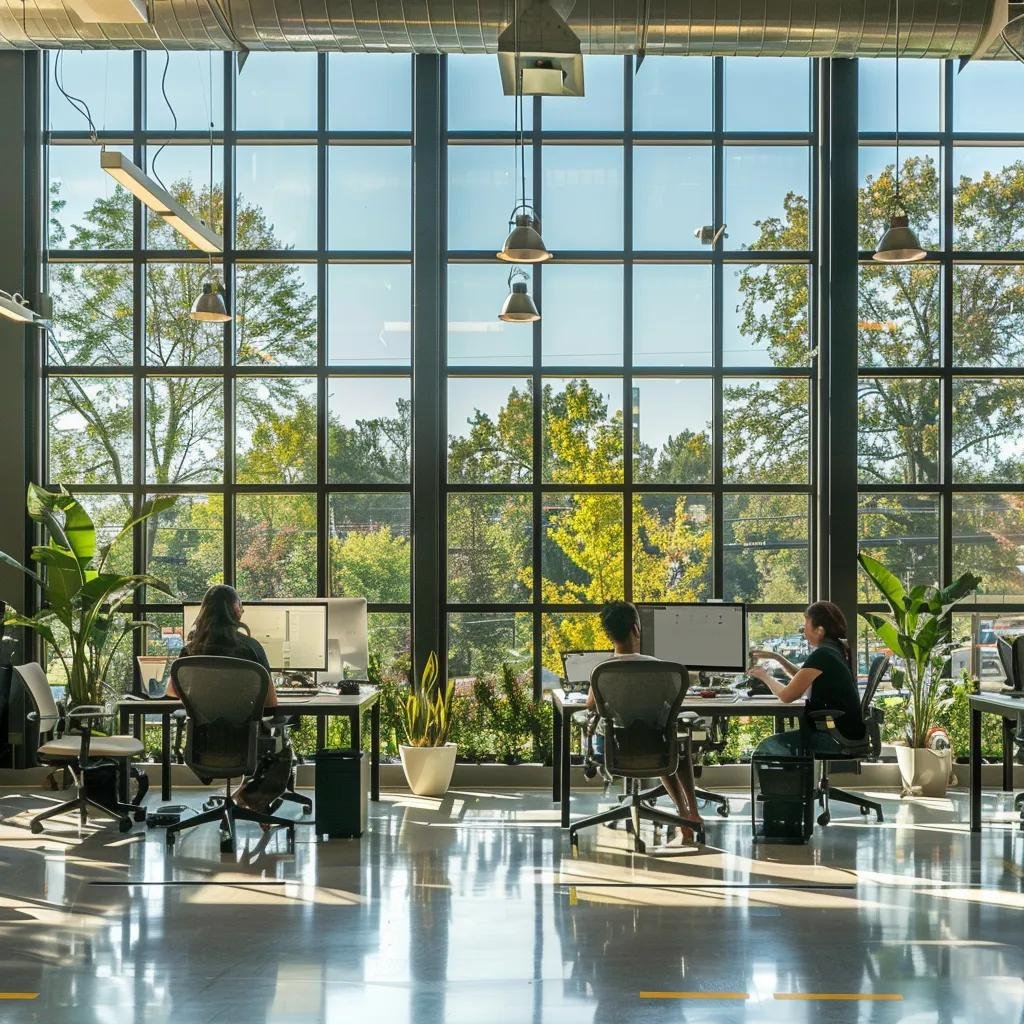
Coworking members spend most of their day staring at screens. Glare from direct sun hitting a monitor surface reduces contrast ratios to the point where fine text becomes difficult to read, causes eye strain within 20 to 30 minutes, and drives members to physically relocate—which means your expensive east-facing window seats sit empty at 9 a.m. every day.
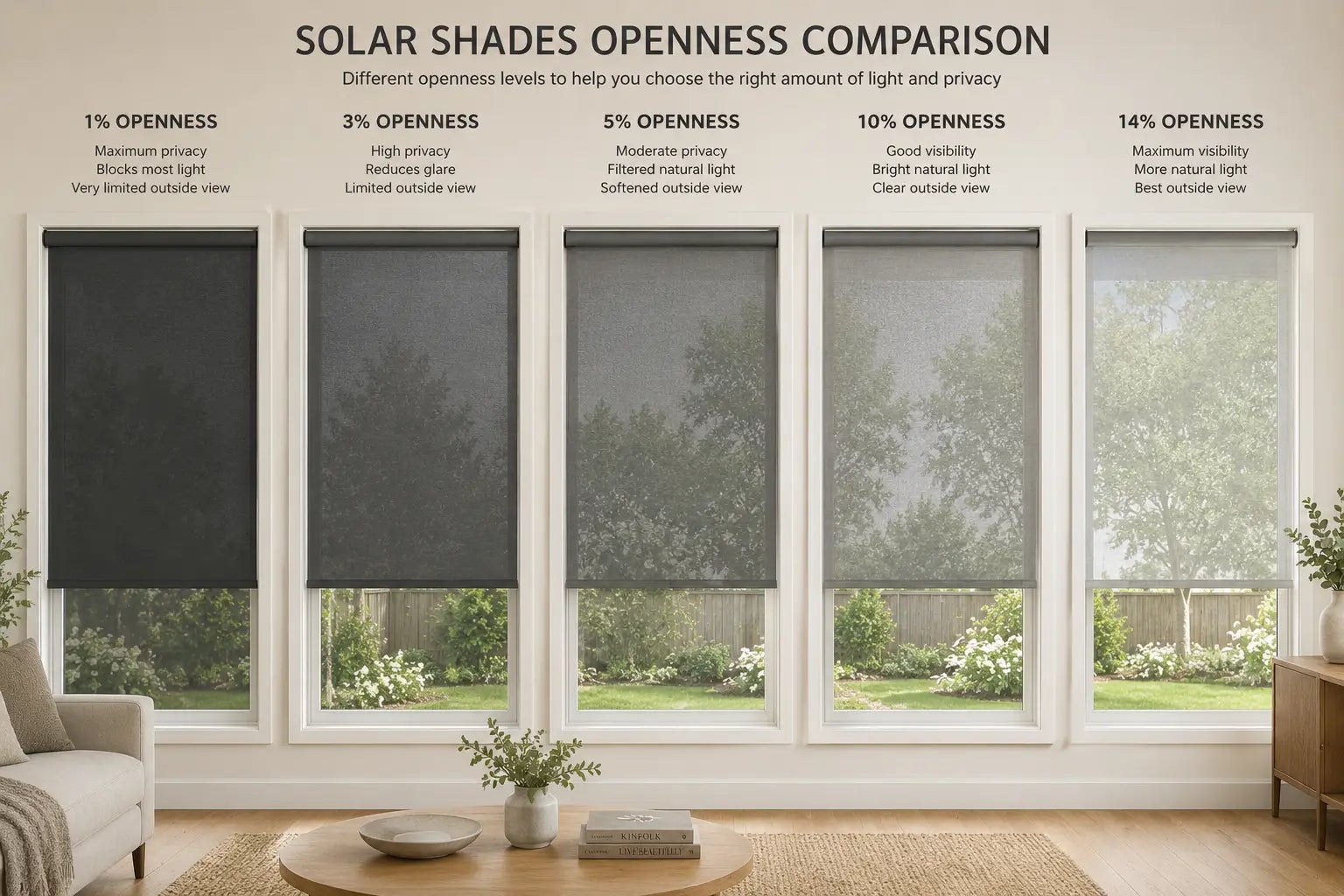
The standard solution for perimeter zones with direct sun exposure is a 5% openness solar shade in a medium-density fabric. A 5% openness factor means 5% of the fabric surface is open, allowing diffused light while blocking 95% of direct beam radiation. This keeps the interior bright and preserves outward views while eliminating reflective glare on screens. Members can see out; direct sun cannot drive in.
For spaces with floor-to-ceiling glazing facing southwest or west—the worst sun angles in the afternoon—consider dropping to a 3% openness fabric. The view remains visible, but solar heat gain drops by roughly 20% compared to a 5% product, which also reduces HVAC load and operating costs. Choosing the right openness percentage matters more than most buyers realize.
World Wide Shades stocks solar shade fabrics from 1% through 10% openness and can send physical swatches to your design team before you commit to a specification. Order free fabric swatches at /swatches to compare light transmission in your actual space conditions.
Phone Booth and Conference Room Blackout Requirements
Acoustic phone booths—those freestanding or semi-permanent pods that have become standard in open-plan offices—need full blackout on any glazed panels. Video calls require a controlled background, and members using booths for confidential client calls have a reasonable expectation of visual privacy from the open floor.
Blackout roller shades for booth panels typically run in the 18-to-36-inch width range, making them ideal candidates for standard bracket-mount systems. A true blackout fabric (rated at 0% light transmission) combined with side-channel hardware eliminates light gaps at the edges—a detail that matters in booths where panels are close together and any light leak is visible.
Conference rooms present a similar requirement. Presentation screens and projection systems require between 85% and 100% light reduction to produce an image contrast ratio adequate for comfortable viewing. A room that uses a 5% solar shade on its exterior wall will still allow enough ambient light to wash out a projected slide. Spec blackout for all conference and training rooms, and install the solar shades on any adjacent floor-to-ceiling glazing to manage the zones independently.
Contact World Wide Shades at (844) 674-2716 to discuss conference room blackout configurations and get a same-day quote.
Motorized Roller Shades for Multi-Tenant Flexibility
Manual cord-operated shades in a coworking environment get left at random positions, have cords that fray or tangle, and require someone physically at each window to adjust—not practical when a 6,000-square-foot floor has 18 windows along its perimeter. Motorized roller shades solve all three problems.
A basic motorized setup uses 24V DC motors integrated into the roller tube, operated by wall switches, remote controls, or a smartphone app. For conference rooms that book through scheduling software like Robin or Skedda, you can integrate shade control directly into the room booking workflow: when a meeting starts, shades lower automatically; when the room releases, they rise to the default position. This eliminates the "who left the blinds down" problem that plagues shared spaces.
For larger floors with 20 or more windows, a hardwired bus system (RS-485 or KNX protocol) allows all shades to be addressed individually or in groups from a single control point. The facilities manager can raise the east bank at 7 a.m. and lower the west bank at 2 p.m. as a scheduled automation, with zero manual intervention.
Explore motorized shade options and smart-home integration details to understand what protocols your building management system supports before you specify hardware.
World Wide Shades supplies and installs motorized systems for coworking operators across the country. Start your motorized shade configuration with our online builder or call (844) 674-2716 to speak with a commercial project specialist.
Brand Expression Through Fabric Color and Texture
This is the dimension that most facility managers underestimate. A coworking brand that has invested in custom lounge seating, curated art walls, and a specific color palette will undermine all of that investment with off-white box-store roller shades. Fabric color is visible from the street, appears in every member photo, and communicates the brand's attention to detail.
The practical range for solar shades runs from near-white (maximizes light transmission, reads as airy and minimal) to charcoal and black (maximizes glare reduction, reads as focused and premium). Midrange warm grays and warm whites work well in spaces with exposed wood and warm-metal finishes. Cool grays and off-whites suit spaces with concrete, white oak, and polished steel.
Texture adds another dimension. A woven fiberglass fabric has a tighter, more uniform appearance than a PVC-coated polyester fabric, and it resists yellowing over time—important in a high-turnover environment where you cannot predict how the space will be lit when photographed by a prospective member. World Wide Shades offers both fabric families, and the fabric swatches page at /swatches lets you order samples before committing.
Understanding fabric materials in depth will help you match texture, durability, and light behavior to your coworking aesthetic.
Cost Per Workstation: Budgeting for a Full Roller Shade Program
Coworking operators typically think in per-member or per-workstation costs when evaluating capital investments. A standard workstation window treatment budget breaks down as follows:
- Solar shade (single window, 36" × 72"): $180–$320 installed, manual operation
- Solar shade (same size, motorized): $380–$580 installed, including motor and single-zone control
- Blackout shade (conference room, 48" × 84"): $220–$400 installed, manual
- Blackout shade (conference room, motorized): $450–$700 installed
For a 50-person coworking floor with 20 perimeter windows, 2 conference rooms (4 windows each), and 6 phone booth panels, a fully motorized program typically runs $14,000–$22,000 installed. That amortizes to $280–$440 per member seat—comparable to the cost of a single ergonomic chair and well within the $1,200–$2,000 per-member build-out budgets that operators commonly plan.
Bulk ordering above 30 units typically qualifies for volume pricing at World Wide Shades. Contact our commercial team at /contact or call (844) 674-2716 for a line-item quote on your specific floor count and window schedule.
See a full cost breakdown for custom roller shades to understand where pricing variation comes from before you get competitive bids.
Sound-Friendly Fabrics for Video Calls
Open coworking floors are acoustically challenging. Hard surfaces—concrete, glass, polished wood—reflect sound, raising reverberation times above 0.8 seconds and making video call audio muddy. Roller shade fabrics have a modest but real acoustic contribution.
A tightly woven, medium-weight fiberglass solar shade fabric adds an absorption coefficient of approximately 0.05–0.15 at mid frequencies (500–2,000 Hz). Across 20 windows of 24 square feet each (480 square feet of fabric), that represents a measurable reduction in reverberation, equivalent to adding roughly 24–72 sabins of absorption. That is not a substitute for acoustic panels, but it is a free acoustic benefit that comes with a product you need for glare control anyway.
Heavier blackout fabrics perform slightly better acoustically because they have higher mass. If you are specifying phone booths or conference rooms and acoustic performance matters, favor a heavier blackout fabric (60–80 g/m²) over a thinner option. World Wide Shades can provide fabric weight specifications for any product in the catalog—reach out through the contact page or use the online builder to compare options.
Noise-reducing window shades explained in detail if acoustic performance is a primary selection criterion for your space.
Installation Speed During Lease Turnover
One of the most underappreciated specs for a coworking operator is installation time per window. When a floor turns over and the new tenant wants their color palette, or when a new location opens on a compressed timeline, the difference between a 3-week and a 3-day installation matters operationally.
Standard bracket-mount roller shade systems install at a rate of 6–10 windows per installer per day, including hardware, fabric, and motor wiring. A 20-window floor can be completed in one 10-hour day with a two-person team. Compare that to motorized drapery or custom fabric panel systems, which require rough-in, trim-out, and a return visit—often stretching over 5–7 business days.
World Wide Shades pre-assembles roller shade units at the factory so that on-site installation is limited to bracket mounting, tube insertion, and motor pairing. Lead times for in-stock fabrics run 5–10 business days from order confirmation to ship. Start your order using the online builder to check current lead times for your specified fabric and size.
Energy Efficiency and HVAC Savings in High-Glass Buildings
Modern coworking spaces favor floor-to-ceiling glazing for the natural light and urban views that attract members. The thermal downside is significant: single-pane commercial glass has a U-value of approximately 1.0 BTU/hr·ft²·°F, and even high-performance double-pane units reach only 0.25–0.30. On a sunny afternoon, an unshaded west-facing glass wall can add 15–25 BTU/hr per square foot of solar heat gain, pushing HVAC loads up by 10–30% during peak cooling hours.
A 3–5% openness solar shade with a reflective backing reduces solar heat gain coefficient (SHGC) by 40–60% when deployed. On a 2,000-square-foot floor with 600 square feet of west-facing glass, that translates to a cooling load reduction of roughly 9,000–15,000 BTU/hr during the afternoon peak—equivalent to removing a 1–1.25-ton air conditioning unit from the load calculation. Annual energy savings typically range from $0.50 to $1.50 per square foot of glazing, depending on local utility rates and climate zone.
Energy-efficient window shades: what the numbers actually mean covers the full methodology if you need to build an ROI case for a facilities or finance stakeholder.
Smart Integration With Conference Room Systems
Enterprise coworking operators are increasingly integrating shade control with room management platforms. The workflow looks like this: a member books a conference room via the space's scheduling app; the booking triggers a webhook that tells the shade controller to lower the shades to 50%; when a presentation is detected (via room sensor or manual button), shades drop to blackout; when the meeting ends, shades return to default.
This integration is possible with motorized shade systems that support open protocols—Z-Wave, Zigbee, KNX, or cloud API via platforms like Control4, Crestron, or Lutron Vive. World Wide Shades works with all of these platforms and can provide motor specifications that confirm compatibility before you lock in a control system. Explore the smart-home motorized shade setup guide for a technical overview of integration options.
For spaces that do not yet have a building management system but want future-proofing, specifying a motorized system now and running the low-voltage wiring during fit-out costs approximately $8–$15 per linear foot—far less than retrofitting conduit after walls are finished.
Frequently Asked Questions
For most perimeter windows with easterly or southerly exposures, a 5% openness solar shade strikes the right balance between daylight, view preservation, and glare reduction. West-facing windows with afternoon sun exposure in warm climates benefit from 3% openness to manage heat gain. North-facing windows with no direct sun can use 10% openness if maximum view and light transmission are priorities. World Wide Shades can help you map exposures and specify the right product for each façade—start with our online builder or call (844) 674-2716.
For any coworking floor with more than 10 windows, motorized shades pay for their premium within 18–24 months through reduced staff time managing manual shades, member satisfaction improvements that reduce churn, and energy savings from automated scheduling. The premium over manual shades runs $150–$250 per window for basic motorized systems. A detailed analysis of whether motorized shades are worth it covers the cost-benefit framework.
Commercial-grade roller shade fabrics are rated for 250,000+ operating cycles, versus 50,000–75,000 for residential-grade products. Commercial fascia systems use heavier-gauge aluminum extrusions and steel bracket mounts that resist deformation under the lateral loads that occur when users pull shades manually at odd angles. For a coworking environment where dozens of people interact with the same shade daily, commercial-grade hardware is not optional—it is the baseline. World Wide Shades only supplies commercial-grade systems for multi-tenant and commercial applications.
Solar shade fabrics are available in a standard palette of 30–50 colors from most manufacturers, ranging from warm whites through charcoals and earth tones. True custom dyeing is available on orders of 200 or more linear yards, which corresponds to roughly 35–40 standard windows. For smaller projects, World Wide Shades' existing palette is broad enough to match most brand color families. Browse the color guide for window shades or order swatches at /swatches to compare against your brand standards.
A typical 20-window coworking floor with motorized roller shades installs in one full day (8–10 hours) with a two-person crew. Motor pairing and control system commissioning add 1–2 hours. Floors with 40+ windows or complex control integrations may require two days. Lead time from order to delivery runs 5–10 business days for in-stock fabrics. Contact World Wide Shades at /contact to get a project timeline specific to your floor plan.
Solar shades control the direction of visibility based on the difference in brightness between inside and outside. During daylight hours, the interior is darker than the exterior, so people outside cannot see in while those inside maintain a view out. After dark, when interior lights make the inside brighter than the exterior, the view reverses. For true privacy during evening events or ground-floor spaces with pedestrian traffic, a higher-opacity fabric (1% openness or blackout) is required. World Wide Shades can specify zone-appropriate products for each exposure. Reach out through /contact to discuss your specific privacy requirements.