Why nursery blackout shades need more than a dark fabric
A nursery needs a predictable sleep environment, but blackout performance is only one part of the decision. Cord safety, side gaps, control access, fabric odor, cleaning, and the location of the crib all affect whether a shade is appropriate. Blackout shades for nursery windows should reduce early-morning and nap-time light without introducing a reachable loop or a large, hard-to-clean treatment.
World Wide Shades helps families match the shade to the window, the crib layout, and the daily routine. Start a nursery shade plan to compare cordless, motorized, room-darkening, and true blackout options before you buy.
For a broader safety checklist, read child-safe window treatments. Our blackout shades for nursery and roller shades for nursery blackout safety guides cover related nursery layouts without assuming every room has the same window.
Blackout versus room-darkening
Blackout fabric blocks light through the cloth, but light can still enter around the sides, below the bottom rail, or through a gap between two shades. A room-darkening fabric may substantially dim a room without promising the same level of fabric opacity. For a baby who naps in the afternoon, either may be sufficient if the installation covers the problem area.
An inside-mounted shade follows the window recess and can leave side gaps of roughly 1/4 to 1/2 inch on each side, depending on the product and measurement. An outside mount can overlap the recess by 2 to 3 inches per side and extend below the sill, reducing bright edges. World Wide Shades can show both approaches so you select actual darkness rather than a label alone.
View the nursery when the sun is strongest, not only in the evening. Check the crib mattress, the changing table, and the wall opposite the glass. A bright stripe on the floor may not matter, but a beam at eye level can wake a baby. If the window faces east, test early morning; if it faces west, check the late afternoon.
Use a temporary towel or cardboard around the existing shade to identify the leak before ordering. This quick test reveals whether the main problem is fabric transmission, side gaps, or glass at the sill. Send the window details to World Wide Shades for help selecting a fabric and mount that solve the actual leak.
Safety comes before convenience
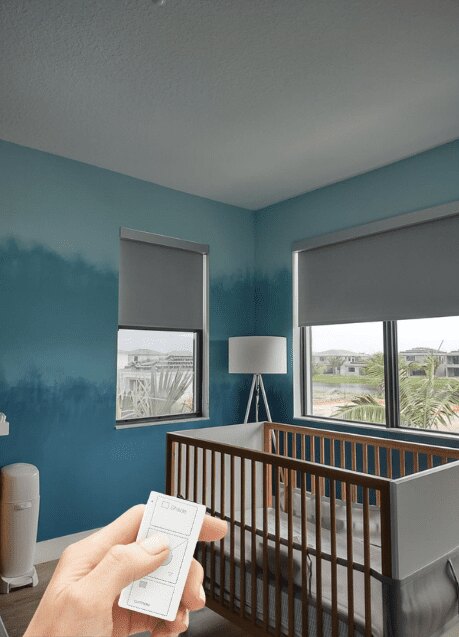
Avoid accessible cords, chains, and loops near a crib, changing table, or climbing furniture. A cordless spring shade keeps the control at the bottom rail; a motorized shade puts the control on a wall switch, remote, or app. Mount any control high enough that a child cannot reach it, and keep the crib, chair, and toy storage away from the window.
Cordless does not mean every part is automatically safe. Inspect the bottom rail, brackets, and fabric for loose parts, and follow the installation instructions. The U.S. Consumer Product Safety Commission window covering safety information is a useful reference for families and installers. World Wide Shades can explain the operating method and recommend a professional installation when the window is high or difficult to access.
Motorization can open the shade at 7:00 a.m., close it for a 1:00 p.m. nap, and raise it gradually before bedtime. A schedule avoids a dangling control and lets a parent adjust a shade without entering the room. Use a quiet motor and a manual override so the room remains usable during a power or battery issue.
Read smart home motorized shades setup for hub and scene considerations, then compare motorized shades with Alexa and Google Home if voice control is part of your home. Ask World Wide Shades about quiet nursery motorization before choosing a platform.
Specify the fabric for sleep and health
Nursery shades are close to sleeping and feeding areas, so odor matters. Ask for fabric and coating information, and air out new shades according to the manufacturer's guidance. A smooth polyester or coated blackout roller is usually easier to dust than a textured treatment with deep folds. Choose a finish that can be gently vacuumed with a brush attachment or wiped as directed.
Avoid placing a fabric shade where it can be grabbed and pulled from a crib. If the window is behind furniture, confirm that the furniture cannot be used as a step. World Wide Shades can help position the headrail and bottom rail so the shade works with the room rather than forcing a risky furniture arrangement.
A completely dark room is not required for every sleep period, and some families prefer a small amount of daytime light for orientation. A dual shade can pair a light-filtering layer with a blackout layer, letting you use filtered daylight during play and deeper darkness during naps. For a simpler installation, use a single blackout roller and raise it fully when the room is awake.
Our dual roller shades day and night article explains the two-layer approach. If the nursery also needs privacy without darkness, compare light-filtering shades for the daytime layer. World Wide Shades can put both fabrics in one coordinated plan. Request fabric samples so you can see the difference against the nursery wall color.
Measure for light control
Measure width at the top, middle, and bottom of the recess, then use the narrowest measurement. Measure height on the left, center, and right. Record the depth of the recess, the sill projection, window handles, and any casing that could interfere with an outside mount. Measure to the nearest 1/8 inch and keep a photo with the measurements.
For a nursery where darkness is the priority, an outside mount may cover more of the wall around the glass. Allow at least 2 inches of overlap on each side when the trim and wall allow it, and extend below the bright portion of the glass without interfering with a radiator or sill. A cassette can conceal the roll and make dusting simpler.
Do not place a bottom rail where it can strike a crib, mobile, or toy shelf. If the window is unusually wide, split the shade into two or more panels to keep weight manageable and alignment neat. World Wide Shades can recommend the split, mount, and bracket location based on the actual opening. Get a measured recommendation before placing the order.
Coordinate blackout shades with the room
Color affects how the nursery feels when the shade is closed. Soft gray, warm white, sand, or pale blue can maintain a calm look; a deeper tone can hide handling marks but may create a stronger visual block. If the nursery has warm wood, compare the options in our window shades color guide. For a natural texture, woven wood shades can be beautiful, but a separate liner and careful child-safe operation may be needed for true darkness.
Check the shade from the door and from the crib. The bottom rail should look level, the fabric should roll evenly, and the cassette should not crowd crown molding. World Wide Shades can match the nursery shade to adjacent bedroom or hallway windows so the room does not look like a one-off installation. Talk to a World Wide Shades designer if you are furnishing several rooms at once.
Cleaning and maintenance
Dust the headrail and fabric gently every few weeks, especially during construction or a dry season. Use a low-suction brush attachment and avoid soaking blackout fabric unless the manufacturer explicitly permits it. Do not spray cleaner onto the fabric; apply only a recommended cleaner to a cloth and test an inconspicuous area.
Check fasteners twice a year and after any furniture change. Confirm that the shade still stops at the intended height, the bottom rail is stable, and the motor or battery compartment is closed. Replace damaged cords or components rather than improvising a repair. Contact World Wide Shades when a shade no longer rolls straight or the control needs service.
FAQ: blackout shades for nursery windows
They can be, when specified and installed with cordless or inaccessible motorized operation and when furniture is kept away from the window. Check the complete assembly, not only the fabric, and follow current child-safety guidance.
The fabric can block light through the shade, but side gaps, the sill, and the bottom edge can still admit light. An outside mount with adequate overlap or a shade designed for room darkening can reduce those leaks more effectively than a tight inside mount.
Both can be appropriate. A cordless shade is simple for a reachable window; motorization is useful for high windows and scheduled naps because it moves the control away from the crib. Select a quiet product with a reliable manual or emergency override.
Choose an inside mount when the recess is deep and the window is square. Choose an outside mount when side-gap reduction, a shallow recess, or an uneven frame matters more than preserving the trim.
Lightly dust them every few weeks and inspect the hardware about twice per year. Follow the fabric maker's cleaning instructions, because water and aggressive cleaners can damage blackout coatings.
Yes. World Wide Shades can keep fabrics and headrails visually consistent while changing the blackout level, width, and operating method for each window. Build a multi-room plan or call (844) 674-2716 to discuss the nursery and the rest of your home.
Build a calmer, safer sleep environment
The best nursery shade is not simply the darkest fabric. It is a complete system: safe operation, appropriate overlap, a cleanable material, quiet control, and a schedule that fits the family. World Wide Shades can guide you from a nap-time light test to final installation. Compare nursery-ready swatches, then call (844) 674-2716 or request your World Wide Shades plan.