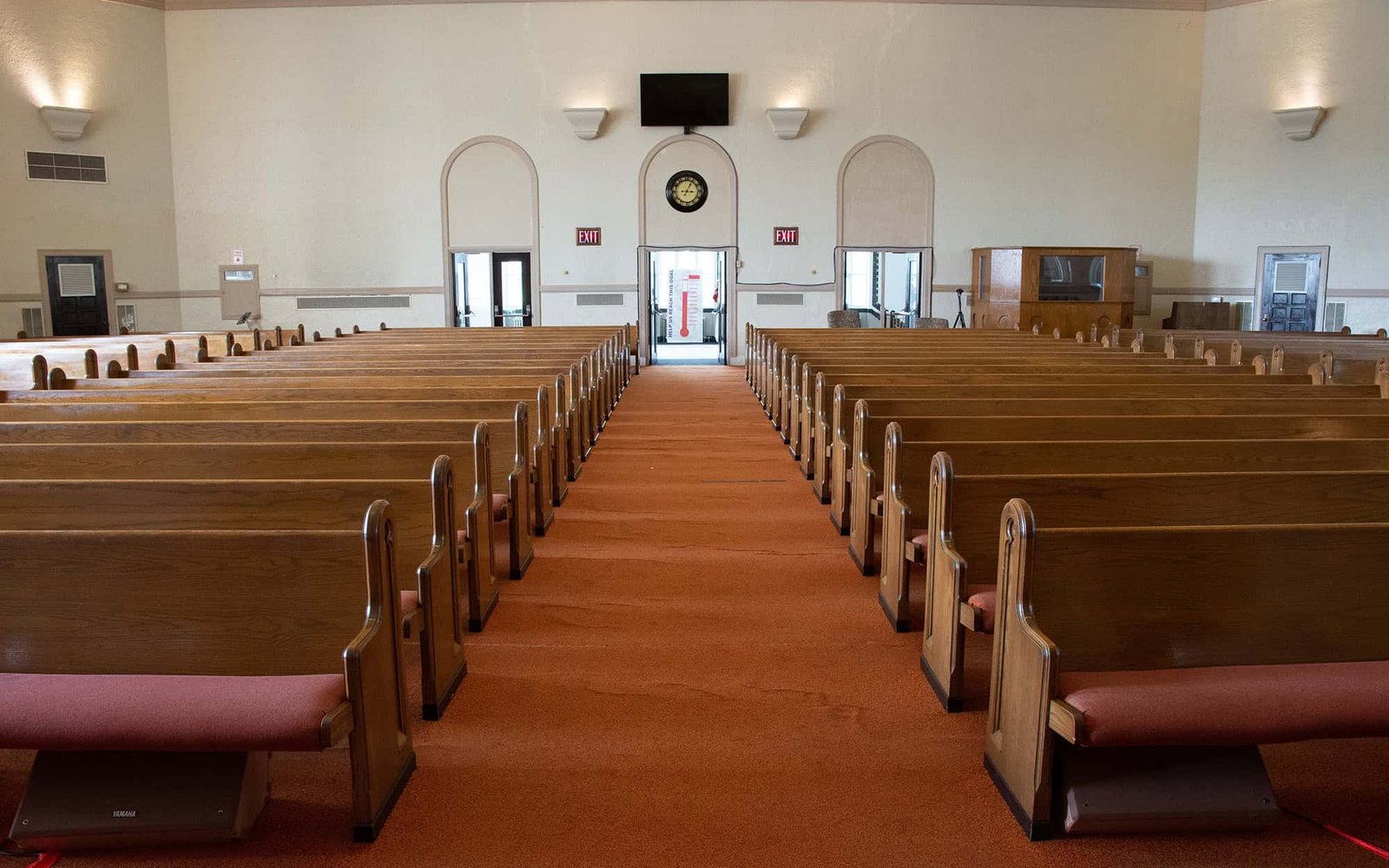
Houses of worship face window treatment challenges unlike almost any other building type. A single sanctuary can combine 25-foot vaulted ceilings, century-old stained glass, a modern video projection system, and a Sunday school classroom down the hall—all under one roof, all with different light control needs, and often on a budget governed by a volunteer committee. This guide walks through every zone of a typical church or house of worship and explains exactly which roller shades work, why, and what they cost.
Why Churches Need Specialized Window Treatments
Standard off-the-shelf shades rarely fit the unusual window sizes, historical trim details, and operational requirements of a church building. Sanctuary windows often run 8–25 feet tall, fellowship halls need total flexibility for events that shift from Sunday brunch to a Wednesday evening concert, and classrooms require child-safe cordless designs to comply with federal safety standards.
Fire code is also non-negotiable. The National Fire Protection Association's NFPA 701 standard governs flame-resistant textile materials in public assembly spaces. Any fabric installed in a sanctuary, fellowship hall, or corridor must meet NFPA 701 testing requirements—this is not optional and your local fire marshal will check. World Wide Shades carries roller shade fabrics with documented NFPA 701 certification, so you don't have to guess or source test certificates separately.
Beyond safety, acoustics matter more in churches than in almost any commercial space. Hard glass surfaces reflect sound, contributing to reverb that muddies spoken word and live music. Fabric window treatments absorb some of that reflected energy. A 3% openness fabric on a bank of sanctuary windows won't eliminate acoustic problems, but it contributes meaningfully alongside other acoustic treatments.
Protecting Stained Glass with UV-Blocking Roller Shades
Stained glass is irreplaceable, and UV radiation is its primary enemy. Even leaded art glass with UV-resistant glazing transmits enough ultraviolet light to fade interior furnishings, damage wood finishes, and degrade upholstery. A solar roller shade installed on the interior side of a stained glass window intercepts UV before it reaches pews, carpets, and finishes—without covering the glass when the shade is raised.
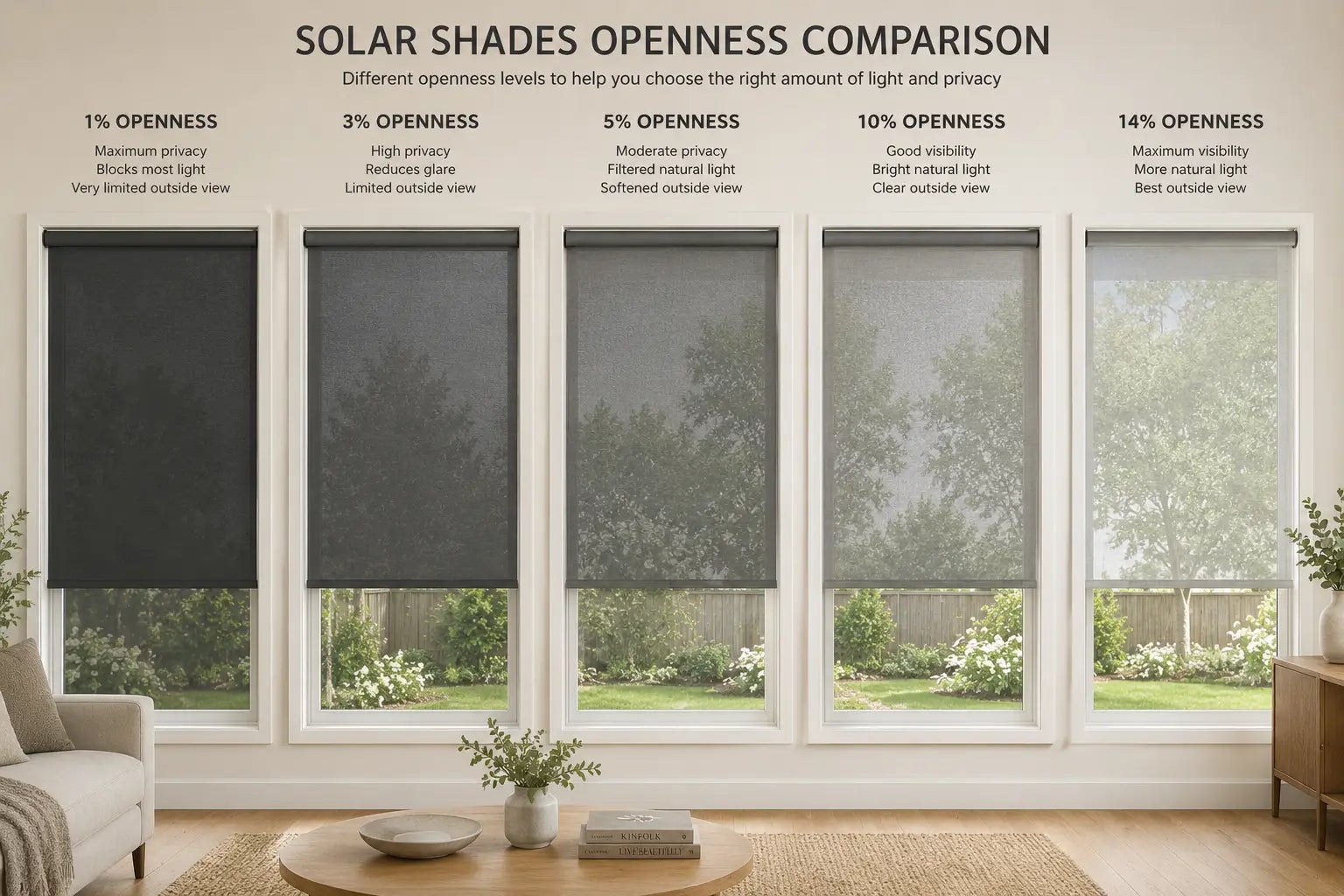
The right solar fabric blocks 94–99% of UV depending on openness factor. A 1% openness fabric blocks the most light and UV; a 5% openness fabric lets in more diffuse daylight while still blocking over 94% of UV rays. For sanctuary windows where the congregation wants to see the stained glass during daylight services, a 3% or 5% solar shade offers the best balance: UV protection when needed, full transparency when the shade is retracted. For more detail on how openness percentages affect performance, see our guide on roller shades fabric openness: 1% vs 3% vs 5% vs 10%.
For historical buildings with fragile or ornate wood trim, outside-mount brackets eliminate the need to drill into window frames. World Wide Shades offers outside-mount hardware specifically designed for situations where damaging original millwork is not acceptable. Review the considerations in our inside mount vs outside mount guide before specifying brackets for a restoration-sensitive building.
AV and Projection: Blackout Shades for the Sanctuary
Contemporary worship services increasingly rely on video projection, LED walls, and streaming cameras. Ambient light from windows directly behind or beside a projection screen washes out the image and forces projector brightness into ranges that shorten lamp life. A blackout roller shade—defined as 0% light transmission through the fabric—solves this completely.
True blackout performance requires both the right fabric and the right mounting approach. A blackout fabric with a poorly fitted side gap or a roller tube that doesn't sit flush against the headrail will still leak light around the edges. World Wide Shades offers cassette-style blackout shades with sealed side channels that eliminate edge bleed, which is the configuration appropriate for projection-critical windows. For sanctuary windows that don't face the projection screen directly, a light-filtering shade in the 3–5% range is usually sufficient and looks less institutional than full blackout.
Budget for sanctuary shades at $200–$600 per window depending on size, fabric, and whether motorization is included. A sanctuary with 12 large windows on motorized blackout shades could run $4,800–$7,200 in shades alone, before installation. That's a meaningful line item for a volunteer-staffed building committee, but spread across a 10–15 year product lifespan it amounts to roughly $320–$480 per year in capital cost.
Ready to spec sanctuary shades? Start your custom order in the World Wide Shades builder or request swatches of blackout and solar fabrics before committing to a fabric color or weight.
Fellowship Halls: Flexibility for Every Event
A fellowship hall hosts wildly different events—morning services, wedding receptions, funerals, children's programs, community dinners. No single light level serves all uses. The practical solution is a dual-shade system: a solar shade for daytime use that controls glare while maintaining a connection to the outdoors, paired with a blackout shade for events requiring full darkness.
Dual-shade systems on a single fascia are available through World Wide Shades and add roughly 30–40% to the shade cost versus a single shade, but they eliminate the need for supplemental drapes or portable screens. For fellowship halls with windows on multiple walls, coordinate fabric colors so the room reads as intentional rather than piecemeal. Warm neutrals—soft whites, warm grays, and sand tones—complement the wood tones and brick common in traditional church architecture. Cooler grays and whites tend to look clinical against warm masonry.
For very large fellowship hall windows—openings over 72 inches wide—consider specifying two shades side by side rather than a single wide shade. Single-shade widths above 96 inches require heavier hardware and create more torque on the roller tube, which shortens lifespan in high-cycle commercial applications.
Classroom and Sunday School Rooms: Child Safety First
Federal regulations enacted after 2018 under the WCMA (Window Covering Manufacturers Association) cordless standard require that all window coverings sold for use in residential environments be cordless or have inaccessible cords. Many churches apply this standard voluntarily to all rooms where children are present—classrooms, nurseries, and children's ministry spaces—because the liability and moral imperative are clear.
Cordless spring-loaded roller shades are the simplest compliant solution and are available in the full range of fabrics. For high-traffic classrooms where shades are raised and lowered multiple times per day, a motorized option with a simple wall switch is more durable and less prone to spring wear than a manual cordless. Budget $150–$350 per classroom shade for a standard cordless or motorized light-filtering roller in typical classroom window sizes (36–48 inches wide, 48–72 inches tall).
Classroom light control needs are different from sanctuary needs. Morning glare reduction is the primary concern, followed by the ability to darken the room for video presentations. A 3–5% solar shade handles the first requirement; if your classrooms show video regularly, specify blackout or add a blackout layer. World Wide Shades can configure dual shades for classrooms using the same dual-channel system used in fellowship halls, keeping the installation clean.
See how other educational facilities approach this in our post on best roller shades for schools and classrooms.
Motorized Shades for High Vaulted Windows
Vaulted sanctuary ceilings in the 12–25 foot range make manual shade operation impractical and often dangerous. Staff or volunteers would need ladders or lifts to raise and lower shades each service—an unacceptable operational overhead. Motorized roller shades with RF remote or wall switch control are the standard solution for high windows.
Battery-operated motors eliminate the need to run electrical conduit to each window, which matters in historical buildings where exposed conduit would be objectionable and concealed conduit would require costly plaster or masonry work. Rechargeable battery motors typically need recharging once or twice per year at normal church usage levels (2–5 shade cycles per week). Solar-powered charger panels can extend battery intervals to once every 12–18 months.
Hardwired motors are appropriate where new electrical is already being run as part of a renovation, or where the usage cycle is high enough that battery maintenance becomes burdensome. Hardwired systems also integrate more cleanly with building automation, allowing the A/V team to tie shade position to the lighting control system. Is motorization worth the premium? Our analysis of motorized roller shades: are they worth it covers the full cost-benefit breakdown.
Call World Wide Shades at (844) 674-2716 to discuss motorized options for vaulted windows—our team can help you spec the right motor torque for large, heavy shade assemblies that exceed the capacity of standard residential motors.
Fabric Colors That Complement Traditional and Contemporary Architecture
Color selection in a church context is more constrained than in a commercial office. Traditional buildings with warm brick, stone, natural wood trim, and stained glass in jewel tones need warm neutrals on the shades—cream, warm white, sand, taupe—rather than cool grays. A cool gray shade installed behind amber and ruby stained glass looks visually disconnected and draws attention to the shade rather than the glass.
Contemporary worship spaces with clean lines, concrete, and modern finishes can handle a broader palette, including cool whites, charcoal, and even deep navy or forest green for a deliberate design statement. In either case, the shade fabric should recede visually rather than compete with the architectural features of the space.
Sample fabrics before ordering. Large church windows involve shades with 15–40 square feet of visible fabric when closed, making the color and texture choice far more consequential than in a residential bedroom. Order free fabric swatches from World Wide Shades to evaluate colors in your specific lighting conditions before placing a bulk order.
For a deeper look at how fabric choices affect both aesthetics and performance, see our post on best fabrics for roller shades and our window shades color guide.
Tax-Exempt Purchasing and Budget Planning
Qualifying religious organizations are exempt from state sales tax on purchases in most U.S. states. World Wide Shades can process tax-exempt orders with a valid exemption certificate—contact us before placing a large order to set up your account correctly and avoid a tax charge that requires a refund process to correct.
Budget committees at volunteer-led organizations typically work in phases. A practical phasing approach: prioritize the sanctuary (highest impact, highest cost) in year one, fellowship hall in year two, and classrooms in year three. This spreads capital cost and allows the committee to evaluate actual performance before committing to the full scope.
Get a full project quote by contacting World Wide Shades with a window count, approximate sizes, and the zones you're prioritizing. For a phased project, we can hold fabric selection consistent across years so the finished building reads as a unified installation rather than a patchwork of separate orders.
Energy Efficiency and Acoustic Benefits
Churches often heat and cool large volumes of air with high ceilings and minimal insulation in the roof. Windows are a significant source of heat gain in summer and heat loss in winter. Solar shades with a low solar heat gain coefficient (SHGC) can reduce cooling loads meaningfully—independent testing shows 20–35% reductions in solar heat gain through windows fitted with exterior-equivalent solar shading.
For northern climates where winter heat loss is the dominant concern, a fabric with tighter weave construction reduces cold-air convection near the window surface. Our energy-efficient window shades guide covers the thermal performance data in detail and is worth reviewing before specifying fabrics for a building in a heating-dominated climate zone.
On acoustics: a fabric shade does not function as acoustic absorption in the engineering sense—you would not specify it in place of acoustic panels. But in a room with hard floor, hard ceiling, and glass on multiple walls, adding fabric coverage to the glass surfaces measurably reduces high-frequency reverberation. Several worship space acoustic consultants include roller shades in their recommendations as a low-cost contributor to a layered acoustic treatment plan.
Working with Historical Buildings
Historical buildings present unique constraints: fragile original trim, irreplaceable glazing, plaster walls that crack when drilled, and sometimes restrictions from historical preservation boards that limit visible modifications. Outside-mount roller shades address most of these concerns by attaching to the wall or ceiling rather than the window frame.
For plaster walls, toggle bolts rated for the shade's weight are appropriate where the plaster is sound. For deteriorated plaster, a wood backing strip attached with longer fasteners that reach the framing behind provides a stable mounting surface without damaging the plaster face. Avoid standard drywall anchors in plaster—the material behaves differently under load and anchor pullout is a common failure mode.
If your building is on a historical register or subject to preservation review, consult your state historical preservation office before installing any exterior-visible hardware. Interior-only modifications typically don't require review, but policies vary by jurisdiction.
Frequently Asked Questions
NFPA 701 applies to public assembly occupancies, which includes sanctuaries, fellowship halls, and any space where the public gathers. The authority having jurisdiction (your local fire marshal) enforces it and conducts periodic inspections. Churches should request fabric certification documentation—not just a vendor's claim—and keep it on file for inspections. World Wide Shades provides NFPA 701 test documentation with qualifying fabric orders.
For windows above approximately 8 feet, motorized operation is the practical choice. RF remote systems require no wiring changes and allow a single operator to control all sanctuary shades from floor level. For very large installations, World Wide Shades can integrate shade control with your existing A/V or lighting control system so shades respond to scene presets—one button press to set the room for a projection service.
Yes. Outside-mount roller shades attach to the wall surface above and to the sides of the window frame, not to the frame itself. With appropriate anchor selection for the wall material (plaster, drywall, or masonry), no fasteners touch the original woodwork. Ceiling-mount is another option that keeps all hardware completely off the walls.
Custom roller shades from World Wide Shades typically ship in 10–15 business days. For large phased projects, we recommend ordering each phase at least three weeks before the planned installation date. Call us at (844) 674-2716 to confirm current lead times, especially during peak seasons (spring and fall renovation periods).
Yes. World Wide Shades motorized shades are available with Z-Wave, Zigbee, and WiFi-enabled motors that integrate with most building automation and smart home platforms. For churches already using a Crestron or AMX A/V system, RS-232 or relay-based control is also available. See our guides on smart home motorized shades setup and motorized shades with Alexa and Google Home for integration details.
Volunteers with basic carpentry skills can install standard roller shades on windows up to about 10 feet. Above that height, the combination of ladder safety, heavy hardware, and the precision needed for level installation makes professional installation advisable. Motorized shades on high windows should always be installed by a professional who can verify the motor wiring and torque settings. For cost comparisons, see our how to install roller shades guide for a realistic picture of what DIY installation involves.