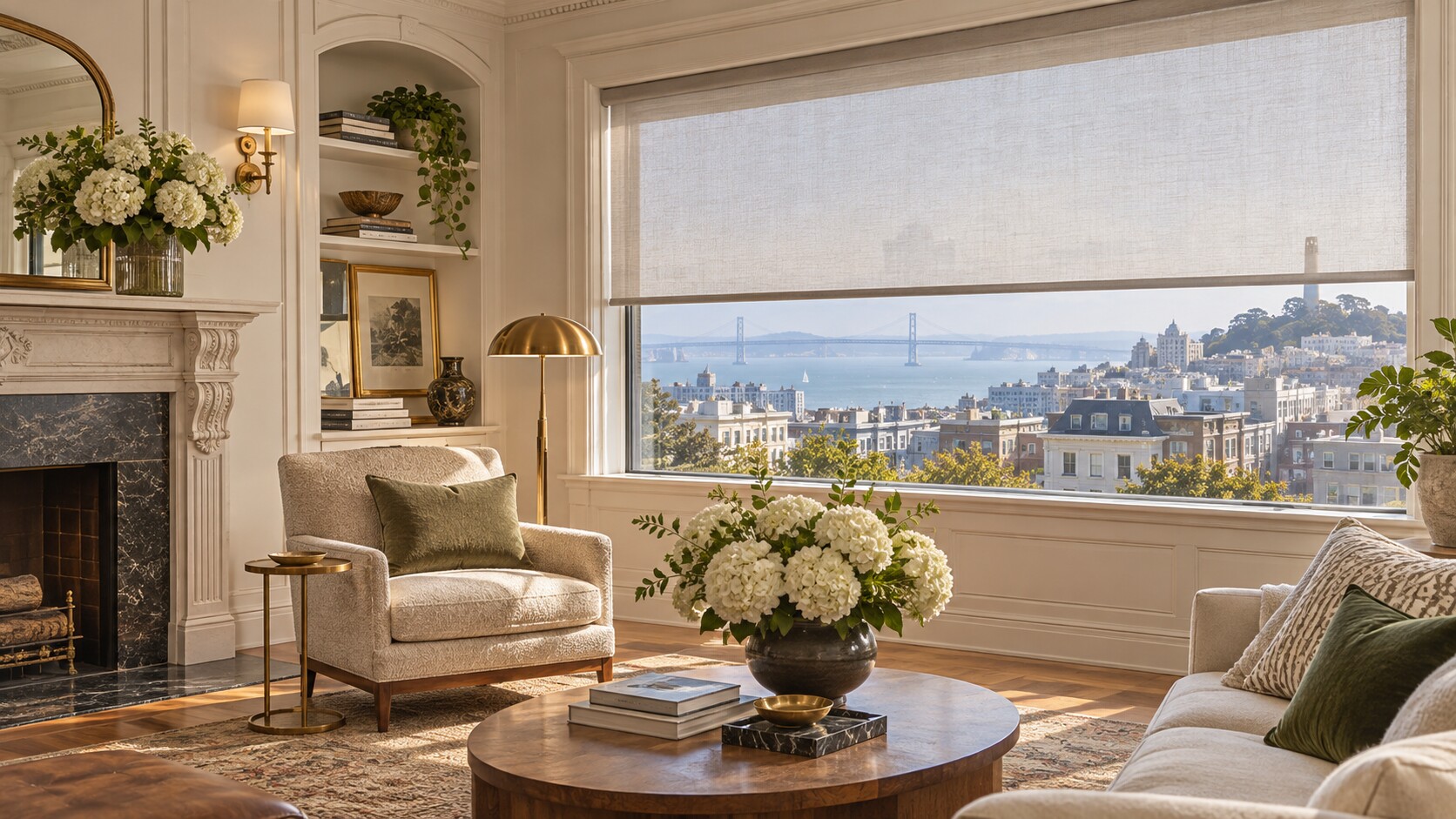
The point of shading a bay-facing window is to make the room more comfortable without losing what drew you to the window in the first place. If you’re shopping for custom roller shades in Pacific Heights, San Francisco, start by deciding where you still want to see the water with the shades down. Then identify where you would trade some or all of that view for a more comfortable place to read, work, or sleep.
The right fabric can differ from one window to the next, even in the same room. A solar screen might make sense on a picture window you look through all day, while a privacy-focused material serves a window beside a dining table you use after dark. You can browse World Wide Shades fabrics with those two jobs in mind rather than looking for one fabric to do everything. For comparisons involving distinct city homes and window styles, see the Palm Beach estate shade guide and Chicago Gold Coast condo guide.
How much of the bay view do you want to keep?
A solar screen has openings in its weave that let you see through it to varying degrees. The openness factor is the percentage of the fabric’s area made up of those openings. A more open weave generally preserves more of the view under similar lighting, while a tighter weave is a better starting point if the brightness outside competes with a book, a television, or a laptop. Openness is not the same as overall light transmission, so don’t buy on the percentage alone.
Think about which details you don’t want to lose. If all you need is the line where the water meets the sky, you may be happy with a tighter weave than someone who wants to watch boats from the sofa. Also consider the angle: the view from the chair by the glass may differ from what you see across the room. Do the comparison from the places you normally sit, not just standing squarely in front of the window.
Fabric color changes the effect, too. A darker solar screen may make the view easier to read when there’s more light outside, while a pale screen may better suit a room where you want the shade to blend with the trim. World Wide Shades offers 500+ colors across 40+ fabric families, with mill-published openness factors and genuine fabric photos. Shortlist by openness first, then use the photos to compare color and texture. The roller shade fabric guide and window shade color guide can help you narrow the choices.
Daytime visibility is not nighttime privacy
A screen you can see out through by day is not necessarily one you can count on for privacy after dark. In daylight, with the exterior brighter than the room, the view outward may be clearer than the view inward. Turn on the lights after sunset and the balance can change. Depending on the fabric and lighting, someone outside may see movement, silhouettes, or more detail than you expect. A tighter screen can change how much is visible, but a low openness figure alone is not a privacy guarantee.
Decide how much that matters at each window. A living room where the main aim is to keep the bay visible may be a reasonable place for a screen if evening privacy isn’t a priority. For a street-facing window where you sit with lights on, consider a light-filtering roller shade that gives up a defined view for softer daylight. Compare the individual fabrics rather than assuming that every light-filtering fabric hides silhouettes equally well. The light-filtering shades guide explains what to look for, while the Beacon Hill roller shade guide discusses a different balance between window character and privacy.
If darkness or evening privacy is the priority, compare blackout roller shades instead. Blackout describes what the fabric does, not what happens at the edges of the finished shade. Light can still enter around the sides of an inside-mounted roller shade; outside mounting with overlap can help if the trim and surrounding wall allow it.
Match the shade to the room and the hour
Look at each pane during the hours you actually use the room. If bright light affects the reading chair in late afternoon but not the rest of the room, you could choose a tighter screen on that opening and keep a more open weave where the view is the priority. If visually matching a bank of windows matters more, choose one fabric that works for the brightest opening and raise the shades where you don’t need them. The guide to shades for south-facing windows is useful if you’ve confirmed that exposure, but the way the light falls in your own room is more useful than guessing from the address.
Think about furnishings separately from the view. If direct sun reaches a rug, artwork, or upholstery, notice when it happens and decide whether you’re willing to leave the shade down during that period. The guide to UV protection and window shades covers the fabric considerations for a room where protecting finishes is another priority.
In a home office, check what happens when you open the laptop or start a video call. If the bright window is reflected in the display, a tighter screen may be a better trade than the most open fabric on your shortlist. If a window behind you is the main source of brightness in calls and the view is secondary, try a light-filtering fabric there instead. For ideas when the same room has to serve guests, see the home office and guest room shade guide.
Bedrooms are a good place to be deliberate about giving up the view when the shade is down. If you want the bay at breakfast but want privacy and a darker room at bedtime, prioritizing blackout and raising the shade when you wake may work better than trying to find a screen that does both. World Wide Shades makes each shade to order, so there’s no need to specify the same fabric in the bedroom and living room. For another room-by-room approach, see the guide to custom roller shades for Boston’s Beacon Hill homes.
Choose a mount that works with the opening
An inside mount keeps the shade within the opening and leaves the surrounding trim visible. World Wide Shades requires at least 1.5 inches of frame depth and recommends 2.5 inches for motorized shades. If you have enough depth, measure width at the top, middle, and bottom and use the narrowest reading; for height, use the tallest reading from the left, center, and right. Enter the exact opening measurements rather than deducting clearance yourself. The factory makes its own deductions.
If the frame is too shallow, choose an outside mount. Plan for 2–3 extra inches on each side and 3 inches above the opening, where the surrounding surfaces allow. That overlap is especially worth considering where privacy or edge light matters. If trim, handles, or nearby cabinetry limit the available space, resolve that before ordering rather than assuming the same mount will work on every window in the room.
You can set up your mount and dimensions in the World Wide Shades builder and see live pricing for the configuration you’re considering. If you’re deciding between an inside and an outside mount, contact World Wide Shades or call (844) 674-2716 before ordering to discuss the opening.
Decide how often you’ll adjust the shades
Motorization makes the most sense on windows you’ll adjust frequently or can’t reach comfortably. If you want a clear view over coffee, less glare in the afternoon, and an unobstructed window again when the light shifts, think about how easy it will be to make those adjustments. A window near the sofa and a high opening across the room don’t have to use the same control.
World Wide Shades motors use rechargeable batteries and require no wiring. Automate is the default; if you already own a Somfy remote, you may choose a paired Somfy motor. A remote is required, and the Automate Push 5 remote controls up to five shades. For Automate, the optional Pulse 2 hub adds app control, voice control, and scheduling. There’s no charger in the box, so use a USB-C charger you already own or add the Motor Charger when you configure your order.
Explore motorized shades if adjusting several windows is part of your daily routine. If you’re buying the hub for a specific feature, the motorized shades guide for Alexa and Google Home is a useful read before you settle on the control setup.
Review the complete configuration before ordering
Go back through your choices by window, especially if similar openings will get different fabrics. Read the specification alongside the fabric photo: openness tells you about the weave, while the photo helps you evaluate color and texture. Neither can show exactly how bright the room will feel at a given hour, so use the photos to narrow the choice and your own observations of the room to make the final call.
World Wide Shades roller shades are 100% hand-custom-made in the USA. U.S. shipping is free, and delivery is typically 2–4 weeks, or 3–4 weeks for limited-stock fabrics and specialty shapes. Custom orders are nonreturnable. Manufacturing defects are eligible for a free remake within 30 days, with one year for motors. If you mismeasure, a one-time free recut is available and you pay the shipping. Those terms are worth reading before you place a multi-window order, particularly if two openings look identical but measure differently.
Frequently Asked Questions
A more open solar screen is a reasonable starting point when a view matters, but the result depends on fabric color, lighting, and your own position in the room. Compare the mill-published openness factor for each fabric rather than assuming all screens look alike.
They should not be treated as a nighttime privacy solution. When the interior is brighter than the exterior, a light-filtering or blackout fabric may be a better fit for exposed windows.
Use the narrowest width from the top, middle, and bottom measurements and the tallest height from the left, center, and right. Enter the exact opening dimensions; the factory makes the deductions.
Rechargeable battery motors need no wiring, and a remote is required. Automate is the default; the Automate Pulse 2 hub adds app, voice, and schedule features for Automate motors.
Most deliveries take 2–4 weeks after order, while limited-stock fabrics and specialty shapes take 3–4 weeks. Free shipping is available within the US.
Ready to Order?
Start with the window where the bay view matters most. Once you’ve chosen how much view you want to keep there, the decisions for the rest of the room are easier to make.
- Measure the opening for the inside or outside mount you’ve chosen.
- Select a fabric based on the view, glare, and evening privacy you need at that window.
- Choose a control and, if motorized, confirm your remote and charging setup.
- See live pricing in the World Wide Shades builder with your exact configuration.
- Review the details for each opening and place your order.
If you’re torn between two fabrics or control options, contact World Wide Shades or call (844) 674-2716 before you order. Have the window’s dimensions and the hours you use the room on hand so the conversation can focus on the choice that matters.