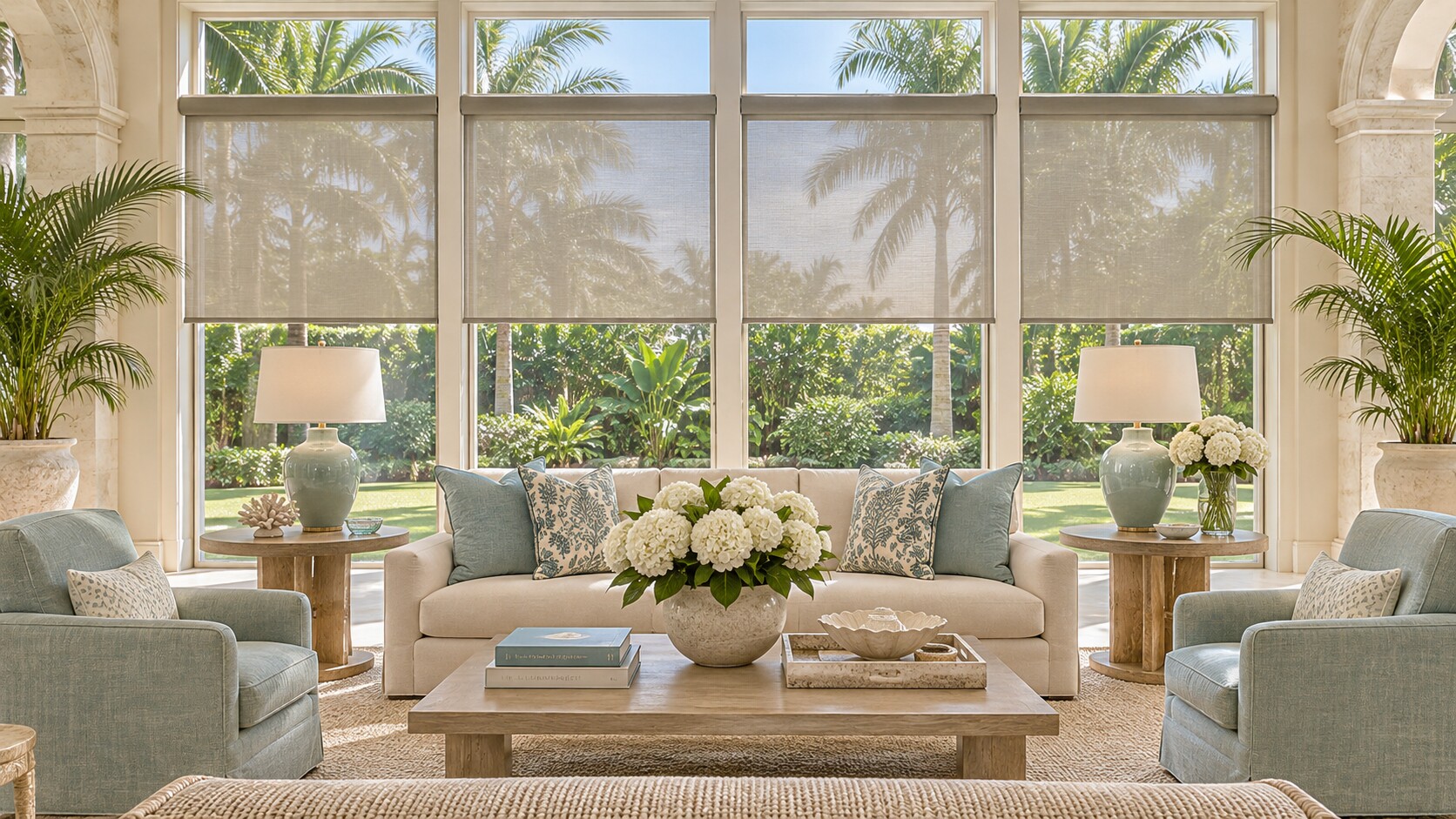
The best custom shades for Palm Beach estate homes preserve the views that drew you to the house while making bright rooms more comfortable to use. An open solar screen might suit a sitting room overlooking the garden, but the same fabric may leave a bedroom exposed at night. Start with what each room needs at the hours you use it, then coordinate fabrics, mounts, and controls across adjoining spaces.
With World Wide Shades, you can start in the custom shade builder with one representative window. Use it to narrow down a fabric, mount, and control before repeating those choices across a wall of windows.
Plan for daylight, views, and privacy by room
Treat a room's most demanding hour as the starting point. In a waterfront sitting room, the priority may be keeping the outdoor view while softening glare on pale upholstery or polished surfaces. At a breakfast table, it may be reducing direct brightness at eye level. And in a front-facing study used after dark, an uninterrupted view out may matter less than keeping the room private when the lamps are on.
- Living and dining rooms: Consider solar fabric on windows with views worth preserving. Where the room faces an arrival court or an active terrace, think through what guests can see from outside in the evening before using the same fabric on every wall.
- Studies and multipurpose rooms: Choose for the position of the desk or screen, not just the direction of the window. A light-filtering fabric can replace a clear view with softer daylight, while a tighter solar weave may suit a workspace where retaining some view still matters.
- Bedrooms and media rooms: Start with blackout when sleep or screen viewing is the priority. Blackout describes the fabric, not the whole installation: light can still enter at the edges, so the mount and coverage deserve as much attention as the fabric.
Look at a continuous window wall from inside at seating height and from the next room. Keeping the same fabric on adjacent openings brings consistency, while different choices in separate rooms can solve functional problems without disrupting that rhythm. The guides to south-facing window shades and home office and guest room shades offer examples for rooms with distinct demands. If the design includes tall or broad glazing with original casing, compare the advice in Boston Beacon Hill homes; for a different view-first approach, see Chicago Gold Coast condos and Pacific Heights homes.
Compare solar, light-filtering, and blackout fabrics
Opacity tells you how transparent a fabric is and helps distinguish a sheer view, diffused daylight, and a fabric that blocks light through its surface. Openness factor is more specific: it describes the share of a woven solar fabric made up of open spaces. A more open weave generally preserves more view, while a tighter weave generally reduces the view and helps temper glare. Openness is not the percentage of visible light, heat, or UV that a shade blocks.
Compare fabric color and weave together. A dark solar fabric can make the outdoor view easier to read in daylight, while a pale fabric can recede into light trim or walls but appear brighter in strong sun. If the distinction could change your choice, take note of whether the shade will be seen against bright glass or against a darker room. For more on how to weigh sun exposure and fabric specifications, see the guides to UV protection window shades, energy-efficient window shades, and roller shade fabrics.
For privacy, consider which side of the glass is brighter. Solar fabric that softens the view into a house during the day can reveal more of the room when the lights are on after dark. Choose light-filtering if you want daylight without a clear view, but keep in mind that some fabrics can still show silhouettes. If obscuring the interior at night is the priority, start with blackout and plan for the edges.
Consider a dining room with garden-facing glass on one side and a clear sightline from the approach on the other. If the walls read separately from the main seating area, you might choose solar fabric for the garden view and a light-filtering fabric for the approach, provided silhouettes aren't a concern. If the windows read as one composition, settle on which matters more for the whole room: the view at lunch or privacy at dinner. That gives you a better basis for choosing one fabric than comparing swatch photos alone.
World Wide Shades offers 500+ colors across 40+ fabric families, with blackout and light-filtering options from Phifer, Mermet, Ferrari, Copaco, Senbesta, and Texstyle. Browse World Wide Shades fabrics to compare genuine swatch photos and mill-published openness factors where applicable. There is no swatch or sample program, so use the photos to judge weave and narrow the palette without treating a screen image as an exact color match to the room.
Specify the mount around the architecture
An inside mount keeps the shade within the window opening and leaves the surrounding trim visible. It's worth considering when the casing is part of the design and there is sufficient depth. An outside mount extends beyond the opening and gives you more control over coverage at the top and sides. It can also unify the look of openings with different trim depths when there's a clear mounting surface above them.
On a broad window wall, decide where shade breaks should fall before settling on individual panel widths. Aligning where possible with existing mullions makes separate shades feel like part of the window rather than a second grid. Consider whether each section needs to move independently: a glare-prone end of a room can be shaded while the rest stays open. Check the proposed coverage against adjacent walls, doors, or trim, especially if an outside mount extends beyond the opening.
For an inside mount, World Wide Shades requires a minimum depth of 1.5 inches and recommends 2.5 inches for motorized shades. Use the narrowest of the top, middle, and bottom widths and the tallest of the left, center, and right heights. Enter the exact opening dimensions and let the factory make its deductions. For an outside mount, plan to add 2–3 inches on each side and 3 inches above the opening, where surrounding finishes allow.
If you're choosing between mounts on a prominent window wall, contact World Wide Shades or call (844) 674-2716 before finalizing the order. Have the room's main priority in mind, whether that's showing the trim, limiting edge light, or maintaining consistent coverage across adjacent windows.
Choose motorization for how rooms are used
Motorize the shades you expect to adjust often or that will be awkward to reach. In a long living room, keeping the shade closest to a television down in the afternoon doesn't have to mean closing the entire room. Think through the groups you will actually use, such as the seating windows together, the dining windows separately, and bedrooms kept out of common-area controls.
World Wide Shades offers rechargeable-battery motors that don't require wiring. Automate is the default. A remote is required, and the Push 5 controls up to five shades. If you have a larger room, count its individual shades before assuming one Push 5 will cover the entire room. A Somfy motor is available only to customers who already have a Somfy remote, and the motor is paired with that remote.
If you want app control, voice control, or schedules, the Automate Pulse 2 hub adds those functions for Automate motors only. A schedule can suit a bedroom that should stay shaded until a set time, while remote control makes sense for the sitting room where you adjust shades as needed. The hub does not remove the remote requirement. A charger isn't included with the shades; use any USB-C charger or add the Motor Charger when ordering.
Compare World Wide Shades motorized shades before choosing a remote or hub. For more detail on the connected options, read the guides to Alexa and Google Home shade control and smart-home shade setup.
Review the room plan before placing the order
Give each opening a room name and position, then keep the corresponding fabric, mount, and control choices together. For a set of windows that are meant to look alike, review the selections side by side instead of assuming the last window matches the first. This is also the moment to decide which rooms should share a fabric family or finish and which have a good reason to differ. The Beacon Hill roller shade guide offers another perspective on coordinating shades with prominent window trim.
If the designer is specifying the fabrics and the homeowner is placing the order, agree on the fabric name and color, not just a description like warm white. For motorized rooms, note which shades should move together and which should stay independent. This way both people are reviewing the same selections before the order is placed.
World Wide Shades makes each shade by hand in the USA and offers free US shipping. Delivery takes 2–4 weeks; allow 3–4 weeks for limited-stock fabrics and specialty shapes. If the shades need to arrive around another part of the project, consider the longer window when choosing those options.
Custom orders are nonreturnable. World Wide Shades remakes defects free within 30 days; the motor has a one-year defect window. A mismeasurement qualifies for one free recut, with the customer paying shipping. Before ordering, check that the builder entry matches the intended mount and the correct window, especially if two nearly identical openings have different dimensions.
Frequently Asked Questions
Do not rely on a solar screen alone for nighttime privacy. A room lit from inside can be more visible from outside, so compare light-filtering or blackout fabrics where evening privacy matters.
The mill-published openness factor describes the fabric's weave and helps compare how open different solar fabrics are. It is a specification to consider with color and room lighting, not a guarantee of a particular view.
Not necessarily. A consistent fabric can make a continuous window wall feel unified, while bedrooms or rooms with different privacy needs may warrant a different opacity.
World Wide Shades motorization uses rechargeable battery motors and does not need wiring. A remote is required; the Automate Pulse 2 hub adds app, voice, and schedule functions only with Automate motors.
Delivery is 2–4 weeks from order, or 3–4 weeks for limited-stock fabrics and specialty shapes. Include that window in your project schedule before choosing the final options.
Ready to Order?
Finalize one room at a time, then review the full set for any differences you didn't intend. If a fabric, mount, or control choice still needs a second look, contact World Wide Shades or call (844) 674-2716 before submitting the order.
- Measure: Record each opening using the method for the intended mount.
- Choose fabric: Match the fabric to daylight, views, and nighttime privacy.
- Choose control: Select the remote and decide if your Automate shades need the hub.
- See live pricing: Review your selections and see live pricing in the builder.
- Order: Confirm the fabric, dimensions, and control for each opening, then submit your order.