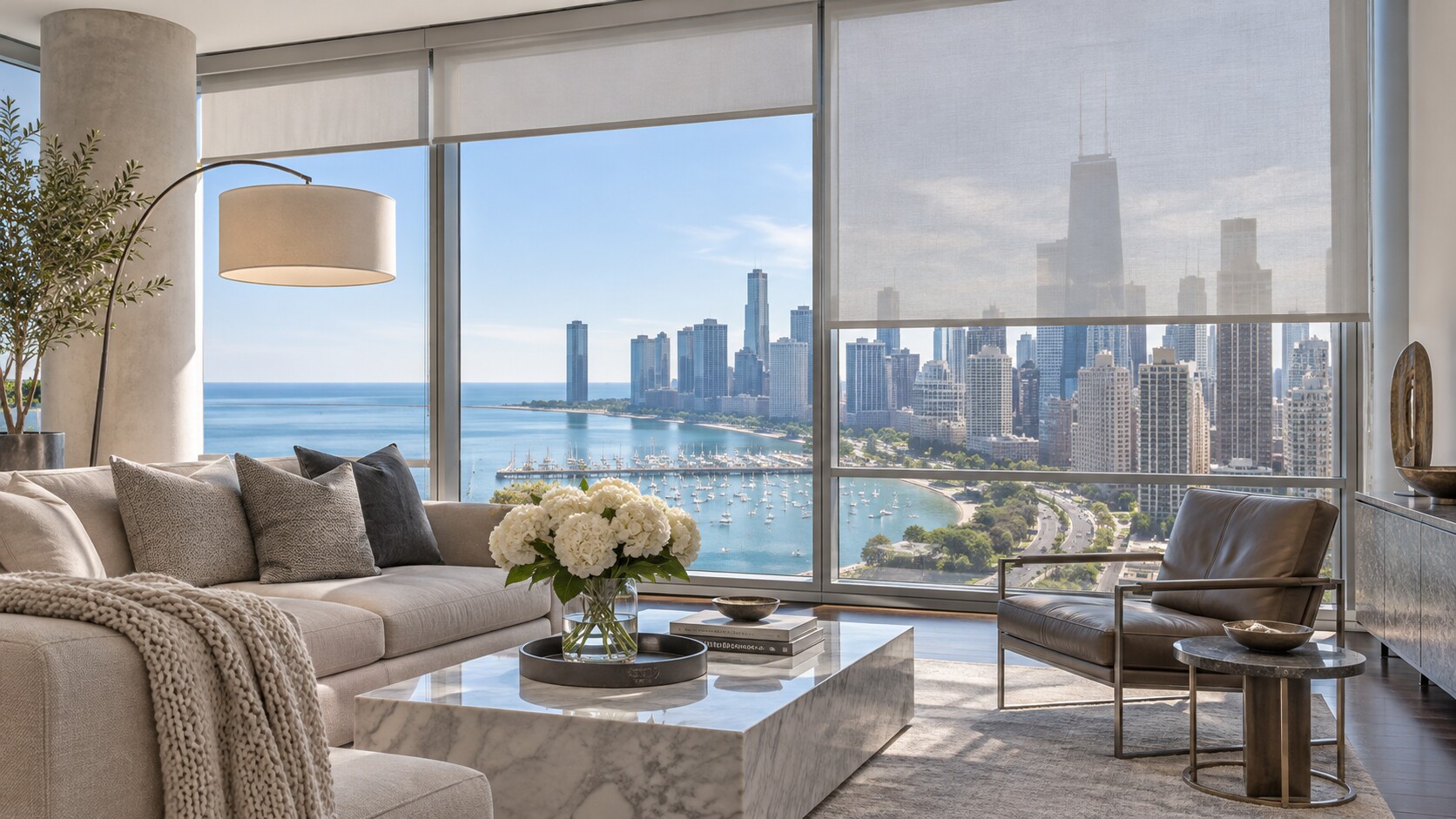
The best custom shades for Chicago Gold Coast condos preserve the view when you want it and give you privacy when you need it. In a lake-facing living room, that might mean a solar screen on the windows you look through most and a denser fabric where reflections catch the television. In a bedroom facing a neighboring tower, privacy after dark is a better starting point than the daytime view.
Start by deciding what you want to happen when each shade is down. Should you still see the horizon? Should the room feel bright without a clear view in? Or should the fabric block light so you can sleep? Those answers will narrow the field faster than picking a color first. Browse World Wide Shades fabrics to compare published openness factors where applicable and see genuine swatch photos before settling on a palette.
Start with the view you actually use
Think about where you sit, not just how the windows look when you walk in. At a low sofa, a band of bright sky may be right in your line of sight. A desk may face the same glass but put the brightest window behind your monitor. The dining table might be comfortable until a different exposure catches late light. Each is a reason to shade a specific window, not necessarily the whole room.
For a corner living room, first identify the panes that frame the view from your main seat. If that view matters throughout the day, start with a screen fabric on those panes. On the adjoining wall, decide whether there is a particular window you would rather shade more heavily at certain hours. Separate controls can be just as useful as a second fabric: one side can come down while the other stays open.
If you want the window wall to read as one composition from inside the room, consider using the same fabric across the main bank and operating it in smaller groups. That can be a better fit than alternating fabrics across adjacent panes, where differences in brightness and texture may be obvious. For a broader comparison of fabric types, see the roller shade fabric guide. The south-facing window guide is useful if your sunniest windows face a different direction from your best view.
Read openness as a spec, not a promise
Openness factor is a mill specification that describes the percentage of open area in a woven screen fabric. A 3% screen has less open area than a 5% screen. That makes openness a useful starting point for comparing similar fabrics, but it isn't a percentage of light blocked, a privacy rating, or a measure of how much of the lake you'll see.
When comparing two screens, look at color and openness together. A darker weave often makes it easier to pick out outdoor details in daytime because the fabric itself is less visually prominent against the bright exterior. A lighter weave can look quieter against pale walls, but it may look brighter when sun strikes it. How either feels in your condo also depends on the angle of the light and whether you're looking toward clear sky, bright water, or the wall of another building. For more on making those comparisons, read the roller shade fabric guide and shade color guide, plus the UV protection guide for furnishings near bright glass.
World Wide Shades offers more than 500 colors across more than 40 fabric families. Compare fabrics in the catalog with two choices in mind: what works on your primary view windows and what works in rooms that need more screening. A genuine swatch photo helps you compare texture and tone, but it can't show exactly how a fabric will look against your glass on a bright afternoon.
Choose privacy for the hours you need it
A solar screen is a sensible first comparison when the view is part of why you use the room. The choice isn't always between living with glare and closing off the entire view. If only the window nearest the television is causing reflections, shading that pane independently may solve the immediate problem while leaving the rest of the view open.
After dark, the balance changes. A screen that feels private by day can allow someone outside to see in when the room is lit and the exterior is dark. If nighttime privacy matters across the entire living room, don't rely on screen openness alone. Consider a privacy-oriented fabric instead, or decide whether the view windows and the windows with direct sightlines into the room warrant different treatments.
Privacy-oriented light-filtering fabrics are worth comparing where you'd like daylight without a distinct view through the cloth. Light filtering doesn't necessarily mean opaque, though. If a nearby window looks directly into your dining room, consider whether visible silhouettes at night are acceptable, especially when seated close to the glass or with a pendant light on.
Explore World Wide Shades light-filtering shades if your priority is diffused daylight rather than a clear view. The light-filtering shade guide can help you compare the effect with the more view-oriented options you're considering elsewhere in the condo.
When sleep and nighttime privacy come first, start with a blackout fabric. The fabric blocks light through the cloth, but the finished room isn't guaranteed to be dark: light can still pass around the edges of the shade. Think about whether a room's layout puts those edges in your line of sight from the bed. A clean inside mount and an outside mount with more coverage are different choices, especially where early light reaches the bed directly.
A guest room that doubles as an office can pull you in both directions. A shade that helps a guest sleep may be more coverage than you want during work hours, while a screen selected for video calls may not provide the privacy a guest expects. If two windows have different jobs, you don't have to give them identical fabric. See the home office and guest room guide for ways to divide those priorities, and compare the light and privacy decisions in energy-efficient window shades and light-filtering shade guidance.
Plan controls around how the rooms are used
Choose control groups before placing the order. In a corner living room, it may make sense to put lake-facing shades on one channel and the side exposure on another. Bedroom shades can stay independent so someone can leave them down while the rest of the condo opens up. If you regularly lower one shade for calls or to keep glare off a screen, it's worth giving that shade an independent channel rather than making the entire bank move with it.
World Wide Shades motorized shades use rechargeable battery motors and don't require wiring. Automate is the default; Somfy is paired only if you already have a Somfy remote. A remote is required, and the Push 5 controls up to five shades. On Automate, the Automate Pulse 2 adds app, voice, and schedule options. A charger isn't included, so plan to use a USB-C charger or add the Motor Charger when you order.
Also think about reaching the shade for charging, particularly if it's above a sofa, a deep console, or a fixed piece of furniture. If you're ordering several shades, compare motorized options and call World Wide Shades at (844) 674-2716 to talk through which windows should operate together and which should stay independent.
Decide how the shades should sit against the architecture
An inside mount can keep the shade visually contained within the opening, which may suit a room where you want the window trim to remain visible. It needs at least 1.5 inches of mounting depth; World Wide Shades recommends 2.5 inches for motorized shades. If depth is limited, an outside mount may be the better option. It also gives you the opportunity to extend the shade past the frame when coverage matters more than keeping the trim exposed.
Check your condo's written window-treatment requirements before finalizing the order, especially if there is a specified street-facing appearance. Don't assume each opening has the same depth or clearance just because the windows look alike. A handle, a shallower return, or a tight corner can change which mount makes sense. For another perspective on coordinating roller shades with the architecture of a high-end home, see the Pacific Heights roller shade guide, the Boston Beacon Hill guide, and the Palm Beach estate guide.
Open the shade builder once you know which openings can use the same configuration. Compare live pricing on your primary window group first, then look separately at any bedrooms or side exposures that need a different fabric, mount, or control. This keeps the order tied to how you'll use the rooms rather than forcing every window into one specification.
Frequently Asked Questions
A more open solar screen is a useful place to start if keeping the view is a priority. Compare the mill-published openness factor and fabric color, then consider how the shade looks from inside at the times you use the room.
Not reliably. A screen that feels private in daylight may show more of a lit room at night, so consider a light-filtering or blackout fabric for windows where evening privacy matters.
World Wide Shades requires at least 1.5 inches of mounting depth and recommends 2.5 inches for motorized shades. If a frame is shallower, an outside mount may be the better choice.
The Push 5 remote can control up to five shades, and a remote is required for motorized shades. Automate motors can also use the Automate Pulse 2 hub for app, voice, and schedule features.
Custom shades generally arrive in 2–4 weeks from order. Limited-stock fabrics and specialty shapes require 3–4 weeks.
Ready to Order?
- Measure each opening and confirm whether you're ordering an inside or outside mount. For an inside mount, enter the exact opening dimensions so the factory can make the deductions.
- Choose the fabric for each window group based on the view you want to keep, the glare you need to manage, and your nighttime privacy needs.
- Choose the control for each shade, including which motorized shades you want to operate independently and which you want to move together.
- Enter those choices in the World Wide Shades builder to see live pricing for your configuration.
- Review the dimensions, mount, fabric, and controls for each window, then place your order.
World Wide Shades makes each shade by hand in the USA, with free US shipping. Delivery is typically 2–4 weeks, with specialty or limited-stock fabrics taking 3–4 weeks. Custom orders aren't returnable, so it's worth resolving any open questions about privacy, mounting depth, or controls before submitting your order.
If you're deciding between two fabrics for the main window wall or have a question about the order, contact World Wide Shades or call (844) 674-2716. Have the room names and your preferred fabric options handy so you can talk through the choices window by window.