Make the Mirror Useful Without Losing the Windows
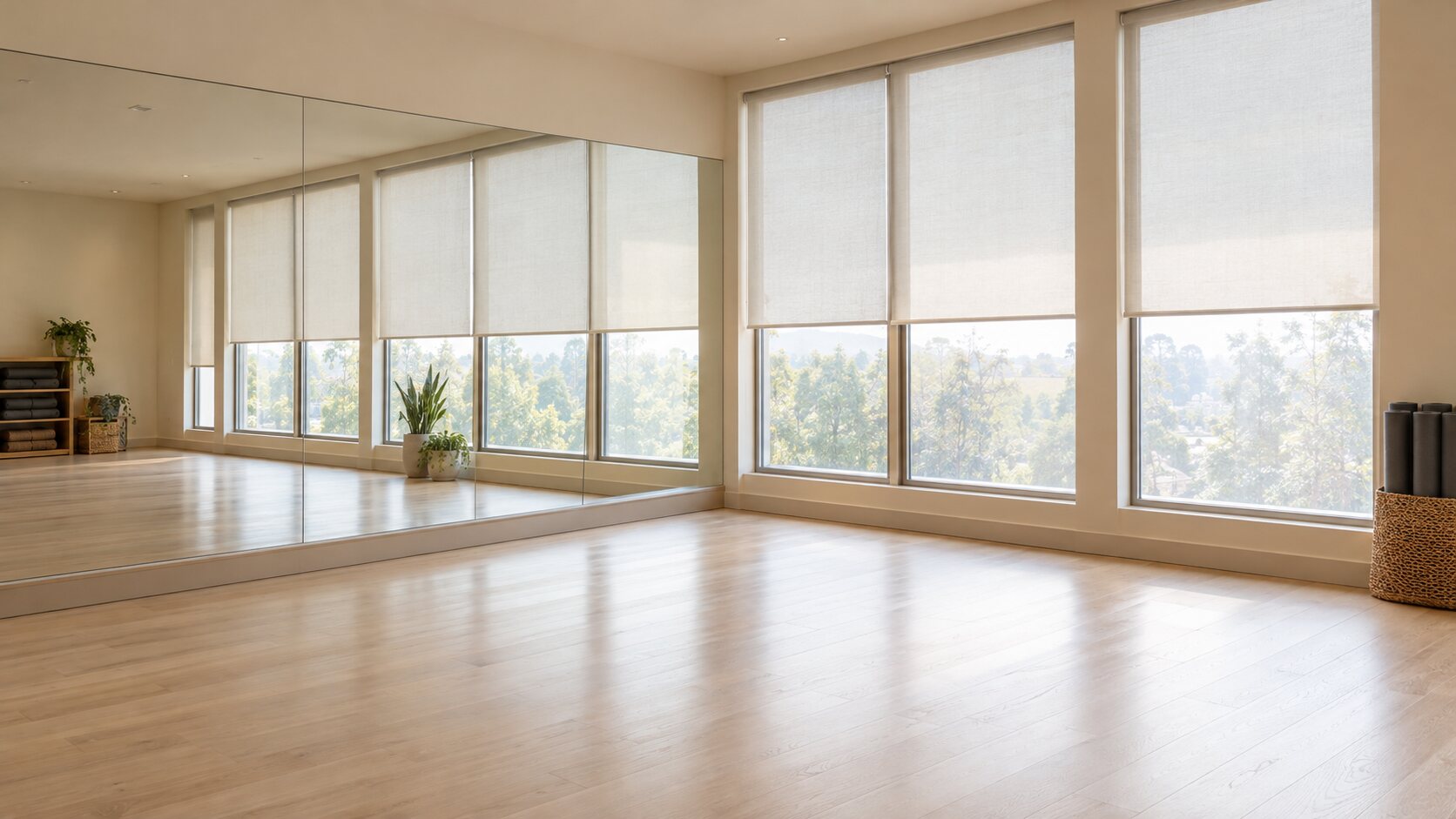
A bright yoga studio can feel welcoming until a window appears as a dazzling rectangle in the mirror. The challenge is not always too much daylight throughout the room. Sometimes it is one bright reflection exactly where an instructor or student needs to look.
The useful starting point is a design goal: soften troublesome light while keeping enough daylight for the class experience you want. World Wide Shades recommends comparing shade fabrics in the actual room rather than choosing from a photograph alone. Window orientation, mirror placement, class times, and interior lighting all belong in that comparison.
For an initial fabric shortlist, request World Wide Shades swatches and plan to view them during your brightest scheduled class. Include both a light-filtering fabric and a solar-screen option so you can compare different approaches.
Follow the Light From Window to Mirror
Start by separating a direct sunbeam from a bright window reflection. A moving patch of sunlight on the floor suggests direct sun is entering the room, while a large luminous rectangle in the mirror points toward the window itself as the reflected source. Both can occur at once.
Think about when the room becomes uncomfortable, not simply which direction the windows face. The Department of Energy notes that controlling heat and glare is trickier at east- and west-facing windows than at north- and south-facing windows. (DOE natural light and daylighting guidance)
Use the class calendar as your observation schedule. A sunrise flow, lunchtime session, and evening class may require different shade positions, so record where bright patches and reflections appear at those times. Repeat the review as the seasons change instead of treating one afternoon visit as a complete picture.
For orientation-specific planning, read the guide to shades for south-facing windows. Treat it as a starting point, then compare its recommendations with your studio’s actual exposure.
A mirror redirects light; it does not have to face a window straight on to show that window to someone across the room. Imagine the path from a bright source to the mirror and then toward the viewer. Changing the viewer’s position changes which part of that reflection becomes visible.
Inspect the mirror from the instructor’s usual position and several student locations. Include standing, seated, and floor-level viewpoints because a reflection that is unobtrusive during standing poses may become distracting during mat work. Do not assume one comfortable viewpoint represents the whole class.
Avoid tilting or modifying large installed mirrors as an informal fix. Begin with reversible adjustments to shades, mat placement, and lighting; leave mirror alterations to the appropriate installation professional.
If the studio has deeply recessed windows, also review roller shades for deep window wells, since the recess can affect mounting choices and the visible coverage at the mirror.
Choose Fabric for the Reflection You Need to Control
World Wide Shades suggests defining the priority before comparing colors: preserve an outdoor view, diffuse incoming light, or block a specific direct beam. These goals overlap, but one fabric may not satisfy all of them equally.
Solar-screen openness describes the open portion of the weave, but it is not a universal prescription for yoga studios. Compare manufacturer information alongside the sample’s appearance, because openness alone does not describe every aspect of visible light, color, or privacy.
If a sample leaves a conspicuous window outline in the mirror, consider a more restrictive option. If it makes the studio feel too enclosed, compare a different weave or a layered arrangement. There is no single openness percentage that is right for every exposure, mirror wall, or class schedule.
Test each candidate while looking both toward the window and into its reflection. A fabric can feel acceptable when viewed directly yet leave a reflection that dominates the mirror. The roller shade fabric selection guide can help organize that comparison.
A light-filtering fabric is worth considering when the goal is softer daylight rather than a sharply defined view outdoors. Compare it against a solar screen at the same window and shade position. Look for the option that makes the mirror useful without making the rest of the studio unnecessarily dim.
Include light and dark samples instead of assuming a white shade will be the least noticeable. Judge the window’s brightness against adjacent walls, the mirror image, and the studio finishes. For help coordinating those choices, use the window shade color guide alongside physical samples.
Review the light-filtering shades guide before narrowing the selection. Then contact World Wide Shades or call (844) 674-2716 to discuss which samples best fit your daylight and mirror concerns.
Use Layers When One Setting Cannot Serve Every Class
A studio that hosts bright morning movement and quieter evening sessions may benefit from two independently operated shade layers. Consider a daylight-managing layer for regular use and an opaque layer for times when stronger light exclusion or privacy is the priority.
Ask what each layer needs to accomplish before choosing hardware. Closing the opaque layer may solve a troublesome direct-beam condition, but it also sacrifices daylight and can require more electric lighting. Keeping both layers available lets the instructor make that tradeoff deliberately.
Do not equate an opaque fabric with a completely dark room. Review potential light paths around the shade edges and between adjacent shades, particularly where a narrow bright opening could appear in the mirror. The guide to roller shade bracket gaps and uneven walls addresses details worth discussing before installation.
World Wide Shades can help you compare a single-fabric approach with a layered concept. Explore shade options in the builder, then keep the final fabric choice open until you have evaluated samples in the studio.
Check Electric Lighting Before Blaming the Windows
Try a simple after-dark inspection with the shades closed. If bright spots remain in the mirror, investigate the reflected fixtures rather than expecting a denser window fabric to remove them. Include the lighting scenes used during class, cleanup, and instructor demonstrations.
The federal Energy Effective Lighting Checklist recommends operable window shades or blinds to control daylight intensity and discusses lighting adjacent walls to avoid excessive contrast around bright windows. (Federal lighting checklist)
Use that principle as a prompt for a coordinated review, not a mandate to add more fixtures. Ask a lighting professional whether exposed lamps, fixture positions, shielding, or dimming settings are contributing to the reflection. Aim for a usable mirror image rather than simply lowering every light to its minimum.
For a broader workplace perspective, see commercial roller shade planning for offices. Adapt the planning approach to yoga practice instead of copying an office lighting scheme.
Three Studio Situations to Plan Around
These illustrative scenarios show how priorities can differ within the same general application. They are planning examples, not claims about tested installations or guaranteed results.
- Morning street-front studio: An early class encounters a bright window reflected behind the instructor. Compare solar-screen and light-filtering samples during that class period, and test whether lowering only the affected window shades resolves the distraction.
- Afternoon corner studio: Two window walls create different reflections as students move around the room. Plan separate shade groups so instructors can cover the troublesome exposure without automatically closing every window.
- Mixed-use wellness room: Yoga shares a space with relaxation sessions and occasional private appointments. Compare a layered solution, then evaluate privacy from outside under the lighting conditions used for those appointments.
For the last situation, the spa treatment room privacy guide offers a related planning perspective. Do not use a daylight view-through test as your only privacy assessment.
Bring class times, room photos, and notes about the troublesome reflections to World Wide Shades. Start a studio consultation or call (844) 674-2716 to discuss the tradeoffs before finalizing an order.
Make Daily Adjustment Straightforward
Design the operating routine around instructors who may have only a few minutes between classes. Label shade groups by location and purpose, such as “street windows” and “afternoon corner,” rather than relying on unexplained channel numbers.
Consider motorization if several tall or difficult-to-reach windows need frequent adjustments. Treat scheduled positions as starting points, with a straightforward manual override for cloudy weather or an unexpected reflection. If connected controls are part of the plan, review local versus cloud control for motorized shade hubs.
World Wide Shades recommends keeping the operating goal simple: preserve useful daylight, cover the distracting reflection, and check the resulting mirror view. Avoid promising clinical benefits or perfect glare elimination; comfort and visibility still need to be evaluated in the finished space.
Related shade guides
For other window-treatment decisions that can affect comfort and day-to-day use, read about motor control during network outages, bracket alignment on uneven walls, privacy and fabric care in spa treatment rooms, and inaccessible shade controls for indoor bird aviaries.
Frequently Asked Questions
There is no universal best percentage. Compare samples against your window exposure, mirror sightlines, desired view, and class schedule, then select the fabric that produces the most useful balance in that room.
Do not expect them to remove every reflection. Window shades address incoming window light, while reflected electric fixtures and other bright interior surfaces may require separate lighting or layout adjustments.
Not necessarily. Start with the daylight experience you want, and consider an opaque second layer when some sessions require stronger light exclusion than the everyday fabric provides.
It might suit a particular room, but do not assume it will. Test several class periods and retain an easy adjustment method so instructors can respond when conditions differ.
Choose representative light-filtering and solar-screen samples, then review them at the window and in the mirror. Order World Wide Shades swatches or begin a configuration in the builder to turn that comparison into a practical shortlist.