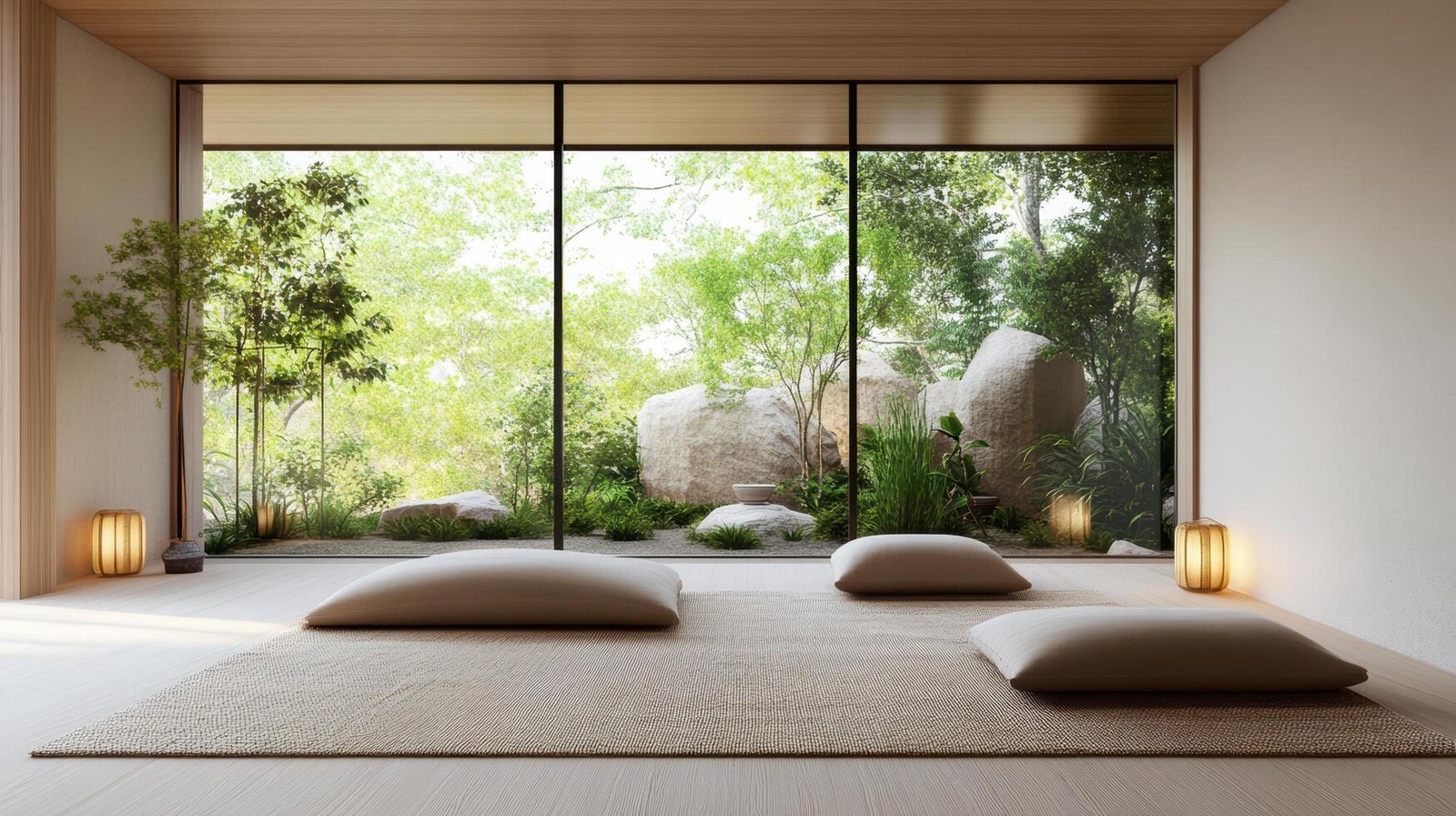
A meditation room needs light, but not visual noise. Bare glass can create harsh glare, shifting shadows, heat, and an uncomfortable feeling that the room is exposed. Meditation room window shades let you shape the space by time of day: diffuse morning brightness, reduce afternoon contrast, and close the room for evening practice without making it feel sealed off.
World Wide Shades designs custom roller, solar, room-darkening, and motorized shades for yoga corners, dedicated meditation rooms, and quiet reading retreats. Start with the online shade builder to compare openness factors and operating options, order swatches under your actual room lighting, or contact World Wide Shades for a recommendation around unusual trim. A thoughtful shade plan supports the practice instead of competing with it.
What meditation-room light should do
The most comfortable practice light is usually even, low-contrast, and predictable. A window facing east may be beautiful at 7 a.m. but intense at the same time you practice. A west-facing opening can turn a quiet breath session into a glare problem after 3 p.m. A south-facing window may need more solar control in summer than in winter.
Think in four layers of performance:
- Glare control: reduces bright patches on a mat, floor, or wall.
- Privacy: prevents neighbors, pedestrians, or other household activity from becoming a distraction.
- Thermal comfort: limits the radiant heat of sun-warmed glass.
- Mood: preserves a soft view or creates a darker cocoon when needed.
A shade is not a substitute for ventilation or an appropriately sized HVAC system, but it can change the perceived comfort near the window. The energy-efficient window shades guide explains why fabric color, fit, and solar exposure matter together.
Choosing the right fabric
Solar screen shades are useful when the window overlooks trees, a garden, or sky that you want to keep visible. Openness factors commonly range from 1% to 10%. A 1% screen gives stronger glare and view control; a 3% screen is a versatile starting point; 5% and 10% fabrics keep more view but admit more brightness and reduce nighttime privacy.
A solar shade can look gentle while still making a large difference. In a 60-inch-wide opening, the difference between a 1% and 5% screen is easy to see when the sun is low. Ask for a fabric data sheet rather than choosing only by color. Build a solar shade plan with World Wide Shades, then order swatches to test the view from the mat, not just from the doorway.
Light-filtering roller shades diffuse daylight without making the room black. They suit practice rooms where you want to see the sky and maintain a warm, welcoming feel. Pale ivory, sand, warm gray, and muted green can soften light; saturated or very dark fabrics may create a stronger visual edge at the window.
The light-filtering shades guide covers how translucent fabric behaves in daytime. Remember that privacy reverses after sunset: when interior lights are on, a light-filtering shade may reveal silhouettes. Close it fully or add another layer if nighttime privacy is important.
Some people meditate best in low light, especially for breathwork, nidra, or evening sessions. Room-darkening fabric reduces brightness substantially. Blackout fabric blocks much more visible light, but the final result depends on edge gaps, the mount, the window frame, and how well the shade covers the opening.
For a darkened room, an outside mount with 2 to 3 inches of side overlap on each side can reduce edge glow. A cassette or side channel may improve the finish on a wide opening. Read blackout curtains vs. blackout shades before deciding whether a roller shade alone meets your goal. World Wide Shades can pair a light-filtering layer with a blackout layer when the room needs both daylight and retreat-level darkness.
Privacy without a closed-in feeling
Privacy is often the reason a meditation room never feels fully relaxing. If the window faces a sidewalk or a neighboring home, a sheer screen may not be enough after dark. Test the fabric with a lamp on inside the room. Daytime privacy and nighttime privacy are different conditions.
A top-down or layered plan can preserve the sky while blocking the sightline at eye level, but roller shades are often simpler: choose an appropriate openness factor, cover the full glass, and schedule closure at dusk. For a room beside a patio, coordinate the shade with outdoor roller shades for a patio. If the space has a French door, see roller shades for French doors.
World Wide Shades can help you balance privacy with a view rather than defaulting to a fully opaque fabric. Contact the team with the window's direction, nearby sightlines, and preferred practice time. Call (844) 674-2716 if the window is high, oversized, or difficult to reach.
Motorized shades for a quiet routine
Manual cordless shades are clean and quiet for a reachable opening. Motorization becomes practical when the room has multiple windows, a high transom, a wide picture window, or a practice schedule that benefits from consistency. A “practice” scene can lower the shade to 40% at 6 a.m.; a “deep rest” scene can close it fully for a 20-minute session.
A rechargeable motor commonly adds roughly $150 to $350 per opening, while hardwired work can add $300 to $600 or more if an electrician must open finished walls. A hub, remote, sensor, or smart-home integration changes the total. Review smart-home motorized shades setup and motorized shades Alexa and Google Home before you choose controls.
World Wide Shades can specify a single motorized shade without forcing a whole-home automation project. Configure motorization and ask for a quiet operating option. Call (844) 674-2716 when the shade must coordinate with lighting, speakers, or a high ceiling.
Mounting and measuring details
Inside mounts preserve trim and create a tailored look when the frame has enough depth. Measure width at the top, middle, and bottom; record the narrowest width. Measure height at the left, center, and right. Check for handles, casing, sill depth, baseboards, and any wall projection that could interfere with the bottom rail.
Outside mounts are more forgiving and can improve privacy at the edges. Plan enough overlap to cover the glass without colliding with wall art or a nearby shelf. If the opening is 48 inches wide and 60 inches tall, do not assume a standard 48-by-60 treatment will fit; the shade mechanism, brackets, fabric roll, and clearances all affect the finished size. The how to install roller shades guide explains basic mounting, while unusual masonry or ceiling installations deserve professional review.
If you are refreshing a bedroom as a meditation space, compare fabric choices with best window shades for a bedroom and consider the calm color guidance in window shades color guide. World Wide Shades can help match a quiet textile to the room's floor, wall, and wood tones. Order sample cards before you make a large-opening decision.
Cleaning and sensory comfort
Choose a fabric that can be dusted with a soft brush or vacuum attachment on low suction. A monthly light dusting is usually easier than allowing pollen and lint to build up. Avoid spraying cleaner directly onto the fabric; moisture can leave marks or migrate into the roller tube. Keep essential-oil diffusers, humidifiers, and candles away from the shade so vapor and residue do not accumulate.
A shade should move smoothly without a sharp snap or loud rattle. A bottom rail that taps the sill can interrupt practice; a cassette can reduce visual clutter at the top. If sound control matters, combine the shade with rugs, upholstered panels, and door seals. Noise-reducing window shades offers more ideas, while World Wide Shades can review the opening as part of a broader quiet-room plan.
Cost and specification guide
A custom manual shade for a standard opening may land around $150 to $350. Solar performance, blackout fabric, a cassette, dual rollers, specialty shapes, and motorization can move one opening to $400 to $1,000 or more. A three-window retreat with rechargeable motors could reasonably range from $1,200 to $3,000 depending on dimensions and controls.
Instead of buying the darkest fabric by default, specify the actual use case: 3% solar for daytime view, light filtering for a softer atmosphere, or blackout for deep rest. World Wide Shades can quote the same opening in two or three fabric levels. Build your meditation-room options and contact World Wide Shades for an opening-by-opening recommendation.
Meditation room window shades FAQ
Yes, when you want to reduce glare and keep an outdoor view. A 1% or 3% openness fabric is often a useful starting range, but nighttime privacy requires a closed opaque layer or another treatment.
Blackout is helpful for nidra, evening sessions, projector use, or a room with severe direct sun. It is not mandatory for every practice; light-filtering fabric may be more comfortable for daytime mindfulness.
Warm whites, sand, stone, pale gray, muted sage, and natural flax tones tend to blend quietly. Order swatches because a color can look darker or cooler when backlit by a particular window.
Quality motors can be quiet enough for many practice rooms, but sound varies by product, width, mounting, and surface. Ask World Wide Shades about a low-noise motor and schedule movement before or after the session.
As a planning rule, 2 to 3 inches of side overlap can reduce edge glow, subject to trim and hardware. Side channels or a cassette can improve the result for demanding dark-room applications.
World Wide Shades can turn a bright, distracting opening into a controlled part of the room's ritual. Start with the builder, order fabric swatches, or contact World Wide Shades for a custom meditation-room shade plan.