Give check-in a comfortable place in the lobby
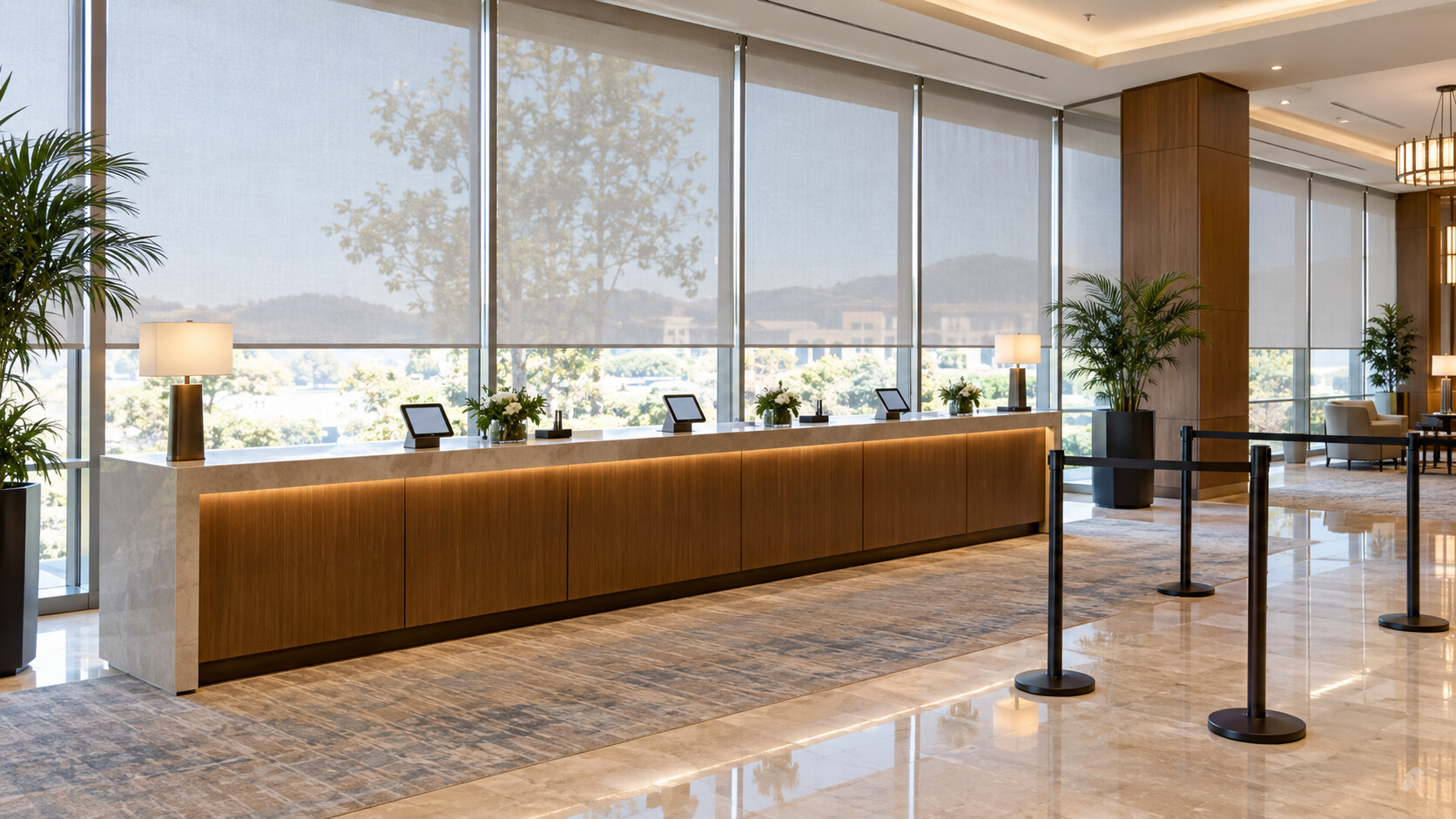
A welcoming event starts before guests receive their badges. At a hotel reception counter, conference registration desk, or hospitality suite, the window behind the team can influence where staff stand, how they read a tablet, and whether arriving guests can easily recognize the check-in point.
Choosing roller shades for event registration areas means balancing a working desk with a public-facing space. The goal is not to turn an airy lobby into a closed office. It is to give staff useful control over daylight while keeping the entrance, queue, and surrounding lounge visually understandable.
World Wide Shades recommends starting with the activity at each window rather than selecting one fabric for the entire property. For a broader commercial context, explore roller shades for office environments, then start a reception-area configuration in the shade builder.
Address glare where staff actually read screens
Set up the check-in tablet, ID reader, badge printer, and staff monitor where they will be used. Look at the screens from the operator's normal seated or standing position, then check the guest-facing display from the other side. A shade decision based only on the view from the lobby may miss the reflection that interrupts the actual transaction.
As a planning exercise, compare the station with the shade raised, partly lowered, and lowered across the relevant glass. Repositioning a display may solve part of the problem without covering every window. Keep task lighting in the evaluation so that fixing a window reflection does not introduce a new reflection from a desk lamp.
Reception is also a conversation space. Avoid a setup where the staff member becomes a dark silhouette against a bright window, especially when guests need to see faces clearly. The Department of Justice's accessible-meeting guidance advises avoiding backlighting and considering furniture relocation or window coverings to support communication (accessible meeting guidance).
World Wide Shades can use your description of the station to help frame fabric questions before ordering. Our light-filtering shades guide provides background on balancing daylight and coverage; request fabric swatches for the check-in desk so the comparison happens beside the actual equipment.
Balance fabric openness, color, and the outdoor view
Solar-shade openness describes how tightly the fabric is woven: lower openness blocks more sun but reduces visibility through the shade, while higher openness admits more light and provides a clearer view (Hunter Douglas solar shade guide). For reception, that creates a practical choice between a more protected work surface and a more open connection to the arrival area.
Do not choose a weave solely because a neighboring hotel uses it. Compare samples at the brightest affected window and ask whether staff can comfortably read names, verify details, and maintain eye contact. Review the available fabric's specifications instead of assuming similarly named materials perform identically.
Color changes the experience as well as the palette. Hunter Douglas notes that darker solar fabrics can reduce glare and improve view-through, while lighter fabrics reflect more heat and brighten a room but can make the view appear hazier (solar fabric color guidance).
Use that comparison as a starting point, not a guarantee for an untested fabric. Put samples beside the reception millwork, flooring, wall finish, and digital signage. The window shade color guide and roller shade fabric guide can help organize those decisions before World Wide Shades helps you narrow the available choices.
Separate daylight screening from nighttime privacy
A daytime view-through fabric should not be treated as a confidentiality system. Open-weave solar shades are not private after dark when interior lighting makes the room brighter than outside; Hunter Douglas specifically warns that people outside can see in when indoor lights are on at night (solar shade privacy guidance).
That matters when evening registration involves guest lists, identification, room assignments, or payment-related screens. A useful operating plan considers the window view from outside as well as views from the queue. Screen orientation, staff procedures, and appropriate screen privacy measures remain separate decisions; window shades alone do not protect information from nearby guests.
If evening visual privacy is necessary, discuss a fabric or separate coverage approach intended for that purpose and confirm the proposed assembly before ordering. Do not assume that a dark solar fabric becomes opaque at night. The principles in our spa treatment room privacy article offer a useful comparison, although reception has different operational needs.
World Wide Shades can help distinguish a view-preserving daytime objective from a privacy-focused evening objective. Call World Wide Shades at (844) 674-2716 to discuss reception privacy before relying on a sample that has only been assessed in daylight.
Coordinate the brand without promising printed logos
A reception shade can support a brand through fabric color, texture, hardware finish, and consistency across related windows. A restrained neutral may keep attention on the welcome sign, while a coordinated accent may connect the counter to the event's visual identity. Neither approach requires the shade to become another information surface.
Do not assume custom logo printing, exact brand-color matching, or a particular graphic treatment is available. Ask World Wide Shades which options are currently offered and review physical samples before making the shade part of a branded installation. Keep essential directions on dedicated signage that remains visible when the shade position changes.
Where the lobby displays photography or framed pieces, consider those surfaces alongside the reception windows. Our article on roller shades to protect framed artwork discusses that adjacent concern, while art studio color accuracy explores why evaluating the room's light matters when color judgments are important.
Choose controls that match event operations
Manual and motorized controls should be evaluated against who operates the desk, how often daylight conditions change, and whether the controls can be reached without interrupting service. A simple staff routine may matter more than adding features that temporary event teams will not understand.
Commercial manual systems are a legitimate control category: Mecho describes its Mecho/5 as a manual, chain-operated solar shade designed for smooth, consistent operation (Mecho/5 product information). That is a manufacturer-specific example, not a claim that World Wide Shades supplies that system or offers identical performance.
For a motorized proposal, ask how staff operate the shades locally, what depends on a network connection, and what happens during a power or connection interruption. Confirm the actual product's capabilities rather than assuming an app, voice assistant, or backup control is included. Our local versus cloud shade control guide can help frame the discussion.
Give separate consideration to the registration counter, lounge seating, entrance glazing, and any adjacent meeting-room windows. If the check-in screen needs coverage, staff should not have to darken an otherwise comfortable waiting area merely because every shade shares one command.
Label controls by location or task, not by an internal installation nickname. World Wide Shades recommends discussing those operating groups before the order is finalized. Ask about a practical control layout at (844) 674-2716, then document the agreed routine for the people opening and closing registration.
Define the work zone without disguising the queue
A partly lowered shade can visually settle the area behind a counter, but it should not be the only cue showing guests where to go. Keep the reception sign, accessible approach, queue entrance, and exit directions legible across the shade positions staff are likely to use.
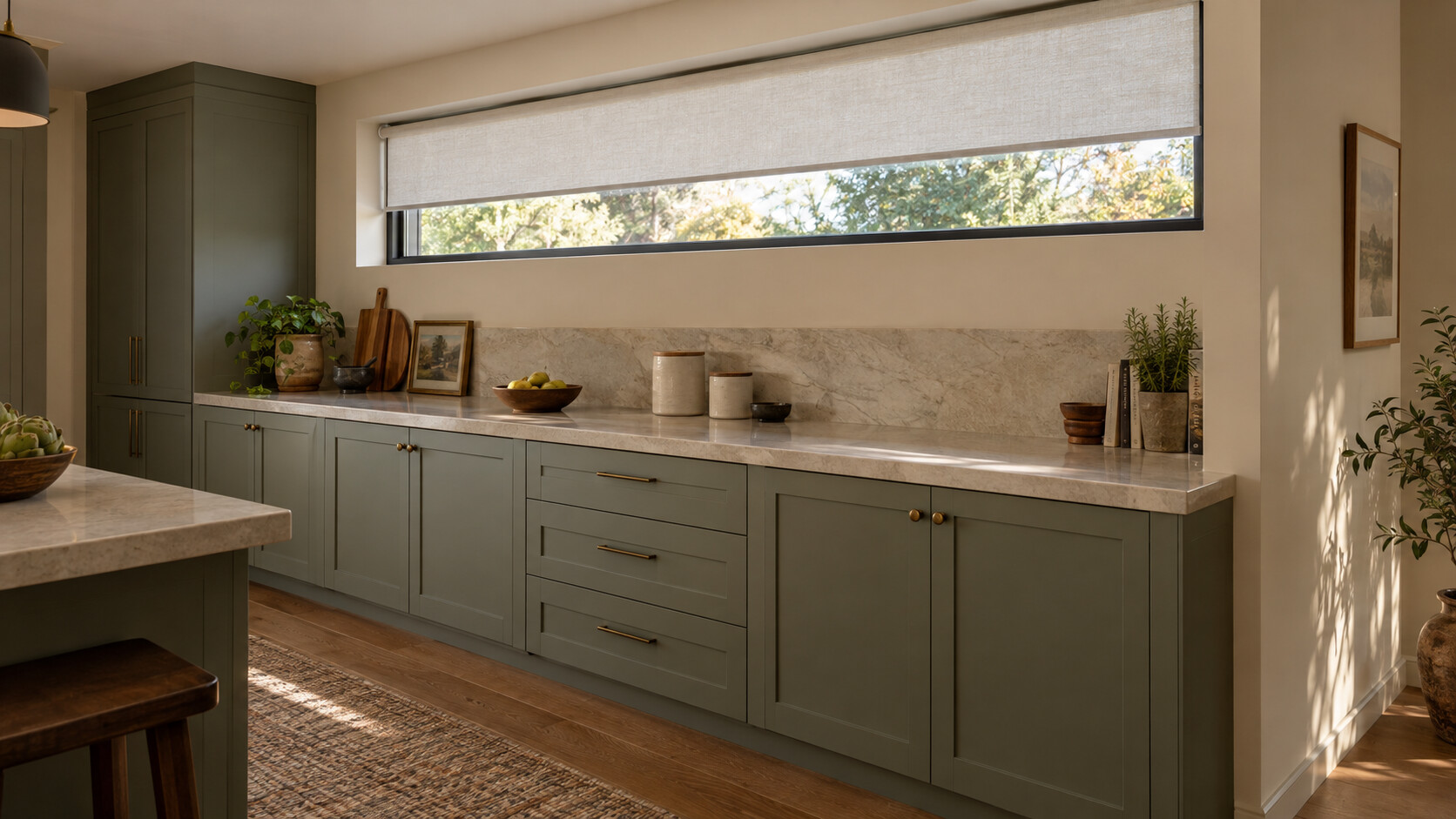
Review the space with luggage, badge collection, and staff movement in mind. Position printers and supply storage so ordinary service does not require someone to step into the queue or reach around a control. If millwork sits under the window, our guide to shades above built-in cabinets addresses a related installation interface.
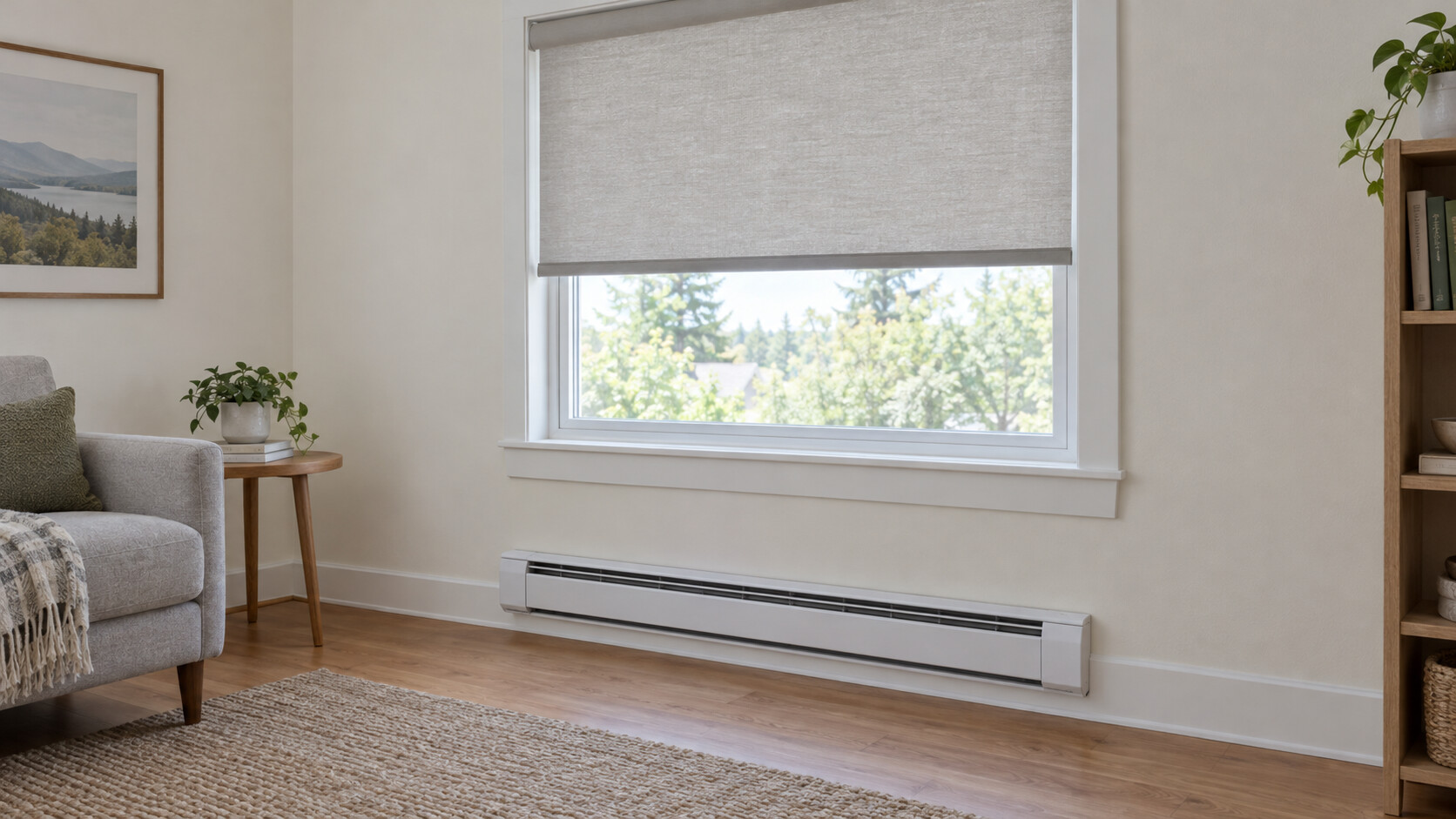
Also identify nearby heat sources before selecting the assembly and its operating position. See roller shade clearance above baseboard heaters for questions to raise with the equipment manufacturer and installer; do not improvise a universal clearance for a different heater.
Protect access and review the entire event route
Window treatment planning belongs within a larger accessibility and life-safety review. The Access Board describes a generally required continuous accessible-route width of 36 inches and permits reductions to 32 inches only at limited segments, for a maximum length of 24 inches, subject to the applicable conditions (Access Board accessible-route guide). Do not interpret the narrower allowance as the default queue or lobby layout.
The Department of Justice also advises that people with mobility disabilities should be able to approach registration tables and turn around easily (accessible registration guidance). Consider occupied positions, deployed queue barriers, supplies, furniture, and shade controls together rather than evaluating an empty floor.
Have the venue's responsible team and appropriate professionals review the entire event egress arrangement, accessible circulation, and applicable local and fire-code requirements. A blog article or line diagram is not legal advice, a permit review, or approval of a particular layout. Keep installation details within the agreed window area and avoid adding hardware or operating components that compromise required paths.
For another example of managing reflections while preserving a specialized room's function, read roller shades for yoga studio mirror glare. Contact World Wide Shades to review the reception project once the venue's access and operational constraints are clear.
Frequently asked questions
Start with the reflection at the actual tablet position, then compare available fabric samples in that light. World Wide Shades can help you discuss the balance between screening the work area and retaining the view, but no single fabric should be assumed best for every reception desk.
Do not rely on open-weave solar shades for nighttime privacy when the interior is brighter than outside (Hunter Douglas privacy guidance). Discuss privacy-oriented coverage separately, and keep screens positioned to limit viewing from the guest queue as well.
Logo printing should not be assumed available. Ask World Wide Shades about current options, and use coordinated fabric and dedicated signage when a printed shade is not confirmed.
Choose based on reach, staff routines, window access, and the controls offered for the proposed product. Evaluate local operation and any power or network dependencies before deciding that automation will simplify the desk.
Only if it suits the different activities and exposures. Consider separate reception and lounge zones, then use the World Wide Shades builder to begin your configuration with those room-specific priorities in mind.