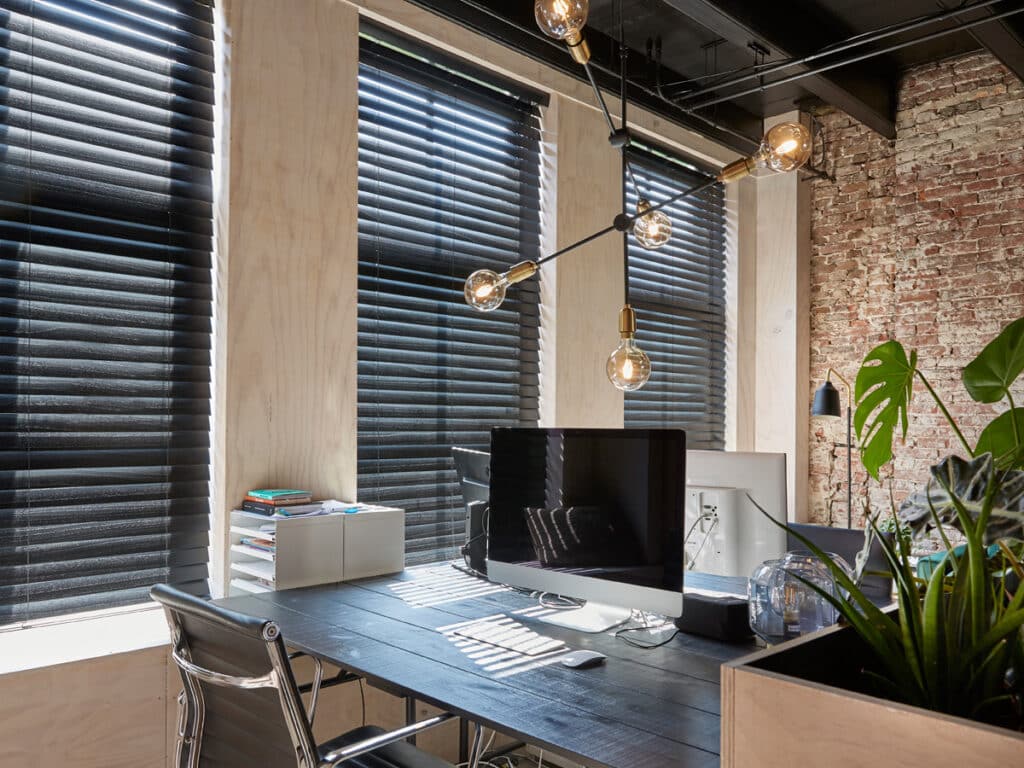
Industrial lofts are defined by contrast: exposed brick beside steel, concrete beside warm wood, and tall glass beside heavy structural lines. Industrial loft roller shades should reinforce that architecture without making the room feel like an office. The best plan manages glare, privacy, heat, and acoustics while keeping the hardware disciplined and the view available when you want it.
World Wide Shades helps loft owners coordinate solar openness, blackout performance, cassette profiles, and motorized controls across tall or oversized windows. Configure an industrial window plan in the World Wide Shades builder, order World Wide Shades swatches against brick and metal, or contact World Wide Shades for unusual openings. Call (844) 674-2716 when the project includes 12-foot glass, corner windows, or limited mounting depth.
For related planning ideas, compare guest-room blackout shades, transitional roller shade design, French Country roller shades, and roller vs. Roman shades for large windows.
Why loft windows need a different shade strategy
Loft windows are often tall, wide, deep, or arranged across multiple exposures. A single unshaded wall of glass can produce screen glare, severe afternoon heat, and privacy problems after dark. A heavy curtain may solve darkness but hide the architecture and consume floor space. Roller shades keep the treatment close to the glass and allow a consistent rhythm across a large opening.
Start by identifying the window’s direction, height, sill condition, and view. For a 120-inch-wide picture window, note whether one shade would exceed the fabric roll, tube, or motor limit. A two- or three-shade split can improve alignment and reduce operating load, but the division should respect mullions and furniture. World Wide Shades can review the elevation before you commit to a headrail layout.
Begin with the builder to compare a single solar roller with a multi-shade plan, then contact the team for a custom scale check.
Choose openness for view and glare
A 1% openness factor allows roughly 1% of the fabric area to be open, so it provides stronger glare and solar control than a 3% or 5% screen. It is useful for a south- or west-facing loft where the television or workstation sits near the glass. The tradeoff is a darker view and less visual connection when the shade is down.
A 3% screen is a common compromise for open-plan living rooms. It softens contrast while preserving a recognizable view outside. At night, however, interior lighting can make the room visible from outdoors. Pair it with an opaque layer, drapery, or a second shade when privacy is important after sunset.
A 5% screen preserves more view and daylight but provides less glare control. It can work on a north-facing elevation or a loft where the view is the main design feature. Use a swatch in the actual window; brick, concrete, and steel reflect light differently from a showroom wall.
The best shades for south-facing windows guide explains exposure choices, while UV protection window shades covers fading concerns. Order physical World Wide Shades swatches before deciding between 1%, 3%, and 5%.
Use blackout where the loft needs privacy
A loft bedroom, media zone, or street-facing window may need a darker layer than the living area. Blackout roller shades reduce light through the fabric, but side and top gaps still matter. Outside mounts, cassettes, and side channels can provide more complete coverage when the wall and trim permit them.
A dual roller is useful in a loft with changing uses: solar or light filtering for the day and blackout for sleep or projection. The headrail is deeper than a single roller, so check brick returns, exposed conduit, window handles, and ceiling beams. For cinema or screen use, compare blackout curtains vs. blackout shades.
World Wide Shades can keep the blackout layer visually quiet instead of covering the architecture with a bulky treatment. Price a dual system, then contact World Wide Shades if the opening is unusually tall or wide.
Match the palette without over-theming
Industrial style does not require every shade to be black. Charcoal, graphite, warm gray, concrete, bone, and natural flax can support brick and steel while softening the room. A black shade can create a crisp graphic line, but it also absorbs more visual weight. A lighter neutral can preserve the airy quality of a loft and keep the window plane from becoming a dark rectangle.
Choose a finish that relates to the building’s existing materials. Matte charcoal can echo steel frames; warm gray can bridge concrete and oak; flax can keep a brick wall from feeling cold. Window shades color guide is useful when the shade must work beside red brick, white plaster, and black hardware at once.
Use texture sparingly. A fine basketweave or subtle linen-look surface can prevent a large roller from feeling flat, while a heavy pattern may compete with masonry. Explore texture in the World Wide Shades builder and order swatches beside the actual wall.
Keep hardware architectural
An exposed roller tube can work in a loft because the structure is part of the aesthetic, but it should be intentional. A cassette creates a cleaner line when the window is adjacent to refined millwork or a finished ceiling. White hardware may recede against a light wall; black or anodized finishes may align with steel frames.
Keep brackets, hem bars, and control positions consistent across adjacent windows. If one opening is inside mount and the next is outside mount, align the visual top line where possible. For wide windows, divide shades at mullions rather than arbitrary room-center points. Review roller-shade valance options if the top needs a polished transition without decorative ornament.
World Wide Shades can coordinate hardware across a wall of glass. Send a photo and dimensions through the contact page before selecting a finish.
Solve tall and oversized windows safely
Tall loft windows change the installation and operating requirements. A 12-foot opening may need a motorized shade, multiple units, or a control placed at a practical height. Do not position a manual chain where it will swing near a stair, sofa, or child’s reach. Cordless and motorized controls reduce dangling hardware; child-safe window treatments covers the safety principles.
Motorization may add about $250 to $600 per shade for the motor, battery, and control, with hardwired power or smart-home integration increasing the total. Rechargeable batteries often need periodic charging, so allow access to the charging port. For connected control, see motorized shades Alexa and Google Home and smart home motorized shades setup.
Call (844) 674-2716 to discuss a high window, or ask World Wide Shades for a motorization plan that keeps everyday controls simple.
Consider acoustics and comfort
Hard loft surfaces can make conversations and music sound sharper. A roller shade will not turn concrete into an acoustic panel, but a textured fabric and a soft drapery layer can add visual and limited acoustic softness. Curtains also help create zones without building walls. Keep the functional shade near the glass and use the fabric layer only where it improves comfort.
Energy is another concern. The U.S. Department of Energy’s window-coverings guidance explains that window coverings can influence heat gain and heat loss. Solar shades can reduce direct glare and help a room feel more usable; blackout and lined layers can help when nighttime comfort or street lighting is the priority. They do not replace efficient glazing or insulation.
Mounting and measuring for brick, steel, and concrete
Measure width at the top, middle, and bottom and record the narrowest inside dimension. Measure height on both sides and in the center. Check whether the lintel, concrete, or steel requires masonry anchors or a specialized fastener. Identify sprinkler lines, conduit, radiators, and deep window pockets before drilling.
For an outside mount, 2 to 4 inches of side overlap and 3 to 6 inches above the frame are useful starting ranges, subject to the structure. If the loft has a 4-inch steel casing, the headrail may need to sit outside the casing rather than in the recess. Follow how to install outside-mount roller shades and have a professional verify heavy or high installations.
Budget by scale and control
A small manual solar roller may land around $200 to $450. A larger 1% or 3% solar shade with cassette can cost approximately $400 to $900, while a tall blackout or dual roller may exceed $1,000 per opening. Motorization often adds $250 to $600 per shade, and masonry installation can add labor beyond a standard bracket install.
For four 48-by-72-inch windows, an early planning range is about $800 to $3,600 before advanced controls. A 120-inch opening split into three shades may cost more than one small window but can operate more reliably and fit product limits. Compare the configurations in the builder, then contact World Wide Shades for a multi-opening quote.
Maintain the loft look
Dust solar fabric with a soft brush or low-suction vacuum every few weeks. Avoid saturating the screen or rubbing the edge against a steel frame. Keep the lower rail clear of furniture so it can travel straight. If a shade telescopes, skews, or rubs, stop operating it and inspect the brackets and alignment; how to fix uneven tracking offers troubleshooting context.
Save the fabric, openness, mount, and control details for future additions. A consistent record makes it easier to extend the same language to a new bedroom or office without guessing at gray undertones.
FAQ: industrial loft roller shades
A 1% screen gives stronger glare control, 3% balances view and light, and 5% preserves more daylight with less glare reduction. Choose by exposure and screen use, then confirm with a physical swatch.
Usually not. Solar fabric can provide daytime privacy when the exterior is brighter, but interior lights can reverse the effect after dark. Add an opaque layer or drapery for nighttime coverage.
Black can echo steel and create a strong architectural line, but it adds visual weight. Charcoal, warm gray, flax, and concrete tones can support an industrial palette while keeping the room brighter.
Tall openings often need motorization, multiple coordinated shades, or both. Review tube and fabric limits, plan safe control access, and verify the wall structure before installation.
Yes, especially for bedrooms, media areas, and street-facing windows. Use an outside mount, cassette, or side channels when reducing edge light is important.
Small manual solar shades may cost about $200 to $450. Larger solar, blackout, dual, motorized, and masonry-installed systems can range from $400 to more than $1,000 per opening.
Keep the architecture visible and the room usable
Industrial loft roller shades work when they respect both the building and the people inside it. World Wide Shades can coordinate openness, blackout performance, mount, hardware, and control across a wall of glass. Start the plan, test the palette, or contact World Wide Shades; call (844) 674-2716 for a high-window consultation.