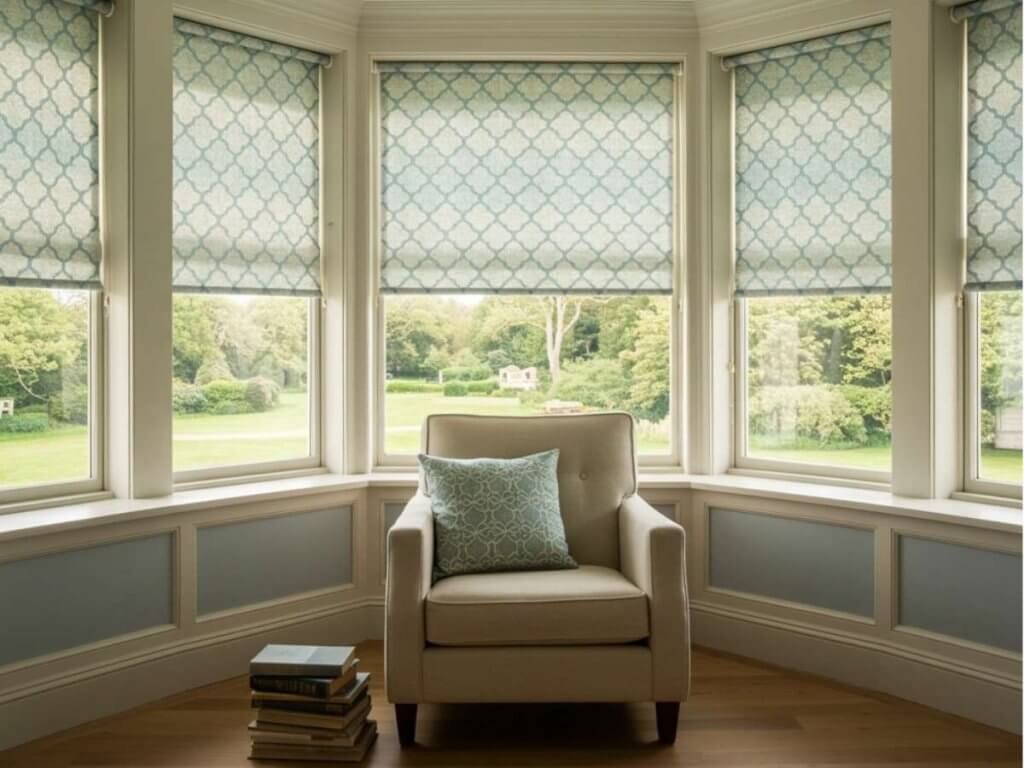
Roller shades for bow windows need to look like one composition even though the window is built from several angled panels. The challenge is not only choosing a fabric. Each shade needs a mounting surface, enough room for its roller, a sensible gap at the panel joint, and an operating plan that does not make one section collide with the next.
World Wide Shades designs bow-window treatments around the number of panels, the angle between them, and the way the room is used. Start with the custom shade builder, order swatches to compare color and openness across the curve, or contact World Wide Shades with a front photo and rough measurements. Call (844) 674-2716 when the bow projects into a walkway or contains unusually narrow side panels.
Why a bow window is different from a flat opening
A bow window is usually a series of windows arranged along a gentle arc, while a bay window often has a more pronounced center projection and angled side panels. In either case, each panel can have its own glass width, depth, trim return, and handle. A single wide roller across the entire opening usually cannot follow the curve or move cleanly.
Plan the window as a set of panels:
- Count the operating sections and identify the center panel.
- Note the angle and depth between adjacent frames.
- Check whether trim or mullions create separate mounting surfaces.
- Decide whether every panel needs independent movement.
- Measure where the shades will stack and whether furniture blocks access.
Use bay window roller shades, roller shades for angled windows, and custom roller shades vs. home depot for related geometry decisions. World Wide Shades can preserve a consistent visual line while allowing a different shade width or mount on each panel.
Choose inside or outside mounting panel by panel
Inside mounting keeps each roller within the individual recess and can make a bow window feel architectural rather than covered. It requires enough depth for the brackets and roller, and the frame must provide a reasonably square surface. Because the shades are separated, small side gaps may be visible at the joints; use fabric color and alignment to make those gaps less distracting.
An outside mount may be preferable when the recess is shallow, the trim is irregular, or the frame angle prevents a square bracket installation. The challenge is keeping the headrails visually aligned around the curve. Spacers, projection brackets, or a shared top treatment may help, but they add depth and need to clear nearby walls.
Ask how far the roller projects into the room and where the fabric will land at full drop. World Wide Shades can compare a discreet inside mount with an outside mount that delivers more overlap and light control. Review roller-shade valance options if the headrails need a finished fascia.
Keep the lines consistent
The top of each shade should read as a controlled line even when the window frames step around a curve. Align the headrails where possible, then account for frame height and installation tolerance. A one-inch difference can be visible across five panels, especially in a high-contrast fabric.
If panels have different heights, decide whether the shades should follow the glass or share a visual bottom line. Following the glass maximizes coverage; a common bottom line can look more unified but may leave a little glass uncovered. For a seating area, consider sightlines from the room rather than only the window exterior.
Adjacent rollers need clearance so fabrics do not rub or hardware collide. A 1/4–1/2 inch joint can be normal depending on the product and frame, but the exact gap should be confirmed after measuring. Dark interiors and strong sunlight make bright lines more noticeable, so order swatches and examine the fabric near a mullion.
Pick the right fabric for a curved projection
A bow window often captures daylight from several directions. Solar shades in 1%, 3%, or 5% openness can reduce glare while preserving an outdoor view; the tighter weave usually gives stronger daytime filtering. Light-filtering fabrics diffuse the scene and create a softer appearance. Room-darkening fabrics help when the window is in a bedroom or media room, but they also make panel gaps more apparent.
For a front bow window, night privacy deserves a specific plan. A solar fabric that looks private at noon may reveal silhouettes when lamps are on. Use a room-darkening layer, dual shade, or a schedule that closes the privacy layer at dusk. Compare light-filtering shades, blackout curtains vs. blackout shades, and window shade color guide.
The same fabric across all panels creates the strongest visual continuity, but a dual shade in the center can be useful if that panel faces the brightest view. World Wide Shades can keep the outward appearance coordinated while assigning different performance to each room-facing section.
Decide whether panels move together
Grouping all panels is convenient when the window is one daylight zone. A single raise or lower command keeps the curve visually balanced and is useful for bedtime, movie time, or a bright afternoon. If the panels are different sizes, a shared percentage may not create an identical visual drop; check how the bottom edges look.
Independent panels make sense when the bow contains a reading seat, a desk, or a plant that needs different light. The center panel might close for screen glare while side panels remain open for a view. Use clear names such as cover.bow_center and cover.bow_left rather than generic numbers.
Motorization is valuable when the bow is deep, behind furniture, or too wide for comfortable manual operation. Rechargeable motors reduce wiring in finished rooms; hardwired or low-voltage power can be easier to maintain for high-frequency use or new construction. The planning details in smart home shade scenes and automations, smart home motorized shades setup, and hardwired motorized shades apply to multi-panel installations.
Keep a manual fallback and stop control. Do not let a shade close onto a pet, toy, or person, and manage cords according to the product’s safety directions. For homes with children or pets, compare child-safe window treatments and pet-friendly window treatments.
Measure a bow window accurately
Measure each panel’s glass width, overall opening width, height at the left and right, recess depth, trim return, and distance to the next panel. Record the angle or use a simple cardboard template if the frame is unusual. Note handles, crank hardware, mullions, sills, baseboards, and nearby furniture.
Take one straight-on photo of the complete bow and one photo from each side. A measuring tape across one panel does not reveal whether the next bracket will have clearance. If the panels share a continuous trim line, show that line in the photo. World Wide Shades can use the information to decide whether the shades should be inside mounted, outside mounted, split, or paired with a valance.
Budgeting for a multi-panel bow
Custom roller shades often plan around $250–$700 per opening, so a five-panel bow can start near $1,250–$3,500 before motorization, unusual brackets, installation, or premium fabric. Motorized operation may add approximately $150–$500 per panel, while a coordinated fascia, specialty mount, or difficult access can add more. A complete bow-window project may reasonably plan between $2,000 and $6,500.
The number of panels is only one factor. Width, height, fabric weight, split lines, mounting depth, power, and installation access determine the actual quote. Use the World Wide Shades builder, request swatches, and contact World Wide Shades for a panel-by-panel review. Phone (844) 674-2716 if you want to discuss one bow alongside the rest of the room.
Roller shades for bow windows FAQ
Usually not when the window curves through multiple planes. Separate shades per panel follow the geometry more safely and make replacement or independent control easier.
The same fabric normally creates the cleanest visual line. Different layers can still be useful when the center panel has a stronger glare problem, provided the colors and headrails coordinate.
The required joint depends on the roller, brackets, fabric thickness, and frame. A 1/4–1/2 inch planning gap is common, but the final clearance should come from the selected system and measured geometry.
It often is when the panels are deep, high, behind furniture, or used frequently. Manual operation can be perfectly practical when every panel is reachable and the window is small.
A solar shade may provide daytime privacy but can reveal silhouettes with lights on inside. Use room-darkening, blackout, a dual shade, or a dusk privacy schedule when nighttime privacy is important.
World Wide Shades can coordinate panel widths, fabric, mounting, gaps, and manual or motorized control so the curve reads as one finished installation. Start with the builder, order swatches, or contact the team; call (844) 674-2716 for a multi-panel plan.