Motorized shades for away mode should make a home look naturally occupied without turning the house into a stage set. A shade that moves every window at precisely 8:00 a.m. and 8:00 p.m. is predictable in the wrong way. A better plan uses a few privacy zones, gentle timing variation, and a clear override for neighbors, cleaners, pets, and weather.
World Wide Shades designs motorized roller shades around the window, room, and control goal rather than treating automation as an afterthought. Use the shade builder to map openings, order swatches to compare daytime privacy, or contact World Wide Shades for a multi-room plan. For a direct recommendation, call (844) 674-2716 and describe which rooms need privacy while you are away.
What an away-mode shade scene should accomplish
Away mode has three jobs: reduce obvious visibility into the home, keep daylight from making the house appear abandoned, and avoid unnecessary movement that drains batteries or distracts neighbors. It does not need to operate every shade. Bedrooms, bathrooms, street-facing rooms, and large ground-floor windows usually matter more than a high clerestory or a rear window hidden by landscaping.
Divide the house into zones:
- Street privacy: front rooms and side windows visible from a sidewalk.
- Night privacy: bedrooms, bathrooms, and rooms with lights that may remain on.
- Daylight balance: living rooms and kitchens where some open fabric looks natural.
- Low-priority glass: upper windows or openings already screened by a fence or trees.
That zoning produces a more believable result than a whole-house open/close command. World Wide Shades can help match one visual language across zones while using different fabrics where the privacy requirements change.
Choose fabrics that work while you are gone
Solar shades can make it difficult to see into a bright room from outside during the day, while the same room may become visible when the interior is brighter at night. A 1% openness fabric provides a tighter weave than a 3% or 5% fabric, but openness factor is only one part of privacy; lighting, distance, angle, and the view through the glass all matter.
For a front living room, a 1%–3% solar shade may keep a natural facade during daylight. For a bedroom, bathroom, or room where lamps remain on after dark, use a room-darkening or blackout layer, a dual shade, or a schedule that closes the privacy layer before interior lights come on. The comparisons in light-filtering shades guide, best shades for south-facing windows, and blackout curtains vs. blackout shades are useful starting points.
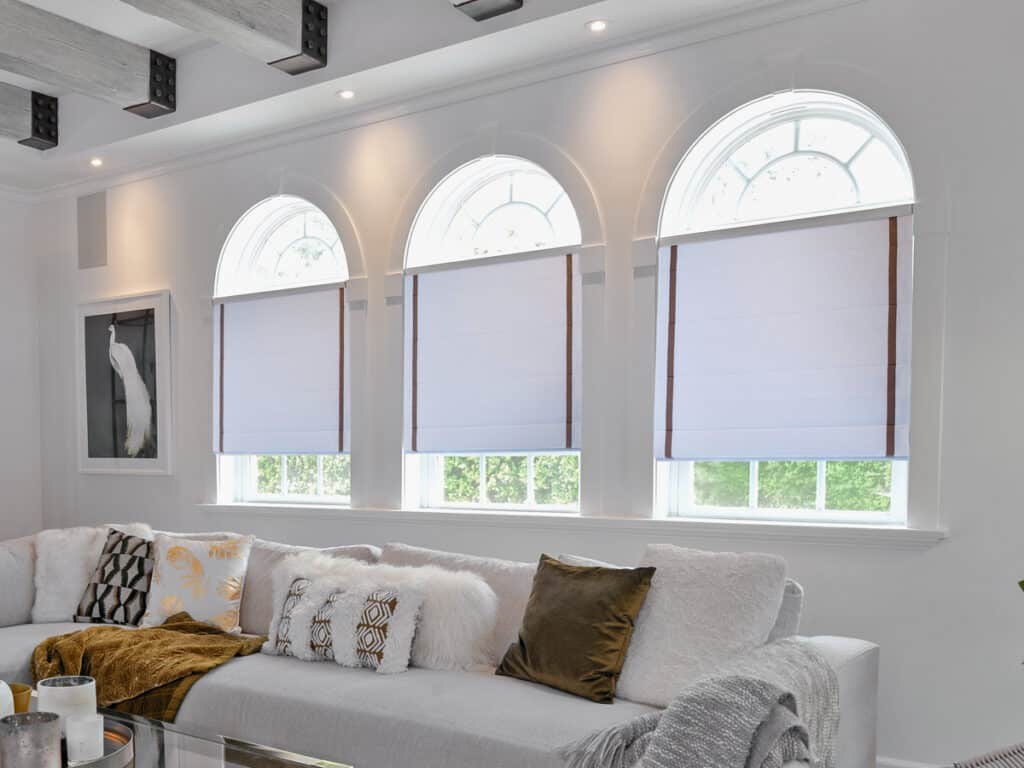
Many shades look different from the exterior than from inside. A neutral-facing backing can create a more consistent street view, while a strongly colored room-side fabric may be part of the interior design. Request swatches and view them against the window trim; World Wide Shades can help keep a large facade from looking like five unrelated rectangles.
Create believable timing without a complicated system
Sunrise and sunset are better anchors than fixed times because daylight shifts throughout the year. Add a small offset: for example, open a living-room shade 20–45 minutes after sunrise and close a bedroom privacy shade 15–30 minutes before sunset. These are starting points, not universal rules.
Vary the start time by 10–35 minutes across days or rooms, but keep the pattern plausible. A front bedroom might close near dusk, a kitchen might remain at 50% until 8:30 p.m., and a living room might move only when the away mode is active. A random delay is useful only if it has boundaries and does not create a strange partial facade.
Do not use random movement for high windows that people cannot see or for rooms where direct sun can overheat finishes. Instead, use a predictable protective schedule and reserve variation for visible privacy zones. Smart home motorized shades setup, smart home shade scenes, and energy-efficient window shades show how different rooms can have different priorities.
Away mode is not merely sleep mode with a longer duration. Sleep mode might close bedrooms and preserve a comfortable temperature; away mode should focus on the facade and occupancy cues. Give each mode its own scene or helper, then add a condition so the two cannot issue conflicting commands.
Hardware planning for unattended operation
An away scene that moves each shade twice a day is usually gentler than a bright-sun automation that makes repeated corrections. Even so, battery life varies with shade width, fabric weight, temperature, movement frequency, and motor settings. Put charging access on the project plan. If a shade is over a stairwell or behind a tall piece of furniture, a rechargeable motor may be inconvenient even when it is easy to install.
For frequently used openings, consider a low-voltage or hardwired option during construction. Ask where the transformer lives, how a failed component is accessed, and whether a manual control remains available. The practical guide to hardwired motorized shade wiring and smart home shade scenes and automations can prevent a hidden maintenance problem.
Ask what happens after a power loss, hub restart, router outage, or low battery. Will shades return to their prior position, calibrate, or remain stationary? A privacy scene should not assume that a command was received. If position feedback is available, use it; if not, schedule a gentle confirmation or rely on a conservative default rather than issuing a rapid series of commands.
World Wide Shades can specify coordinated motors and shade splits, but the controller and network should be tested as a complete system. For a project with more than eight motorized openings, request a written device list before installation and keep the model numbers with the home documentation.
Add manual overrides and sensible exceptions
The best away mode is easy to pause. A household member should be able to stop the scene for a delivery, a repair visit, a house sitter, or a storm without editing an automation. Use a dashboard button, wall control, or remote that clearly communicates “hold.” Automatically clear the hold after a selected interval, such as two hours, or require a deliberate resume when privacy matters more than convenience.
Do not close a shade onto a plant, toy, pet, or person. Keep cords and furniture away from operating paths, follow manufacturer instructions, and use child-safe products in family rooms. For safety context, see child-safe window treatments and pet-friendly window treatments.
During strong wind, smoke, or severe weather, the shade response should be based on the window system and manufacturer guidance, not an improvised “close everything” command. A shade is not a storm shutter. If a home has large or specialty glass, outdoor roller shades for a patio is a useful planning reference for separating exterior and interior coverage.
Budget the project by zone
Custom roller shades often plan around $250–$700 per opening, while motorization can add approximately $150–$500 per shade before installation, power work, or a bridge. A six-opening away-mode project may therefore land near $2,400–$7,200 depending on fabric, width, dual rollers, and controls. Use those figures for a first-pass budget, not as a quote.
World Wide Shades makes the decision easier by keeping facade appearance, privacy, and operation in the same conversation. Start with the builder, request swatches, and contact World Wide Shades for a zone plan. Call (844) 674-2716 when you want to compare a simple battery setup with a hardwired or dual-shade approach.
Motorized shades for away mode FAQ
No. Prioritize street-facing rooms, bedrooms, bathrooms, and large visible openings. Leave hidden or high windows on a daylight or thermal schedule unless they contribute to the facade.
A 10–35 minute variation across visible rooms is usually enough to avoid synchronized movement while keeping the pattern plausible. Use stable boundaries around sunrise, sunset, and normal household hours.
They can provide useful daytime privacy when the room is brighter outside than inside, but they generally do not provide the same privacy at night with interior lights on. Pair them with a room-darkening layer or close them before evening lights are used.
Use a visible hold or pause control that temporarily suspends scheduled movement. A timer that clears the hold after a few hours helps the normal privacy plan resume without manual cleanup.
Often, yes, when the shades are accessible for charging and the movement schedule is modest. Large shades, high windows, frequent solar corrections, and difficult access may justify hardwired or low-voltage power.
World Wide Shades can help zone windows, compare fabrics, plan shade splits, and select an operating configuration for the automation platform you intend to use. Start on the builder, order swatches, or contact the team; call (844) 674-2716 for a room-by-room review.