Start with the movement, not the noise
When a roller shade rattles in airflow, start by asking what moves and what it touches. Do not assume the whole shade needs replacing, and do not assume the air conditioner is the only cause. World Wide Shades recommends a calm comparison of the room with and without the suspected draft before considering hardware changes.
Shade manufacturers offer specific ways to limit swaying: LEVOLOR describes optional hold-down brackets, while Crestron uses an engineered cable-guided system to prevent fabric movement. LEVOLOR’s installation guide and Crestron’s specialty-shade documentation explain those different approaches.
For an existing shade, gather the product name and a short description of the noise. Contact World Wide Shades or call (844) 674-2716 before buying parts, and ask which checks fit your particular system.
Why an unrestrained bottom rail can move
The useful distinction is between holding the shade at a chosen height and holding it against sideways movement. Rollease Acmeda describes a balanced spring system that positions the bottom rail at a desired height; Crestron separately describes tensioned side cables and matching hembar end caps that guide movement. Rollease Acmeda’s spring-system overview and Crestron’s cable-guide description illustrate these separate functions.
Air moving through an open window or across a room can set an unrestrained shade swaying; Lutron specifically identifies areas of heavy airflow as a use case for its cable-guided honeycomb shades. That example concerns honeycomb shades, not a universal roller-shade accessory. Lutron’s shading brochure makes the product distinction.
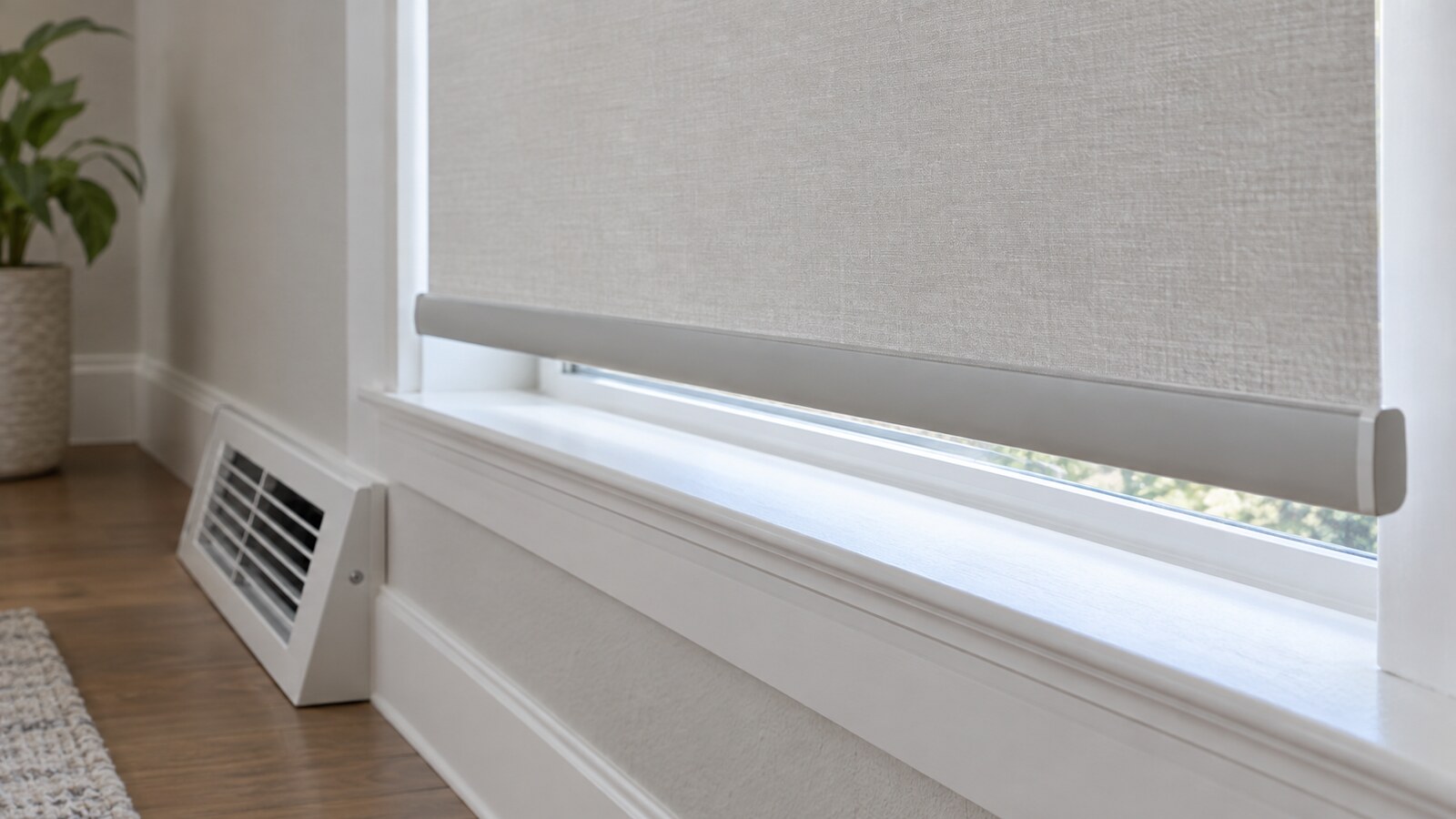
In your room, look for a simple chain of events: the air starts, the fabric moves, and the bottom rail approaches a hard surface. Treat a tap against the sill or trim as a possible explanation to test, not a diagnosis made from the sound alone. Check whether the rail actually makes contact rather than guessing from across the room.
Use our noise-reducing window shades guide as a separate planning resource. Keep the immediate troubleshooting focused on this shade’s movement, mounting, and nearby surfaces.
Separate three possible noise patterns
Watch the lowered shade without operating it. Look for the rail swinging toward the glass, an end approaching the side trim, or the fabric moving while the top stays still. Note whether each sound matches a visible contact point.
Try not to label every small movement a defect. Instead, record whether it is silent, whether it causes contact, and whether it changes when the suspected airflow stops. Those details give the installer more to work with than “the shade is noisy.”
Look at the upper assembly from the floor. If a bracket appears loose, the headrail looks partly disengaged, or the whole assembly shifts, stop operating the shade and arrange an inspection. LEVOLOR warns that improperly engaged brackets can allow the shade to fall and cause injury. LEVOLOR’s mounting precautions explain why this deserves priority.
Do not reach up and shake the assembly to reproduce the sound. Use how to install roller shades for background, then consult the instructions supplied with your exact product before any mounting work.
Compare the parked shade with a normal raising or lowering cycle, but only if the mounting appears secure. Watch the fabric edges for contact with trim, handles, or nearby objects. If the sound occurs only during travel, do not treat a draft as the confirmed cause.
Tell World Wide Shades whether the sound is a tap, a buzz, or a scrape, and where you hear it. Send the details through our contact page, along with photos taken safely from the floor.
If the fabric looks partly separated from the tube, stop the test rather than continuing to cycle it. Read our related guide to roller shade fabric detached from the roller tube and request model-specific repair advice.
Make a safe airflow comparison
Change one condition at a time so the result is useful. Keep children and pets away during the observation, and do not climb onto furniture, lean out of a window, or reach behind a moving shade.
If safe and practical, turn off the HVAC using its normal controls and close nearby windows. Leave the shade at its usual resting height and observe from a safe position. Do not switch off equipment needed for health, safe temperatures, or essential ventilation.
Record whether the noise stops, slows down, or continues unchanged. Avoid taking the shade apart during this comparison. A useful note describes what happened without claiming more than you saw.
With the windows closed, restore normal HVAC operation and watch the shade from the same place. If it is safe to do so, compare that with the HVAC off and a nearby window opened normally. Skip the open-window test during strong winds, rain, or any situation where access is unsafe.
For a sample observation, write: “The shade was quiet with the window closed and the fan off; tapping returned when the fan restarted.” This is an example, not a performance standard or proof of a faulty shade. Repeat the comparison only if it remains safe and easy.
Do not block a supply vent or return grille for the test. Ask an HVAC professional about air direction if the outlet appears to be involved, rather than restricting the system yourself.
If the shade operates normally, try another permitted resting height using its regular control. Observe whether the rail stays clear of nearby surfaces, then return it to the position you need. Never lower it beyond its ordered length; LEVOLOR warns that doing so can expose the tube and damage fabric. LEVOLOR’s troubleshooting guidance provides that limit.
For a replacement project, start with the World Wide Shades builder and describe the window’s airflow before finalizing the order. Ask about the complete system rather than choosing a bottom rail by appearance alone.
Choose a remedy that matches the cause
Start with reversible choices: keep a nearby window closed during unsuitable conditions, use a different normal shade position, or ask a professional to review the air outlet’s direction. Do not sacrifice needed ventilation, safe temperatures, or access to an exit just to quiet a shade.
If you suspect contact with trim or a handle, ask the installer to review the mounting arrangement and clearances. LEVOLOR’s guide distinguishes traditional back-roll fabric from optional reverse-roll fabric, so first identify which arrangement you actually have. LEVOLOR’s installation overview shows that distinction.
Do not reverse the roll, shift brackets, or attach padding to the shade without approval. Avoid taping the rail to the sill or tying it to nearby hardware. Ask for a repair that preserves normal operation rather than creating a restraint that someone may forget to release.
For future fabric decisions, request World Wide Shades swatches and compare them in the room. Use samples to judge appearance and light control, not as a promise that a particular fabric will eliminate rattling.
Hold-down brackets and cable guides are different
LEVOLOR identifies optional hold-down brackets as a way to prevent swaying, particularly on doors. Its product-specific guide shows the matching bottom-rail hardware.
Before ordering hold-downs, ask whether they are offered for your model and how normal raising and lowering will work. Do not assume an accessory from another brand will fit. Confirm the release procedure, attachment position, and any operating limits with the manufacturer.
Crestron’s cable-guided roller shade uses tensioned steel cables, special slotted hembar end caps, anchors, and dedicated upper mounting hardware. Crestron’s design guide presents it as a complete engineered solution.
That Crestron system also has stated light-gap and retraction limits and is not compatible with its blackout options. Crestron’s compatibility notes are a reminder to check the whole design, not just the guide cables.
Treat side channels, cable guides, and hold-downs as system-specific choices. For patio projects, read outdoor roller shades for patios, then ask about the exact product’s exposure and operating limits. Do not copy outdoor restraints onto an indoor shade.
Avoid added weight and improvised repairs
Do not add weights, drill the rail, open its end caps, or alter the fabric unless the manufacturer expressly permits the work for that model. Rollease Acmeda’s Easy Spring Air is a balanced spring system with specified adjustment features, not a general invitation to change the bottom rail’s load. The manufacturer’s system overview describes those features.
Do not use loose cords, wire loops, or homemade tethers as a shortcut. Review child-safe window treatments when planning any change, and ask the manufacturer to approve the complete arrangement.
For a motorized shade, avoid repeated test cycles if it catches, binds, or sounds strained. Use smart home motorized shades setup for planning questions, not as permission to change motor limits or bypass safeguards.
World Wide Shades can be your next point of contact before a repair decision. Ask about your shade through our contact page or call (844) 674-2716, and have the model details and observation notes ready.
Related guides for fit and repair decisions
For other situations that affect a shade plan, read about dormer-window fit, front-door sidelights, deep recessed openings, and fabric that has detached from a roller tube.
For more specialty installations, see the recent guides to steel window frames, triangular gable windows, aligning adjacent shades, office glass partitions, and glass-block windows.
Frequently asked questions
Do not decide from the sound alone. Compare parked movement, upper mounting, and contact during travel before choosing a repair. Stop using the shade if you suspect an insecure mount; LEVOLOR warns that a poorly secured assembly can fall. LEVOLOR’s safety instructions explain the risk.
Include normal HVAC operation in your comparison rather than testing only the window. Lutron identifies heavy airflow as a reason to use guided shades, though its cited example is a honeycomb system. Lutron’s product brochure supports checking airflow without assuming every roller shade accepts guides.
Ask the manufacturer before changing any rail or adding weight. A balanced spring shade is designed around its operating system, and Rollease Acmeda describes specific spring and tension features for its Easy Spring Air product. Rollease Acmeda’s documentation is product-specific guidance, not a universal weight recommendation.
Do not assume so. Crestron’s example requires dedicated cables, end caps, anchors, and mounting hardware, with defined compatibility limits. Crestron’s cable-guided shade documentation explains why approval must cover the complete system.
Request a diagnosis before making that choice. Ask for separate options for an approved repair and a replacement suited to the room, then use custom roller shade cost guidance to organize budget questions.
World Wide Shades recommends ending the investigation with an approved solution, not an improvised restraint. Explore the builder when replacement makes sense, and describe the airflow, contact points, and installation concerns before placing an order.