If you found your roller shade fabric detached from tube hardware, pause before reaching for glue. The right repair depends on how that specific shade holds its fabric: Lutron documents an adhesive-strip design, while North Solar Screen provides instructions for a spline inside a fabric pocket. (Lutron manual shade specifications, North Solar Screen fabric replacement instructions)
Start by checking the maker’s instructions and warranty terms before changing anything. Photograph the loose edge, tube, and product label so you can ask about the correct repair rather than guessing.
For help planning your next step, contact World Wide Shades or call (844) 674-2716. Have your shade details and photos ready when you reach out.
Stop Using the Shade and Identify What Came Loose
Leave the shade out of service while you assess the damage. Avoid repeated test runs or pulling the hanging panel to see whether it catches.
First, look without taking the assembly apart. Is the fabric separating from the tube, or has the whole roller shifted in its brackets? Does the top fabric edge look intact, or is there a torn pocket or loose plastic strip?
Treat removal as a separate job with its own instructions. Draper warns that improper installation and handling can let a shade fall, and its guide requires secure, level hardware and careful testing after installation. (Draper installation and operation guide)
Do not open a spring assembly or remove a motor as an exploratory step. If the product guide does not clearly authorize the work you intend to do, ask the manufacturer or a qualified installer instead.
For background before an approved reinstall, read the World Wide Shades guide to how to install roller shades. Keep the original product manual as the authority for your actual bracket and control system.
How Roller Shade Fabric Attaches to the Tube
There is no single attachment method to copy across every shade. The following manufacturer examples show why identifying the system comes before choosing materials. (Lutron manual shade specifications, Rollease Acmeda Switch system)
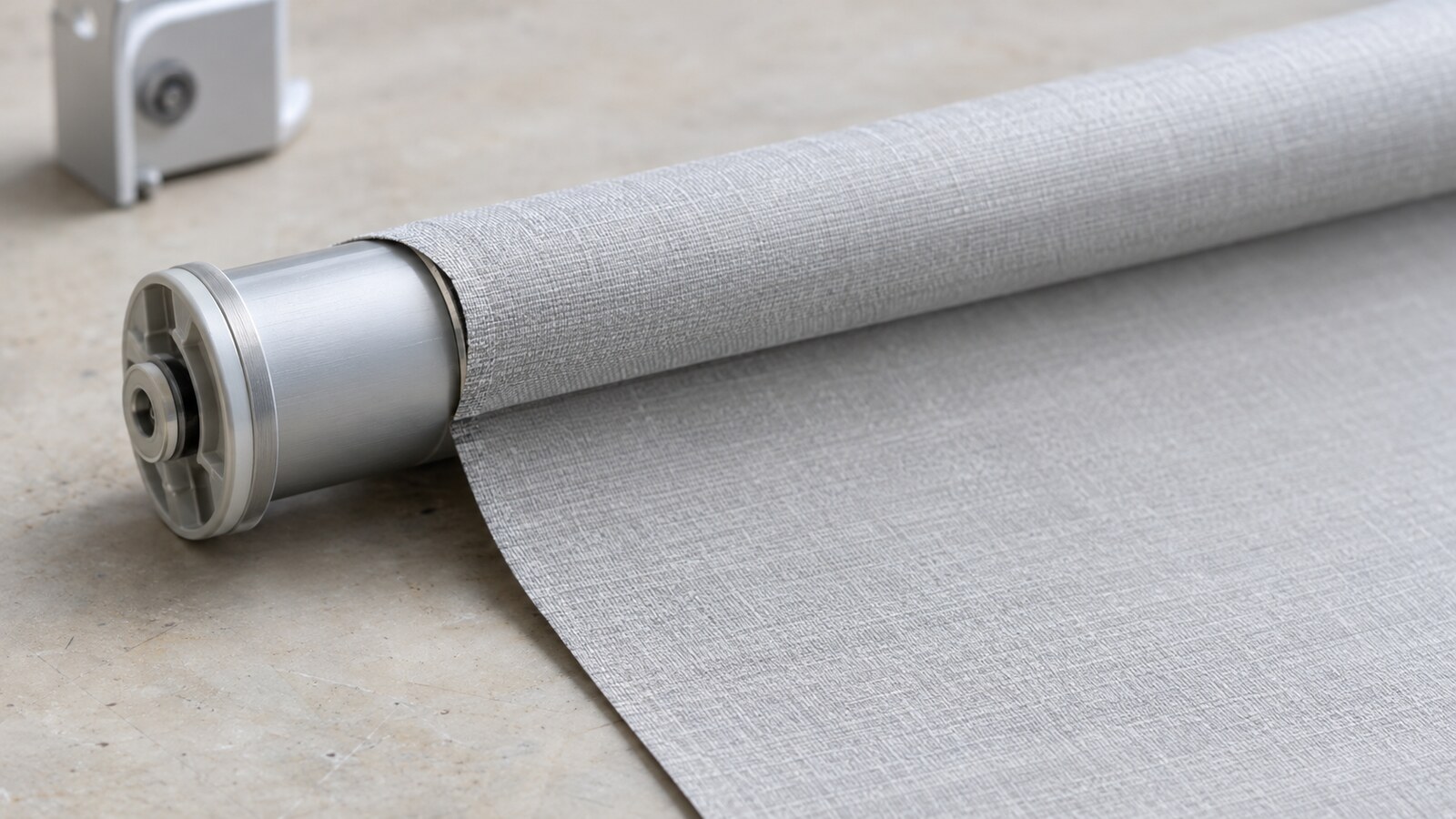
Some shades use a double-sided adhesive strip to connect the fabric to the roller. Lutron’s manual shade specifications describe that arrangement and call for a fabric turn around the roller before the working section begins. (Lutron manual shade specifications)
That example does not make ordinary double-sided tape a suitable replacement. Ask for the exact approved product, preparation method, placement, and any required waiting time before use.
A spline is a strip or cord used to retain the fabric in a channel. In North Solar Screen’s documented box-shade system, the spline runs through the fabric’s top pocket, and the roller’s U-channel slides onto that pocket. (North Solar Screen fabric replacement instructions)
Do not assume a loose spline should be glued into place. Use the maker’s directions to determine whether the original part can be reused or whether the pocket, spline, or fabric needs replacement.
Some systems have purpose-built fabric-changing hardware. Rollease Acmeda’s Switch system allows fabric removal and reattachment while the tube stays installed in the cassette or fascia. (Rollease Acmeda Switch system)
Before removing an entire shade, confirm whether yours has a supported release method. At this stage, World Wide Shades recommends identification over experimentation.
Why the Fabric May Have Come Loose
Use the visible damage as a starting point, not a final diagnosis. Ask the manufacturer to review these possibilities with your photos and service history:
- Attachment failure: On a taped system, ask whether the separation points to an adhesive bond problem and what preparation or replacement material is approved.
- Damaged retaining parts: On a spline system, ask whether the strip and top pocket are intact enough to reuse.
- Excessive travel: Ask whether the shade lowered beyond its intended stopping point and whether its limits need correction.
- Earlier repairs: Report any added tape, glue, trimmed fabric, or changed control settings rather than covering those details up.
Travel limits deserve attention before reattachment. Draper’s spring-assist instructions specifically warn against lowering the shade far enough to expose the roller and call for the supplied stops to set travel limits. (Draper installation and operation guide)
Avoid assuming the problem proves that the original shade was defective. Ask what evidence is needed for a warranty review, and wait for a response before making changes that could complicate that review.
If you are weighing repair against a new shade, explore the World Wide Shades builder to organize your replacement preferences. Keep the existing system’s repair quote separate so you can compare both paths.
Choose a Repair Path Before Buying Supplies
Make reattachment your first question when the panel looks sound and the attachment method can be positively identified. Ask the maker to confirm whether this is an owner-serviceable repair or a workshop job.
Request written directions that cover the approved attachment material, fabric position, required wraps, and final testing. For a spline system, also ask whether the top pocket needs inspection before the original strip is reused.
Do not broadly substitute household glue, spray adhesive, duct tape, or a general-purpose solvent. The documented systems use specific attachment arrangements, not a universal bonding recipe. (Lutron manual shade specifications, North Solar Screen fabric replacement instructions)
Favor professional service if you cannot safely support the roller, identify the release mechanism, or understand the reattachment instructions. Also pause if the job involves concealed hardware, uncertain spring tension, motor removal, or electrical connections.
Manufacturer procedures can be quite specific. North Solar Screen’s instructions include removing the box front and roller assembly, while Rollease Acmeda’s Switch design supports fabric changes with the tube left in place. (North Solar Screen fabric replacement instructions, Rollease Acmeda Switch system)
World Wide Shades suggests asking what a service quote includes: diagnosis, approved parts, alignment, reinstallation, and a full operational check. To discuss replacement choices alongside that quote, contact World Wide Shades or call (844) 674-2716.
Why Straight Reattachment Matters
Getting the panel to stick or seat is not the only goal. Lutron’s specifications link precise fabric mounting with preventing telescoping, and Draper requires the shade assembly to be level and square. (Lutron manual shade specifications, Draper installation and operation guide)
Telescoping means the fabric moves toward one side as it rolls up. Blinds.com describes this as a tracking problem and directs owners to consult their specific product guide. (Blinds.com roller shade repair guidance)
A crooked attachment can start the panel winding unevenly and contribute to telescoping; as it crowds one side, watch for bunching or crease formation rather than continuing the test. Treat visible wrinkles as a reason to stop and check alignment, not as something to force through the roller. (Lutron manual shade specifications, Draper installation and operation guide)
After an authorized repair, test only as the product instructions direct. Stop at the first sign of sideways tracking, rubbing, or a lifting attachment edge, and ask the service provider to resolve it before returning the shade to daily use.
Do not confuse a tracking shim with a structural repair. Blinds.com describes small tape pieces for telescoping adjustment, but that guidance is not a method for reattaching a detached fabric panel. (Blinds.com roller shade repair guidance)
When Fabric-Only Replacement Makes Sense
Ask about a replacement fabric panel if the top edge is torn, the retaining pocket is damaged, or you no longer want to reuse the material. Treat fabric-only replacement as a compatibility question, not an automatic option for every shade.
Some systems are designed for it: North Solar Screen documents transferring a spline into a new panel, and Rollease Acmeda describes fabric changes that preserve the installed hardware. Neither example confirms compatibility with a different brand or model. (North Solar Screen fabric replacement instructions, Rollease Acmeda Switch system)
Ask the supplier to confirm the tube profile, attachment design, fabric dimensions, bottom-bar connection, and control requirements before ordering. Do not cut a new panel to match the visible window opening without the fabricator’s instructions.
If you want to reconsider light control or texture, read best fabrics for roller shades. Then request World Wide Shades swatches to compare possible replacement-shade fabrics in your room while you investigate whether your existing hardware can be retained.
When to Compare a Complete Replacement
Request a full replacement quote if approved parts cannot be identified, the repair scope keeps expanding, or you would prefer a different shade system. Compare written totals for parts, labor, shipping, and installation rather than judging by one replacement component.
The World Wide Shades guide to how much custom roller shades cost can help frame your questions. Use your actual quotes to make the final decision instead of assuming repair will always cost less.
This is also a useful time to review your preferences. Browse roller shade valance options, read about child-safe window treatments, or explore the smart-home motorized shades setup guide if those features belong in your replacement plan.
When you are ready to compare configurations, start a shade in the World Wide Shades builder. Confirm your final selections before placing an order.
Related guides for other shade questions
Also see roller shades for dormer windows, privacy shades for front-door sidelights, mounting shades in deep window wells, and troubleshooting a bottom rail that rattles in airflow.
For more specialty installations, see the recent guides to steel window frames, triangular gable windows, aligning adjacent shades, office glass partitions, and glass-block windows.
Frequently Asked Questions
Do not choose household glue as a default repair. Ask the maker whether your shade uses an approved adhesive strip, a spline, or another attachment system; published manufacturer examples include distinctly different designs. (Lutron manual shade specifications, North Solar Screen fabric replacement instructions)
Not necessarily, because some manufacturers document fabric replacement while retaining the hardware. Ask whether your specific model supports that option and whether the damaged parts remain serviceable. (Rollease Acmeda Switch system, North Solar Screen fabric replacement instructions)
Ask the repairer to check the attachment alignment and whether the installed assembly is level and square. Manufacturer guidance treats accurate fabric mounting and level installation as important parts of controlling tracking. (Lutron manual shade specifications, Draper installation and operation guide)
Do not use a reset as an experimental fix for a loose panel. Start with the maker’s mechanical repair instructions, then ask whether the repaired shade needs its travel limits checked before normal operation.
Check your own warranty and request a coverage decision before modifying the shade. Keep photos, purchase records, and any service messages, but do not assume that either repair costs or replacement parts will be covered.
Take the Next Step Without Guessing
Identify the attachment, get model-specific directions, and compare approved repair and replacement options. World Wide Shades encourages a clear decision before you buy materials or dismantle the shade.
For help choosing a new shade if replacement is your preferred path, contact World Wide Shades. You can also request fabric swatches before settling on the look and light control you want.